Daily Diary

Doug KassDoug Kass
DATE:

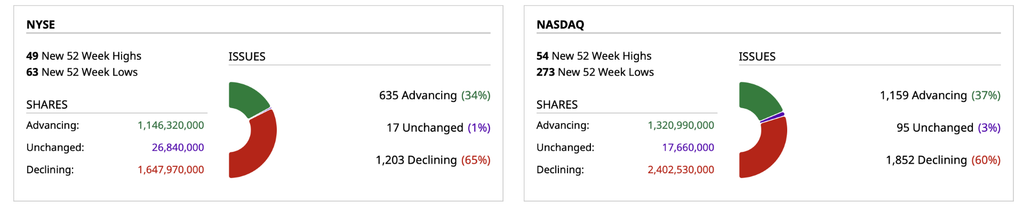
Friday’s Closing Market Stats

Closing Volume

– NYSE volume 3% below its one-month average 

– NASDAQ volume 19% below its one-month average 

– VIX index: up 3.73% to 19.74

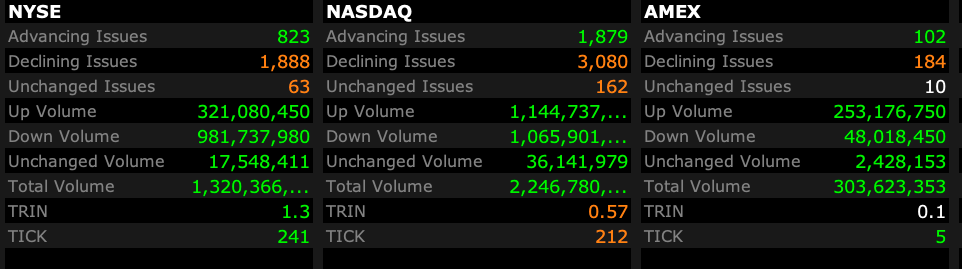
Breadth

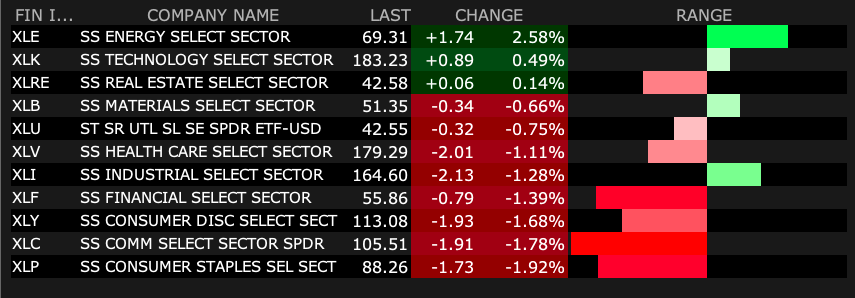
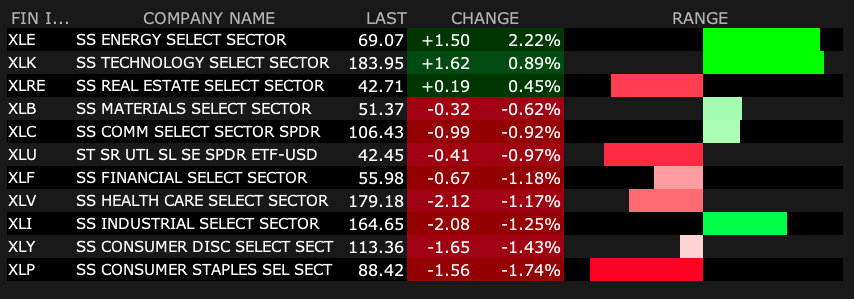
S&P 500 Sectors

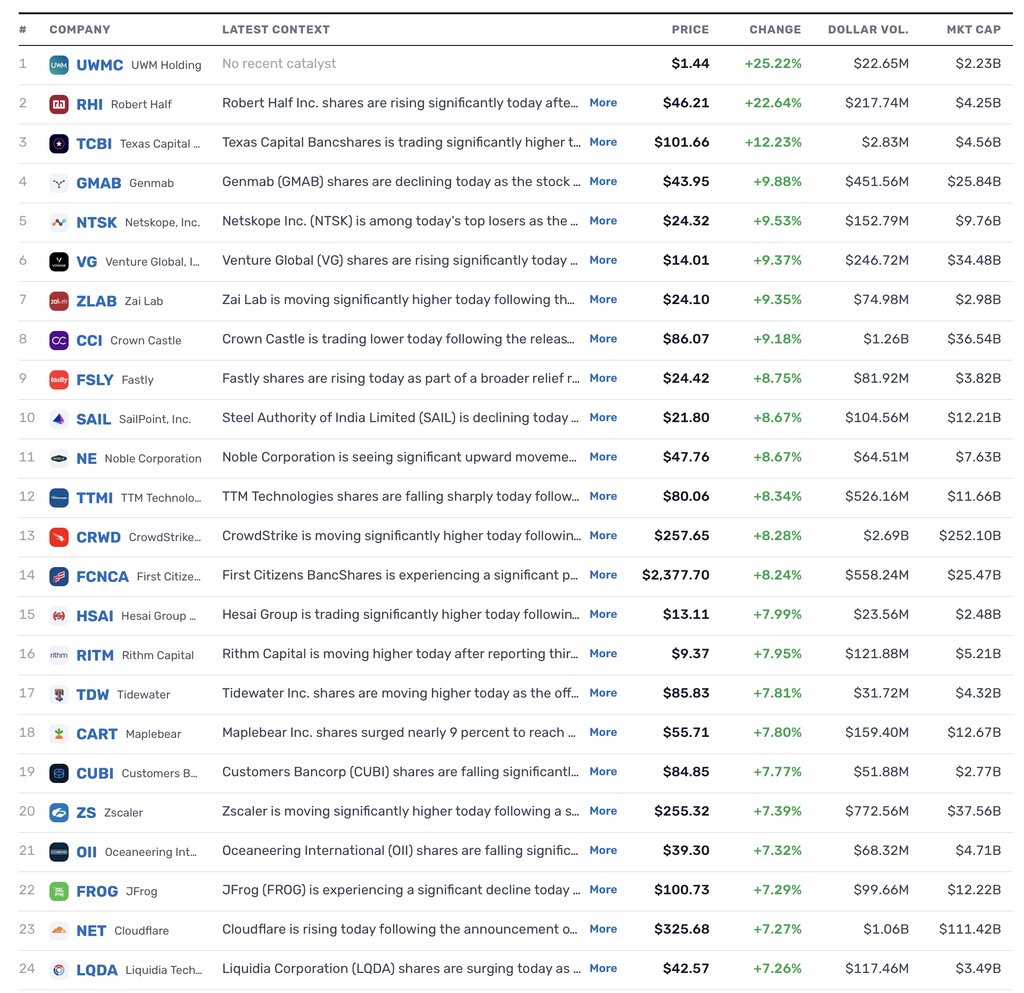
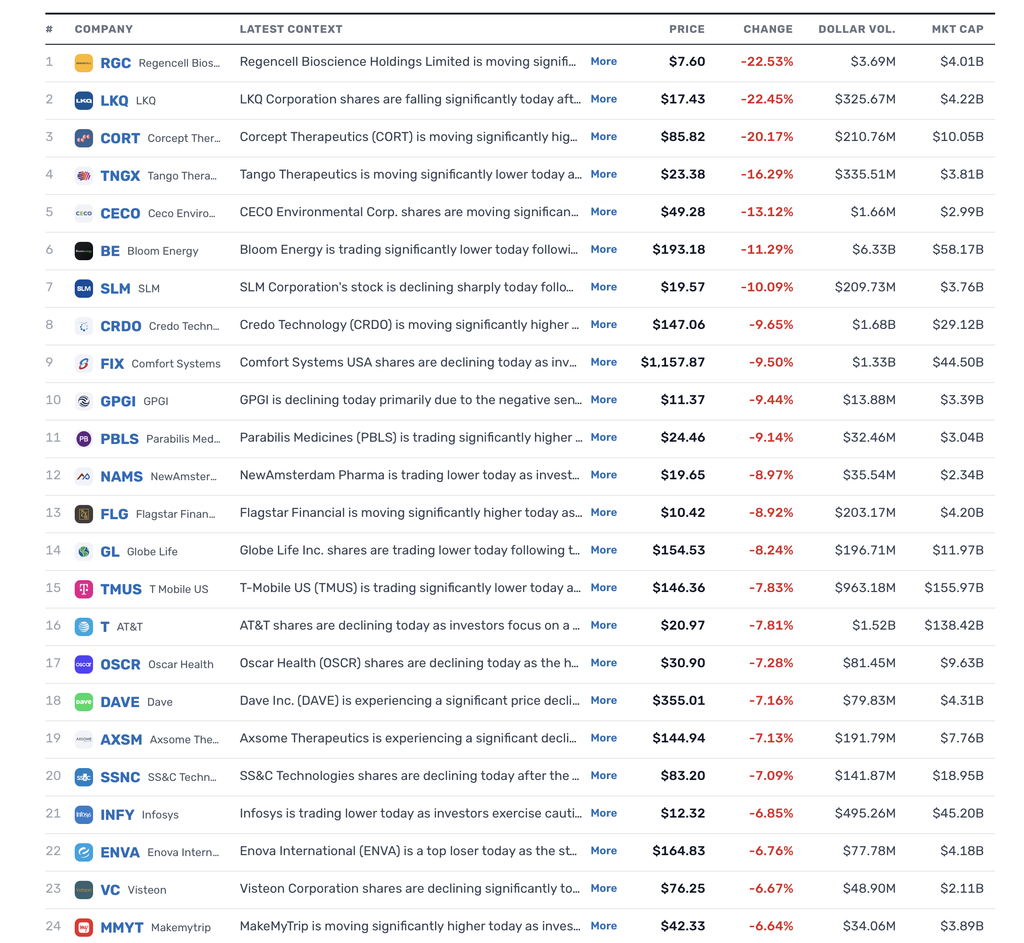
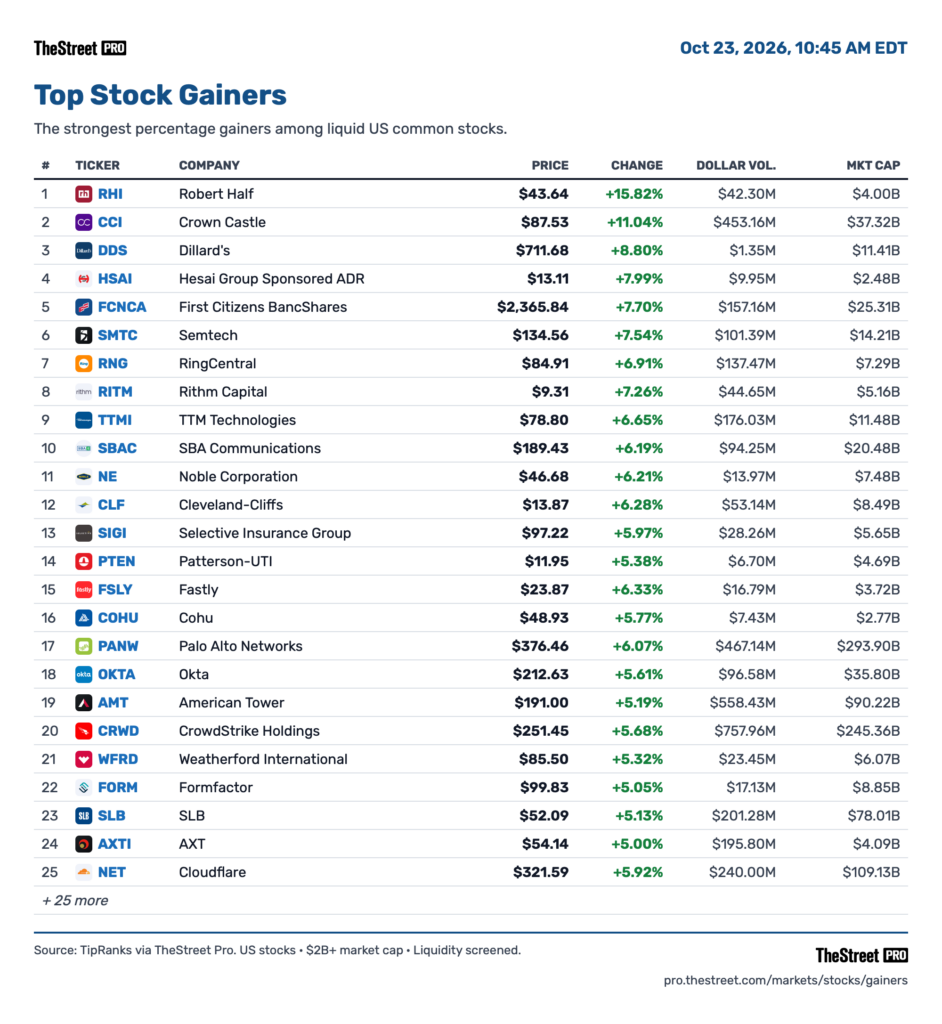
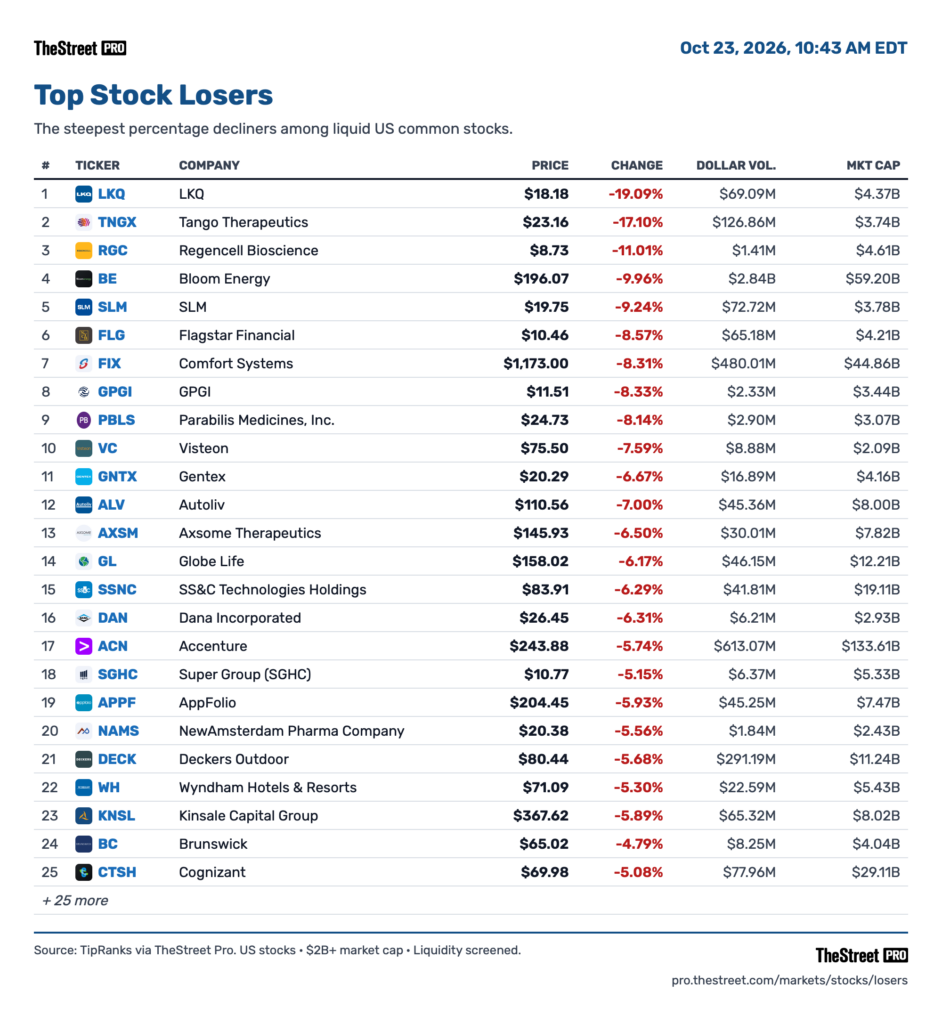
% Movers

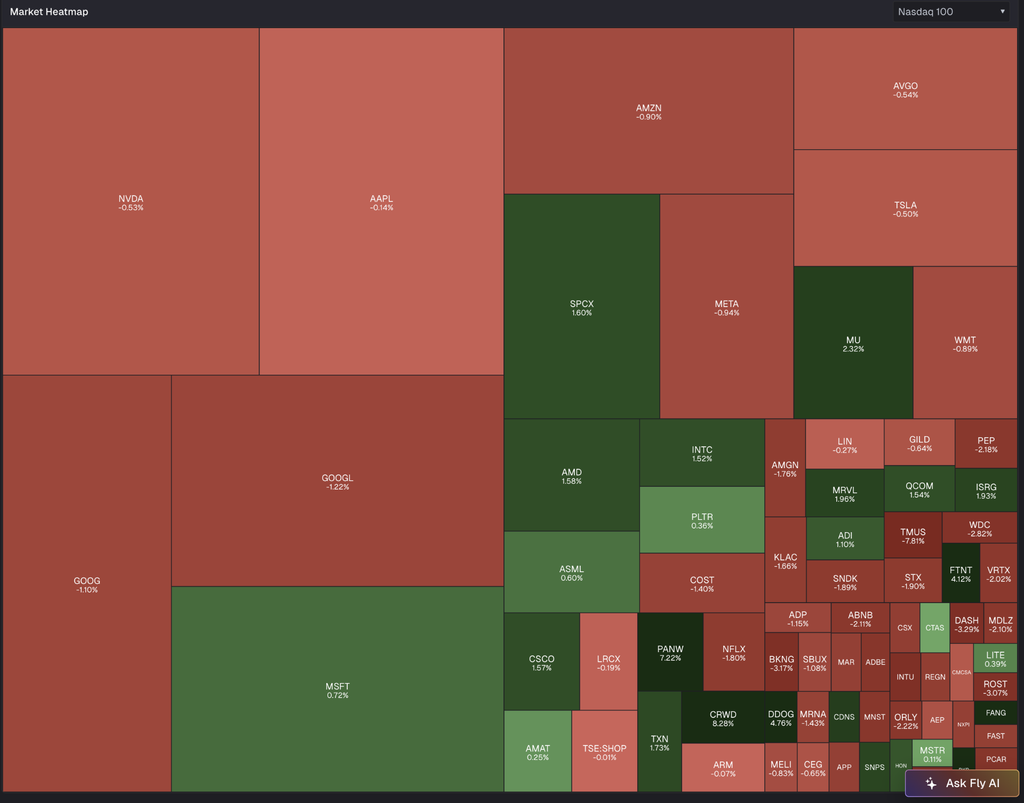
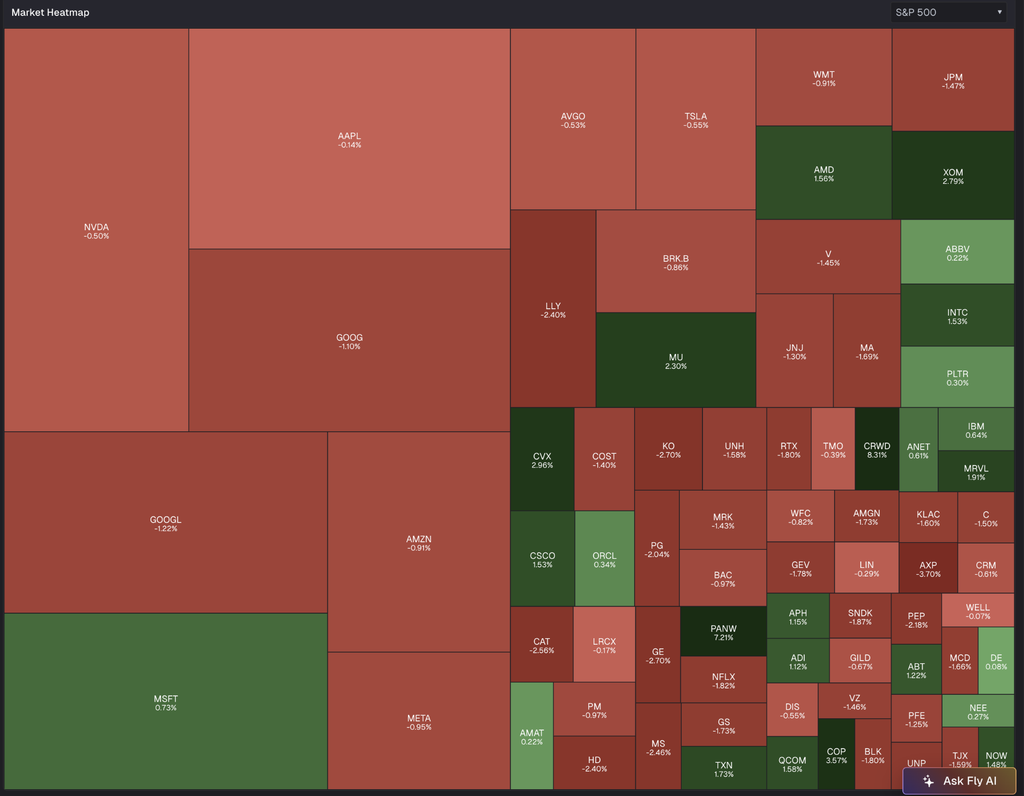
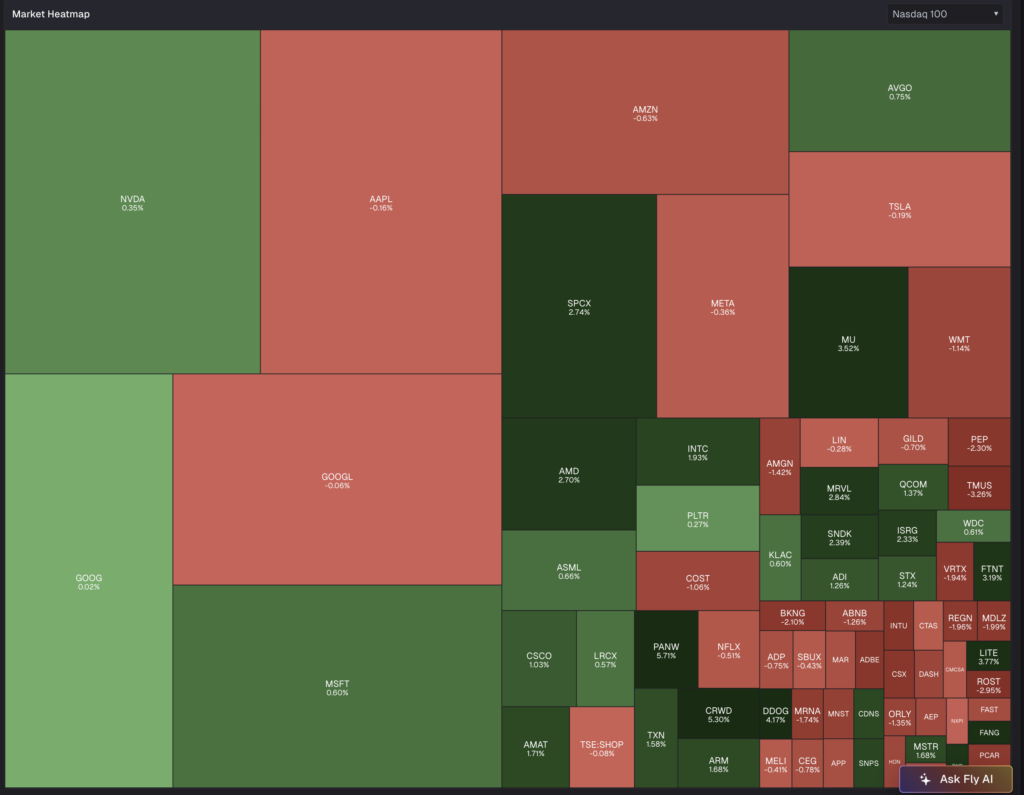
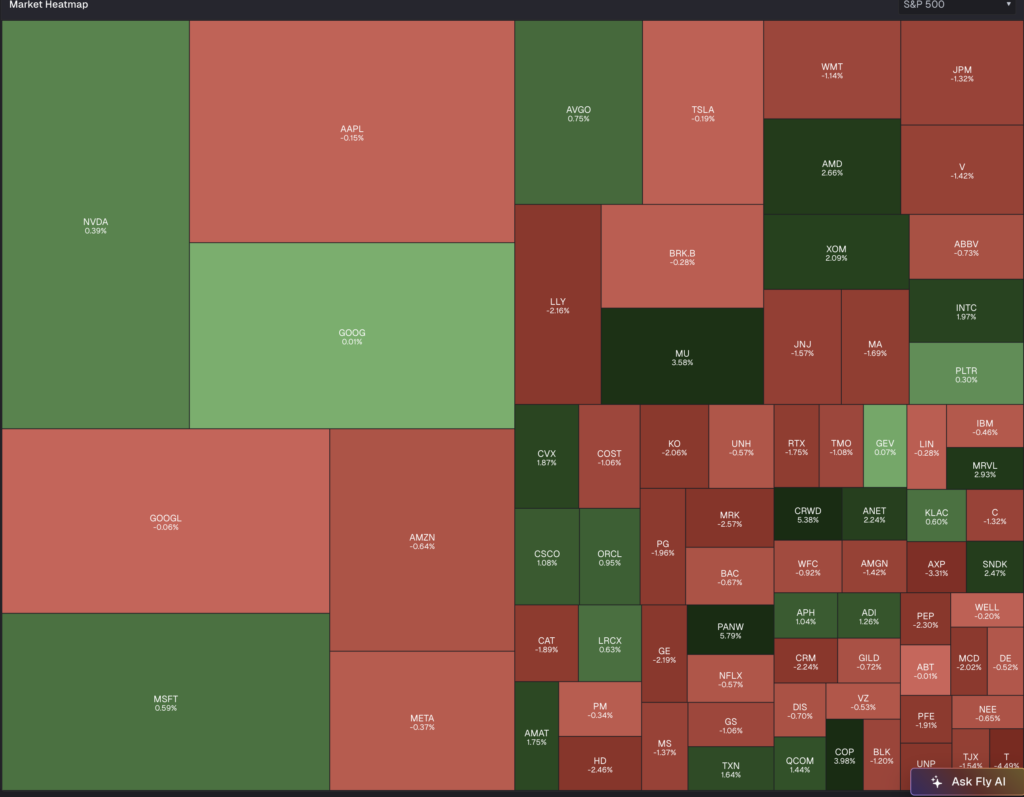
Heat Maps

Position: None

BY Doug Kass · Oct 23, 2026, 4:23 PM EDT

Boockvar Sums Up the Week’s Events

From Peter Boockvar:

Positives,

1)  Initial jobless claims fell to 194k from 200k last week and that was 6k below expectations. It lowered the 4 week average to 198k from 199k. Delayed by a week, continuing claims rose to 1.728mm from 1.703mm but remains well below the above 1.9mm we saw last year.

2)  The S&P Global US manufacturing PMI rose a hair to 56 from 55.9. Services (not including construction, retail and wholesale trade)  fell to 57.9 from 58.8. On manufacturing, they said “Although production and new orders growth rates slowed, both remained elevated to register sustained strong expansions. Jobs growth meanwhile accelerated further to reach the highest since March 2012, and input inventories rose at the fastest rate for four months. Suppliers’ delivery times meanwhile lengthened to the greatest degree since July 2022.”

3)  From Meta: “we are seeing all-time highs in engagement on both Facebook and Instagram, driven by strong growth in video. Threads has now overtaken X in monthly actives and continues to grow quickly. WhatsApp is hitting all-time highs in messaging and is becoming an increasingly important platform for agents as well.” With Muse, “In just a month and a half, more than 10 million people in the US and Canada have set up Muse personal agents. Growth continues to be strong, and we have been number one in the App Store almost every day…Beyond shopping, the most common connectors are for personal productivity and connecting Muse to your other services like email and calendar.”

4)  From Tesla: Spending will still rise in the coming years “as we add more Robotaxi fleet, we expand our production capacity for Optimus, install manufacturing capacity for solar, purchase additional SI (Super Intelligence)  compute infrastructure, and build a semiconductor fab.

5)  From Robert Half: “Hiring activity continues to improve, supported by gradually improving market conditions. Demand for risk and compliance consulting services also showed encouraging signs of improvement during the quarter.” That said, “I’d say so far, it’s still more selective, and the inflation concerns, the geopolitical concerns all add to that. Our clients are grinding their way through those uncertainties, but we haven’t yet had the clearing event you’ve had traditionally at the beginning of up cycles.” They cited for example, “typically the ending of an overall recession is a clearing event.”

6)  From Nestle: “Emerging markets continued to grow strongly while we saw improving momentum in developed markets.”

7)  From Proctor & Gamble: “We delivered broad based growth across the business…Growth was also broad based geographically with each of our six regions growing organic sales.” Particularly in North America, “volume was up 3 pts driven by continued improvement in consumption across categories…In aggregate, the consumer is resilient.” But, “there’s clearly pressure on the consumer in the short-term. And so far the consumer has held up. We don’t know if that’s going to continue. There’s a bull case to be made, but there’s a bear case to be made here, so we want to be straight in the middle.”

8)  From Hermes: “The Americas, Japan and Europe, excluding France, achieved particularly dynamic growth…In spite of macroeconomic and geopolitical difficulties, all regions posted growth, with the exception of the Middle East.” Also, “Greater China was stable across the period, which is very positive given the backdrop.”

9)  From MSC Industrial Direct: “we continue to see increasing evidence of an industrial recovery taking hold with positive IP (industrial production)  readings across all of our top manufacturing end-markets…average daily sales outpaced the IP index for the 5th consecutive quarter and was above the target of 400 bps again this quarter. While this continues to be largely price driven, our improving volume trends signals that our initiatives are taking hold.”

10)  From United Rentals: “we saw projects kick off in the third quarter across numerous end markets, including energy, manufacturing, infrastructure, and data centers.”

11)  From Union Pacific: “when you think about our fuel conservation efforts and really the fact that rails are so much more fuel efficient than truck, that’s actually enabling us to win even more business and bring it onto the railroad.”

12)  From Blackstone: “Demand for compute is accelerating and we see no signs of that slowing down as AI use cases ramp for both businesses and consumers and the world increasingly engages with the vast potential of this technology. At the same, there’s a critical scarcity of supply that is only intensifying…Current public attitudes towards data centers will likely only amplify this scarcity…In AI infrastructure our data center portfolio is built on durable, long-term contracts with highly credit worthy counterparties. Overall, we keep coming back to the fundamental supply demand imbalance, which supports our conviction that this is the right place to invest significant capital.”

13)  From United Airlines: Premium cabin was strong but also “it was nice to see standard economy cabin RASMs up.” Business revenue rose 22% and contracted business revenues were up by 26%. Leisure revenue was higher by 16%, “with stronger y/o/y yield gains than business traffic.”

14)  From Ryanair CEO speaking this week: “You’re going to see the biggest increase in airfares, I would say, in history in Europe in the next 12 months. The question is, will that increase in airfares be enough to cover the dramatically higher oil bills? I don’t think it will be.”

15)  From Texas Instruments: “During the quarter we saw broad demand, with revenue growth across all end markets and regions. Secular growth of semiconductor content is continuing alongside a strong cyclical recovery.” Their three main markets are industrial, automotive and data center and “we are seeing the broadening of the demand across” these sectors. Not surprisingly, “The data center market, it’s a market that we see strong secular growth. I don’t think it’s influenced by seasonality. The demand continues to be strong and growing.”

16)  From GM: “The US market remains resilient. We expect total SAR to be in the mid 16 million unit range for the full year, which implies approximately 16 million for the rest of the year, consistent with what we are seeing in October.” Perspective though, in 2019 we were seeing annualized vehicle sales of over 17mm.

17)  From Cleveland Cliffs: “All three of our major profit drivers improved. Shipments increased, selling prices rose in line with our expectations, and costs performed better than we had guided…As a consequence of the renaissance of manufacturing in the US, we are currently selling steel under the best price environment in three years.”

18)  From Capital One: They lowered their reserves for bad debt by releasing $250 million of allowance in their domestic card business. “The allowance release was driven by continued favorable observed credit in the quarter, partially offset by greater consideration to downside economic scenarios related to geopolitical risks.” Net charge-offs fell and “are benefiting from the steady improvement in delinquencies that we observed in the first half of this year and from strong recoveries’ performance.”

19)  From Fifth Third Bancorp: On the impact of higher rates on the decision making of their customers with respect to taking out a loan, “Certainly as people talk about high rates, it influences how they think about the world, but I think in general, the feedback that we’re hearing overwhelmingly is that it is still a growing economy, and high rates are not the meaningful driver of decision making from here. It’s like they need investment because they’re worried about continued inflation and input costs and things where they know they need to make this investment, they want to go ahead and get it done. Another 50 bps to 100 bps on rates does not impact their view.”

20)  From M&T Bank: “Asset quality remained relatively stable this quarter, with net charge-offs below our initial year expectations and non-accrual loans remaining near cyclical lows.”

21)  Japan’s PMI for October saw services rise to 52 from 51.3 while manufacturing slipped a touch to 53.3 from 54.1, though remaining above 50. In India, strength remains with manufacturing at 54.9 vs 55.1 and services at 56.2 vs 55.2.

22)  French business confidence in October rose 1 pt after falling by 2 last week. The manufacturing recovery led the way as we know it is global. The rest of the picture was mixed as services rose 1 pt but retail, employment and building construction confidence all fell.

23)  In the UK, its PMI improved in October with manufacturing up to 52.8 from 51.9 and services higher at 53.1 vs 52.1. From S&P Global, “This encouraging sign of economic resilience is underscored by firms taking on additional workers for the first time since hiring was hit by the 2024 Autumn Budget.”

24)  The October UK CBI industrial orders index rose 9 pts m/o/m and CBI said “There are growing signs of stabilization for manufacturers, with firms expecting a prolonged period of falling output to come to an end in the coming months and anticipating their first increase in headcount in two years.”

25)  In September, the UK jobs number was better than expected with a gain in those employed rising by 13k vs the estimate of down 8k. Also, August was revised up to a gain of 1k, up from the initial print of down 26k. Jobless claims though jumped by 30.3k but August was revised down by 20k. Thru August, the UK unemployment rate held at 4.7% and wage growth ex bonus rose 3.7% y/o/y which is decent but really only just keeping up with inflation.

26)  China’s Q3 GDP rose 4.5% y/o/y, about as expected but we know the contribution to GDP is as bifurcated as it is here. Industrial production continues to mainly drive growth and it rose 5.5% y/o/y as estimated in September. Retail sales in that month were up just 1.1% y/o/y but that was above the forecast of up .5%.

Negatives,

1)  From S&P Global in the October US PMI press release, “Selling price inflation picked up further momentum in October. The overall rise in prices across goods and services was the largest since August 2022. The upturn in price pressures was also broad-based: while services inflation edged up to the steepest since August 2022, manufacturers’ selling prices rose at a pace not seen since July 2022, with the rate of inflation accelerating markedly.”

2)  The September Architecture Billings Index weakened to 44.7 from 47.2 with 50 being the breakeven. Commercial/industrial (which includes data centers) is the only category remaining above 50 while the other three, including multifamily, is below. The AIA said “This is an increasingly difficult environment for architecture firms. Weakening billings are being compounded by a soft economy, challenging project financing and growing caution among clients. With fewer projects moving forward, there is little reason to expect a meaningful improvement in business conditions in the near term.”

3)  While the average rate of 7.41% was down 9 bps, the elevated level resulted in a 7.3% w/o/w drop in purchase applications and down 18% y/o/y. They now sit at the lowest since January 2025. Refi’s dropped for a 6th week, by 2% w/o/w and by 59% y/o/y.

4)  September single family housing starts fell to 859k from 900k and vs 875k in the month before. That’s the least in a year. Multifamily starts slowed to 362k from 388k in August and vs 494k in July. Permits for single family homes fell to 845k and that is the lowest since March 2023. They rose to 555k from 523k for multi family.

5)  Pending home sales in September plunged by 7.3% m/o/m, well worse than the estimate of down just .5%. It now sits at a fresh low for this data point back about 25 years. The weakness was across all four main regions. The reason is obvious, “Market conditions weakened in September due to fast-rising mortgage rates” said the NAR.

6)  The October NAHB home builder sentiment index fell to just 29 from 32 vs the estimate of 31 and well below the breakeven of 50. Both the Present Situation and Future Outlook components slipped and Prospective Buyers Traffic declined to just 18 which is the lowest since 2012 not including Covid. On the demand side, something we are clear on, “Mortgage rates have climbed well above 7% in recent weeks, and higher gas prices and inflation have further weakened buyer traffic across much of the country” said the NAHB. With respect to delivering homes, builders are contending with “higher costs for construction loans, building materials and diesel.” Also, “Nationwide, more than one-third of builders reported immigration enforcement activity in their market areas during the past month, causing construction delays and discouraging legal workers from reporting to work.”

7)  The final October UoM consumer confidence index remained depressed at 48 vs 48.1 in September and vs 51.7 in August. One year inflation expectations rose one tenth to 4.7%, the highest since May. The UoM said “Purchasing power continues to dominate consumer views of the economy. Sentiment is now 10% below a year ago and 15% less than February, just prior to the Iran conflict.”

8)  From Meta: “Muse’s compute intensity means that expanding its user base will require significant investment, and we expect total serving costs to rise.” And, “Looking beyond 2026, we are still developing our budget and capacity plans for next year, but we expect to continue investing aggressively to support both our core business and emerging AI initiatives.”

9)  From Nestle: “So as we look forward to 2027, it is an inflationary environment. It’s likely we’ll see more pricing. And while there may be a short-term consumer reaction, because there occasionally is in the quarter that you take price, we’re confident that over the medium term that we can sustain both RIG (Real Internal Growth) and price…And with respect to US freight, oil prices where they are, we’ve got inflationary pressures on freight and distribution across the portfolio. And that’s one of the reasons you heard me saying that we’ll be taking a little bit more price in some places in the fourth quarter. It’s a factor for everybody.

10)  From Proctor & Gambe: Higher commodity costs this year are going to cost them an incremental $1.4 billion. And partly in response, “So we will price, and we will price with innovation, not jeopardizing the top-line momentum…at this level of commodity pressure, not a projection, just the fact, the industry generally is pricing up, because there is no way to recover this level of commodity pressure without pricing.”

11)  From MSC Industrial Direct: “from a price cost perspective, we’re in a highly inflationary time. We’re putting through that price with our contract customers and that takes time in negotiations.” And the inflation is not just on the material side, “the other factors I wanted to talk about also was on freight, we’re seeing inflation there. And then on employee related expenses as well and the biggest one being medical expense.”

12)  From United: Not good for us flyers, “I’ve been pleasantly surprised at the industry’s ability this year to raise yields and pass through much of the increase in fuel prices…Consumers and businesses have been accepting price increases, which we believe is a result of fares lagging the rest of inflation, along with other aspects of travel costs, for many years.”

13)  From Kering: Sales fell 1% on a comparable basis as “Traffic remains the main constraint across the group.” Gucci was particularly weak.

14)  From Decker Outdoors: “In the US, we saw promotional activity increase throughout the quarter, particularly in athletic footwear, which weighed on our US e-commerce performance as we maintained full price discipline. We also observed two shifts in consumer behavior, consumers increasingly seeking discounts, concentrating traffic around promotional events and consumers becoming more purposeful in their spending and prioritizing products with immediate relevance and utility.”

15)  From PulteGroup: “consistent with all the reporting and commentary swirling around the current state of the US housing industry, we experienced a notable slowdown in homebuying demand as we moved through the third quarter and interest rates surged higher…Prospective buyers continue to have concerns about stretched affordability, high monthly payments, and home sale contingencies…What changed in the quarter, and most notably in September, is that the big move higher in interest rates, along with inflation, global tensions, and waning confidence, reached the point where more consumers simply put their search on pause.”

16)  From Blackstone: “On the one hand, the AI revolution is powering robust growth in many areas, while on the other hand, a higher cost of capital has negatively impacted investor sentiment and transaction activity and triggered significant volatility in the markets.”

17)  From Carrefour: “Thousands of stores across France were attacked, products robbed, and for some stores, equipment was destroyed…Around 50 of our stores were hit on day one. Many were looted, and the damage is considerable.” Also, “The direct costs are only part of the impact. Stores that were not physically damaged are also affected. Lower customer footfall in many areas, shorter opening hours because of curfews, precautionary closures, and access difficulties are disrupting trading. This is continuing in some areas at the beginning of this week…Going forward, we will have to increase our operating costs, notably in areas such as security and specific logistics for damaged stores.”

18)  From Tesla: they are cutting its CapEx guide this year to $20b from $25b “as a result of managing our capital deployment efficiently and plan to fund it primarily from our cash flows from operations. Additionally, during the quarter, we secured capacity to borrow up to $30 billion to support the expected growth in CapEx.”

19)  From Winnebago: “consumer interest in the RV and boating lifestyle remains healthy with continued engagement across shows, digital channels, campgrounds, marinas, and the used market. At the same time, affordability pressures, elevated financing costs and broader macroeconomic uncertainty continue to weigh on consumers and delay the conversion of that interest into new product purchases…That caution is also reflected in dealer ordering, with dealers continuing to manage inventory carefully.”

20)  From NEXTDC, the Australian data center builder and whose stock plunged this week: “The main reason is M3 Melbourne. The timing of power to that site is no longer certain and I’ll explain why…Jemena in Victoria is the distributor that supplies power to M3. Jemena suspended parts of network works that deliver the next step up in grid supply to the site. Jemena has attributed the suspension to community and stakeholder opposition to the works. And to the local council not giving its consent until more community consultation takes place on the program for installation of poles and wires. Jemena told us formally they don’t expect to restart before February next year.”

21)  That Elice IPO in South Korea was disastrous with the pricing taking place two weeks before it started trading.

22)  From Ally Financial: “While the portfolio is performing largely in line with our expectations, our late 2025 and early 2026 vintages are showing higher early life delinquency, which are being closely monitored.”

23)  In Japan, September CPI ex food and energy rose 2.4% y/o/y, up from 1.9% in August and one tenth above the estimate.

24)  In Australia, its PMI is below 50 for both manufacturing and services.

25)  The October PMI in the Eurozone fell with manufacturing at 52.4 vs 52.9 last month. Services declined to 51.7 from 53. France was a drag, offset by better reads in Germany. S&P Global said, “A key drag on growth was a renewed drop in business activity in the French services sector. While some of the weakness in France may be linked to strikes and unrest having disrupted some local economies, growth has also edged lower in the rest of the eurozone, both in terms of manufacturing and services activity. Hiring has meanwhile come close to stalling as new order inflows cooled to show only meagre growth.”

26)  The German October ZEW investor expectations survey on their economy fell to 28.1 from 34.7. The estimate was 30. The Current Situation though did improve to -35.9 from -47.1. ZEW said “The German economy is slowly emerging from stagnation, but the recovery is not self-sustaining. Private consumption and investment remain weak because of high energy prices: They put real incomes under pressure, increase production costs and keep inflation higher for longer.”

27)  Germany also said its September PPI rose 6.7% y/o/y, up from 4.6% in August.

28)  September CPI in the UK rose 3.5% y/o/y with a core rate of 2.8%, though about as estimated. With respect to wholesale prices, PPI input prices were up by 8.3% y/o/y and output charges were higher by 4.6%.

29)  Japan reported September export growth of 16.7% y/o/y but while solid it was below the estimate of 21.3%. Of course, the shipments of semiconductors and chip equipment led the way, higher by more than 40% for each. Auto exports were up by 15%. Exports to the US rose 23%, to the EU by 10.5% and to China by almost 9%. Imports were higher by 19%, just under what was forecasted.

Position: None

BY Doug Kass · Oct 23, 2026, 2:30 PM EDT

Programming Note

I will be leaving (for the day) around 2:30 for some personal errands.

Position: None 

BY Doug Kass · Oct 23, 2026, 2:05 PM EDT

Midday Musings

The recent market decline looks like the Leopold liquidation without Leopold liquidating.

That, to me, is worrisome as it is not “event driven” by a temporary and one-time very large seller.

Moreover, as mentioned earlier this week, the selling is happening in multiple asset classes (e.g. bitcoin, gold, etc.) and is not confined to large-cap technology. 

Caveat emptor.

Position: None  

BY Doug Kass · Oct 23, 2026, 1:25 PM EDT

Subscriber Comment of the Day

It’s not only me that is critical:

rolf thrane

I was listening to Josh Brown yesterday when someone pointed out here – that he had the company’s market cap wrong. I know the company extremely well, and for various reasons, I  can’t trade in it. He seemed to have little understanding of what it actually does beyond a vague reference to clinical trials. It’s a very complicated business; unless he has an analyst dedicated to following it, he has no chance. I say that from firsthand experience. That’s the problem with much of the commentary on CNBC: It is a narrative, zero actual analysis of the businesses, with a few exceptions.To go further on this – it was trading in the dump for  most of the year, and then it exploded up. And now Josh is interested. CNBC loves stocks that have already gone up. 

Position: None

BY Doug Kass · Oct 23, 2026, 1:20 PM EDT

My Tweet of the Day

*I should not have tuned in after a hiatus:

Position: None

BY Doug Kass · Oct 23, 2026, 1:00 PM EDT

Cannabis Investors Keep on Selling and I Keep on Buying

Market participants continue to be resistant and are growing increasingly impatient in their perception of the procedural delays in the rescheduling of cannabis.

By contrast I am using the weakness to further accumulate names in the space as the inevitability (at least to me) of rescheduling to Schedule III and an end date to Schedule I grow clearer. With that rescheduling will likely come more uplistings (and eligibility in index funds), an easing of custodian restrictions and remedy and clarification of UTP treatment (with some retroactive suspension of liabilities and lengthening in tax obligation payouts). 

This could lead to a meaningful change in the ownership of cannabis equities from retail to institutional (and index funds) — that has yet to begin. 

I suppose this selling was inevitable given the recency bias related to the dramatic decline in share prices over the last five years and the persistent regulatory disappointments — both of which are etched in traders’ and investors’ memories. (It doesn’t help that the general market has become unstable.)

I remain a buyer.

Position: Long MSOS common (VL) and calls (VS) 

BY Doug Kass · Oct 23, 2026, 11:53 AM EDT

Charting the Late Morning Market

– NYSE volume flat to its one-month average; 

– Nasdaq volume 16% below its one-month average; 

– VIX index: up 0.79% to 19.18

Breadth

SOURCE: Interactive Brokers

S&P500 Sector ETFs

SOURCE: Interactive Brokers

% GAINERS, DECLINERS

SOURCE: TheStreet Pro

Nasdaq 100 and S&P500 Heat Maps

SOURCE TheFly

BY Doug Kass · Oct 23, 2026, 11:35 AM EDT

Another Marijuana Moment

Positions: None.

BY Doug Kass · Oct 23, 2026, 11:02 AM EDT

My Comment of the Day


Dougie Kass

3m ago

The tide is going out and now you understand my resentment towards Fin TV.

Look at their favorite stocks – BABA UBER NFLX SHAK GEV CAT Paramount, BA, RDDT  the banks/brokers/private equity et al

They are swimming naked.

Memo to retail investors – they will not take ownership of their mistakes, the will continue to smile, they will be confident in view, they will take your assets. 

They will cost you money. 

Turn off your TVs.

Positions: None 

BY Doug Kass · Oct 23, 2026, 10:45 AM EDT

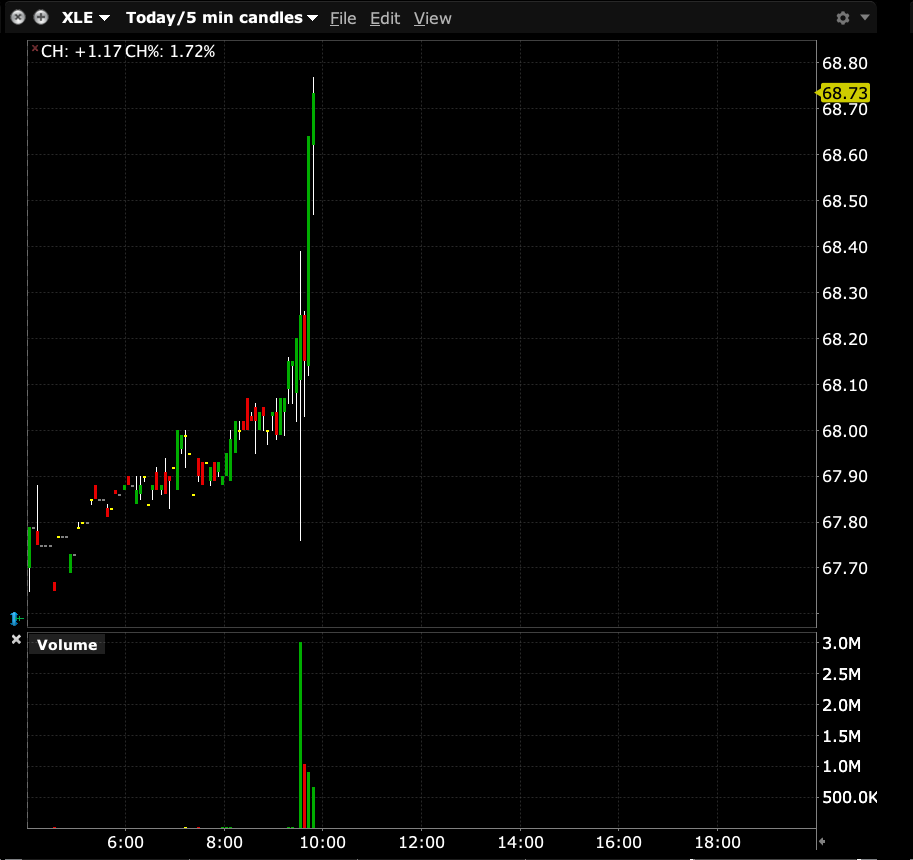
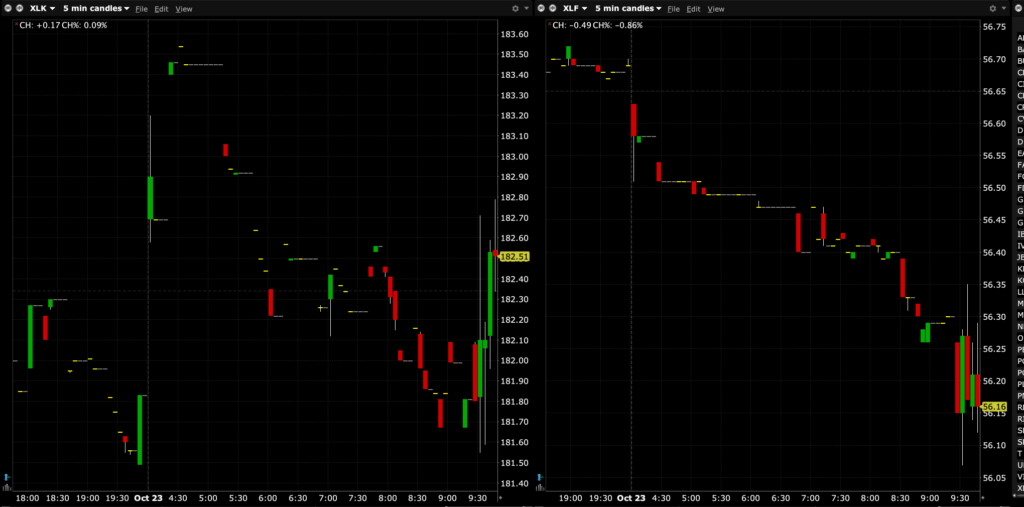
Energy (XLE) Tops Largest % Gaining Sector; Vs. Tech (XLK) and Financials (XLF)

Charts from 9:49 a.m. ET

BY Doug Kass · Oct 23, 2026, 10:24 AM EDT

Boockvar on Earnings, Doing the Opposite of The Economist

The Following Is From Peter Boockvar:

Works every time/Flood of earnings but worth the read

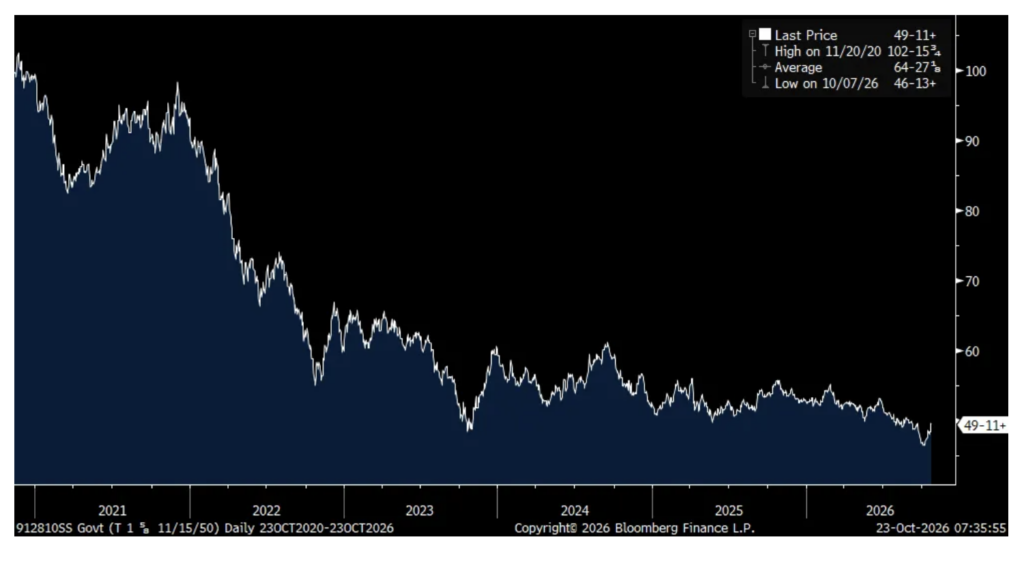
I’ll say quickly on US Treasury yields and the decline over the past two weeks. It really is amazing how effective it is to do the opposite of what the front page of The Economist prints. What they didn’t realize when they printed “Will bonds blow up?” was that many already have. Two weeks ago, a US Treasury bond that was issued on November 15th, 2020 with a maturity in 2050 with a coupon of 1.625% was trading at $.46 on the dollar. Yes, a buy and hold investor will get their full principal back in 2050 but on a mark to market basis, they lost about half their money.

Price of US Treasury maturing in November 2050

A flood of earnings calls and I do my best to cut to what’s most important.

This was from Robert Half, the staffing company and a go to read on the labor market and whose stock is rising premarket:

“Hiring activity continues to improve, supported by gradually improving market conditions. Demand for risk and compliance consulting services also showed encouraging signs of improvement during the quarter.”

That said, “I’d say so far, it’s still more selective, and the inflation concerns, the geopolitical concerns all add to that. Our clients are grinding their way through those uncertainties, but we haven’t yet had the clearing event you’ve had traditionally at the beginning of up cycles.” They cited for example, “typically the ending of an overall recession is a clearing event.”

“Technology remains the strongest performing practice group within contract talent solutions while finance and accounting also returned to y/o/y revenue growth.”

“Across markets, clients remain focused on securing specialized expertise for high priority initiatives, particularly in the areas such as technology modernization, data, cybersecurity, and IT infrastructure. Small and mid-sized businesses continue to face significant challenges finding the skilled talent they need.”

And what are they seeing in terms of AI impacting the labor market? “AI has increasingly become part of how work gets done across the professions we serve. Rather than broadly displacing specialized roles, these technologies are instead adding to the skills employers value and increasing the importance of professionals who combine strong functional expertise with AI fluency, critical thinking, and sound judgment. The ability to assess and validate AI generated outcomes is becoming an increasingly important part of that skill set.” I bolded to highlight.

From Nestle, up 3% yesterday as part of a broad rally in consumer staples stocks that I’m very positive on and this is a stock we own:

With about half their business in coffee and pet food, “Emerging markets continued to grow strongly while we saw improving momentum in developed markets.”

“So, the way to think about pricing in Q3 is we had a lot of input cost inflation last year and we took a lot of price. And that input cost inflation in 2026 has actually turned into deflation on coffee and cocoa. So we haven’t been taking very much incremental price in 2026.”

“So as we look forward to 2027, it is an inflationary environment. It’s likely we’ll see more pricing. And while there may be a short-term consumer reaction, because there occasionally is in the quarter that you take price, we’re confident that over the medium term that we can sustain both RIG (Real Internal Growth) and price.”

“And with respect to US freight, oil prices where they are, we’ve got inflationary pressures on freight and distribution across the portfolio. And that’s one of the reasons you heard me saying that we’ll be taking a little bit more price in some places in the fourth quarter. It’s a factor for everybody.”

They have a big pet food business and they said “underlying the trends in cat are very favorable. Cat adoption is still up while dog remains flattish, but is slightly improving.”

From Proctor & Gamble, up almost 6% yesterday:

“Bottom line results reflect the strength of the top line progress and productivity to offset the higher costs from raw materials, energy and increasing freight costs, primarily in North America. We expect these headwinds to increase in the next few quarters taken together.”

Higher commodity costs this year are going to cost them an incremental $1.4 billion. And partly in response, “So we will price, and we will price with innovation, not jeopardizing the top-line momentum.”

“We delivered broad based growth across the business…Growth was also broad based geographically with each of our six regions growing organic sales.”

Particularly in North America, “volume was up 3 pts driven by continued improvement in consumption across categories…In aggregate, the consumer is resilient.” But, “there’s clearly pressure on the consumer in the short-term. And so far the consumer has held up. We don’t know if that’s going to continue. There’s a bull case to be made, but there’s a bear case to be made here, so we want to be straight in the middle.” They expect 3% growth from here.

From Hermes on the luxury side of the economy, down 5% yesterday and 3% today:

“The Americas, Japan and Europe, excluding France, achieved particularly dynamic growth…In spite of macroeconomic and geopolitical difficulties, all regions posted growth, with the exception of the Middle East.” Also, “Greater China was stable across the period, which is very positive given the backdrop.”

Not all fine with the Chinese consumer though as “it’s worth reminding you that the macroeconomic context is not favorable because real estate is down. Consumer trust in China is still quite low with a very high savings rate and consumption which remains unchanged.” And they are seeing declines there in fashion accessories, watches and shoes.

With France, sales there still grew 4% with “a lot of momentum on the French Riviera. So, Monaco, Cannes. But it was a bit slower in Paris, especially during the summer, with a drop in footfall, which we believe is linked to the heat wave.”

With the riots in France, “it’s too early right now to gauge the impact on our stores, and even less so on tourism. We haven’t noticed anything different over the last couple of days. It’s mainly our store in Marseille that was attacked, which will not be reopening anytime soon. But otherwise, we have very few damages. It’s Nantes, Lyon and the George V display windows that were broken, but nobody broke into these stores.”

From Kering, down 13% today and in the same luxury space as the owner of Gucci among other things:

Sales fell 1% on a comparable basis as “Traffic remains the main constraint across the group.”

With Gucci, sales fell 6% as its “performance in Q3 is impacted by the fitting effect of our collections and before benefiting from the ramping up of our ongoing work on products.”

Strength was seen elsewhere in “Saint Laurent, Bottega Veneta, and Brioni as well as Kering eyewear and Kering jewelry, which continue to extent their strong trajectory.”

With their China business, “Mainland China is our major headwind as consumer confidence stays subdued and customers are increasingly selective while South Korea continued to grow.”

From Deckers Outdoors, the maker of UGGs and Hoka and trading down premarket:

“In the US, we saw promotional activity increase throughout the quarter, particularly in athletic footwear, which weighed on our US e-commerce performance as we maintained full price discipline. We also observed two shifts in consumer behavior, consumers increasingly seeking discounts, concentrating traffic around promotional events and consumers becoming more purposeful in their spending and prioritizing products with immediate relevance and utility.” I bolded to highlight.

“As consumers face increasing economic pressure, our updated fiscal outlook reflects a more measured framework.”

From PulteGroup who rallied 6% yesterday with the drop in interest rates:

“consistent with all the reporting and commentary swirling around the current state of the US housing industry, we experienced a notable slowdown in homebuying demand as we moved through the third quarter and interest rates surged higher.”

“Buyers are spending more time getting comfortable with the higher monthly payments, interest rates, and financing options before moving forward. The need to sell an existing home remains one of the most significant conversion barriers.”

“Prospective buyers continue to have concerns about stretched affordability, high monthly payments, and home sale contingencies…What changed in the quarter, and most notably in September, is that the big move higher in interest rates, along with inflation, global tensions, and waning confidence, reached the point where more consumers simply put their search on pause.”

Finally of note, “In the 3rd quarter, our customer conversion rates were relatively stable, but traffic to our communities was down 14% from the prior year and on a sequential basis, down 11% from Q2. These conditions have continued through the first few weeks of October. As you would expect, most of the missing traffic were first time buyers, as this group remains the most impacted by higher interest rates.”

MSC Industrial Direct is a go to read for me on the state of the industrial and manufacturing world because it’s a distributor of so much stuff that gets sold to these end markets. Their stock got hit by 15% yesterday off a 52 week high because of lighter gross margins and they said this of note:

“we continue to see increasing evidence of an industrial recovery taking hold with positive IP (industrial production) readings across all of our top manufacturing end-markets.”

“average daily sales outpaced the IP index for the 5th consecutive quarter and was above the target of 400 bps again this quarter. While this continues to be largely price driven, our improving volume trends signals that our initiatives are taking hold.”

“from a price cost perspective, we’re in a highly inflationary time. We’re putting through that price with our contract customers and that takes time in negotiations.” And the inflation is not just on the material side, “the other factors I wanted to talk about also was on freight, we’re seeing inflation there. And then on employee related expenses as well and the biggest one being medical expense.”

From United Rentals and whose stock has rallied this week:

“we saw projects kick off in the third quarter across numerous end markets, including energy, manufacturing, infrastructure, and data centers.”

From Union Pacific, saying something similar to CSX this week, in how they are taking share from the trucking market and also benefiting from the intermodal business:

“when you think about our fuel conservation efforts and really the fact that rails are so much more fuel efficient than truck, that’s actually enabling us to win even more business and bring it onto the railroad.”

From Blackstone, chiming in on the AI data center buildout debate as they are now a big financing player in it:

“On the one hand, the AI revolution is powering robust growth in many areas, while on the other hand, a higher cost of capital has negatively impacted investor sentiment and transaction activity and triggered significant volatility in the markets.”

“Demand for compute is accelerating and we see no signs of that slowing down as AI use cases ramp for both businesses and consumers and the world increasingly engages with the vast potential of this technology. At the same, there’s a critical scarcity of supply that is only intensifying…Current public attitudes towards data centers will likely only amplify this scarcity.”

“In AI infrastructure our data center portfolio is built on durable, long-term contracts with highly credit worthy counterparties. Overall, we keep coming back to the fundamental supply demand imbalance, which supports our conviction that this is the right place to invest significant capital.”

Fyi, data centers and logistics are about half their global real estate portfolio.

To some overseas data of importance.

In Japan, September CPI ex food and energy rose 2.4% y/o/y, up from 1.9% in August and one tenth above the estimate. While the BoJ won’t hike at their next meeting ‘according to people familiar’, they will most likely hike again in December.

With its PMI for October, services rose to 52 from 51.3 while manufacturing slipped a touch to 53.3 from 54.1, though remaining above 50.

In Australia, its PMI is below 50 for both manufacturing and services.

In India, strength remains with manufacturing at 54.9 vs 55.1 and services at 56.2 vs 55.2.

The October PMI in the Eurozone fell with manufacturing at 52.4 vs 52.9 last month. Services declined to 51.7 from 53. France was a drag, offset by better reads in Germany. S&P Global said, “A key drag on growth was a renewed drop in business activity in the French services sector. While some of the weakness in France may be linked to strikes and unrest having disrupted some local economies, growth has also edged lower in the rest of the eurozone, both in terms of manufacturing and services activity. Hiring has meanwhile come close to stalling as new order inflows cooled to show only meagre growth.”

And of note, “Key to the broader slowdown is the further escalation of inflationary pressures seen during the month. Input costs are rising sharply again, the rate of increase surging in manufacturing on the back of higher energy prices, causing firms to push selling prices higher in order to protect margins.”

This too, “Higher interest rates are also starting to take a toll, dampening demand.”

In the UK, its PMI improved in October with manufacturing up to 52.8 from 51.9 and services higher at 53.1 vs 52.1. From S&P Global, “This encouraging sign of economic resilience is underscored by firms taking on additional workers for the first time since hiring was hit by the 2024 Autumn Budget.”

Cost pressures though remain evident, “October data indicated another steep increase in input prices across the private sector economy. The overall rate of cost inflation was the strongest since June, led by a marked acceleration in inflationary pressures across the manufacturing sector.”

Nothing market moving from these reports. Bond yields in Europe are mixed after falling in Asia. The US dollar is up vs the euro and pound while stocks are in the red.

BY Doug Kass · Oct 23, 2026, 10:10 AM EDT

Consumer Non-Durables Selling Off

As expected consumer non-durables (staples) are selling off.

We used the exaggerated strength provided by machines and algos in the last two days to reduce to tagends.

Positions: Long KO VS PG VS KMB VS

BY Doug Kass · Oct 23, 2026, 10:00 AM EDT

A Must Cannabis Read

Here is a great rescheduling timeline from The Dales Report:

Positions: None.

BY Doug Kass · Oct 23, 2026, 9:30 AM EDT

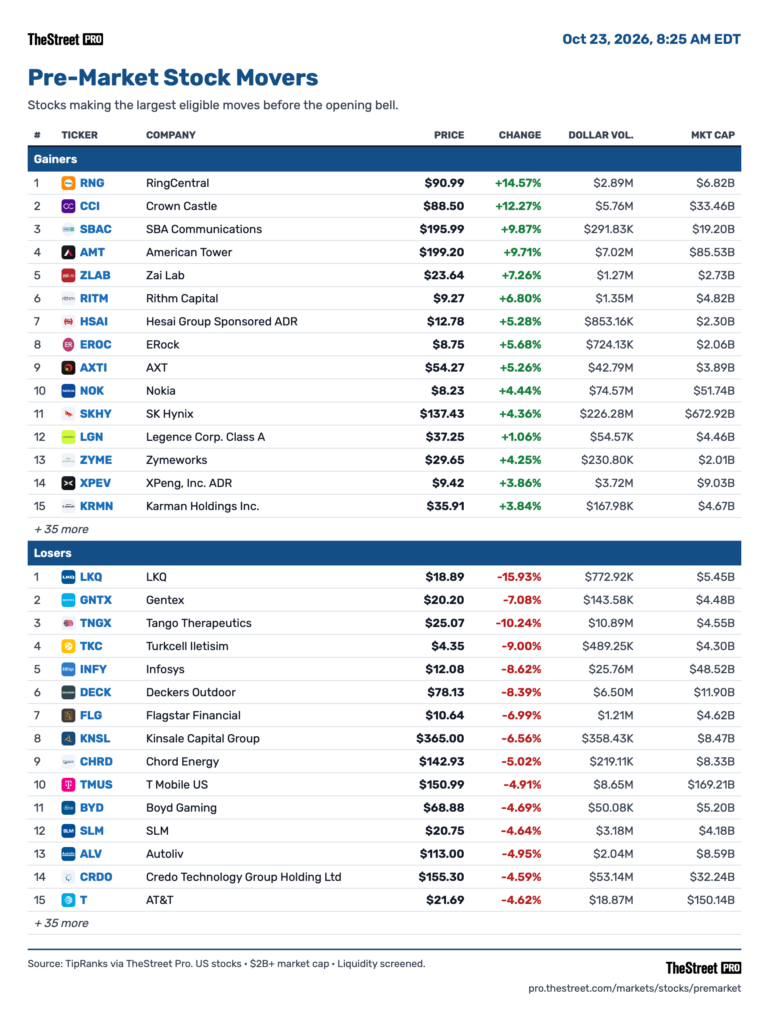
Deckers Down, Nokia Up: Upside, Downside Movers in the Morning

Upside

– CCI +11%, SBAC +9.9%, AMT +8.5% (tower operators rise after a report that SpaceX is discussing infrastructure partnerships for a nationwide wireless buildout)

– NOK +5.2% (Q3 profit beat as AI-and-cloud sales more than doubled and order intake surged)

– LITE +3.5%, AAOI +2.3%, COHR +2.3% (optical-networking names gain on read-through from Nokia’s sharp AI-and-cloud order growth)

– BAH +1.9% (Q2 profit beat offset a slight revenue miss)

– TECK +1.7% (copper-linked stocks rise as copper prices advance)

Downside

– FLG -8.3% (Q3 profit and revenue missed expectations)

– DECK -8.2% (quarterly sales missed and the FY sales outlook was cut, while the higher EPS guide relied partly on tariff refunds)

– INFY -8.2% (FY revenue-growth guidance was cut to 1%-2% despite strong large-deal wins)

– ALV -5.2% (Q3 profit and sales missed as cost headwinds weighed on results)

– CRDO -4.6% (AI-infrastructure hardware weakness continues amid concerns over the pace and returns of sector spending)

– TMUS -4.5%, T -4.4%, VZ -3.9% (wireless carriers fall after a report that SpaceX is pursuing a nationwide cellular-infrastructure program)

– BE -3.9% (record results and raised guidance were not enough after a major AI-power rally)

– MRNA -3.7% (extends losses following leaked cancer-vaccine data that disappointed investors)

– FIX -3.1% (earnings beat, but the CFO retirement and elevated expectations drive a sell-the-news reaction)

– ACN -2.7%, CTSH -2.0% (IT-services names fall after Infosys cut its FY growth outlook)

– WDC -1.9%, STX -1.4% (storage names retreat despite WDC’s beat-and-raise report as elevated expectations trigger profit-taking)

BY Doug Kass · Oct 23, 2026, 9:20 AM EDT

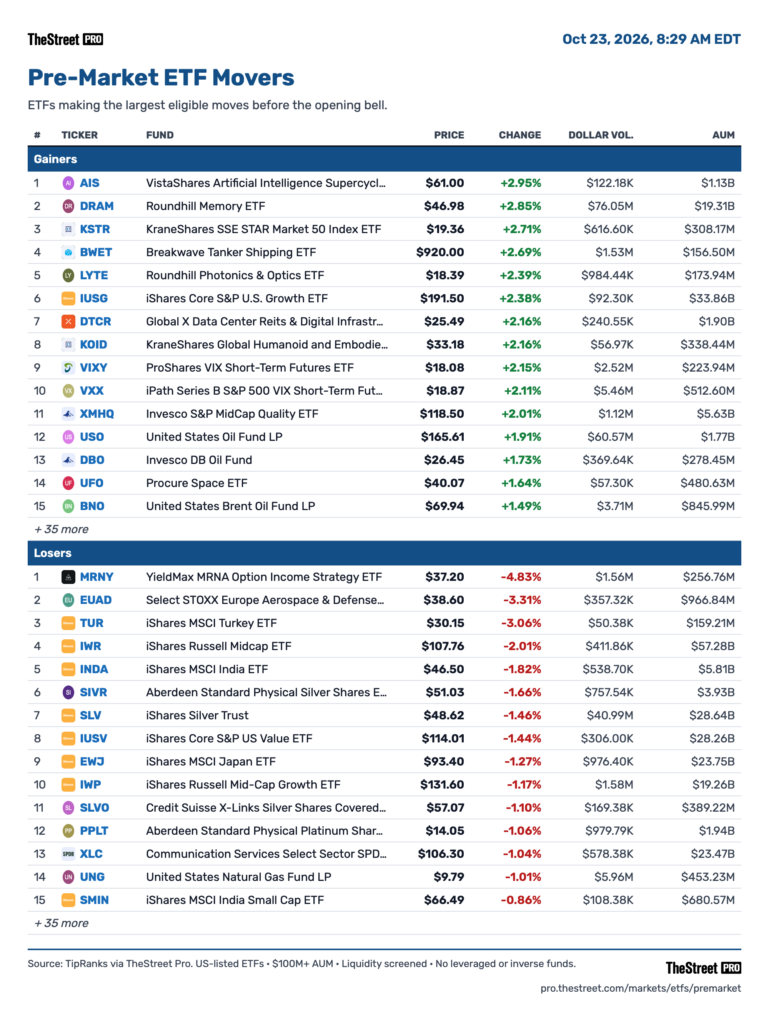
Market Movers in the Early Morning

Source: TheStreet Pro

BY Doug Kass · Oct 23, 2026, 9:05 AM EDT

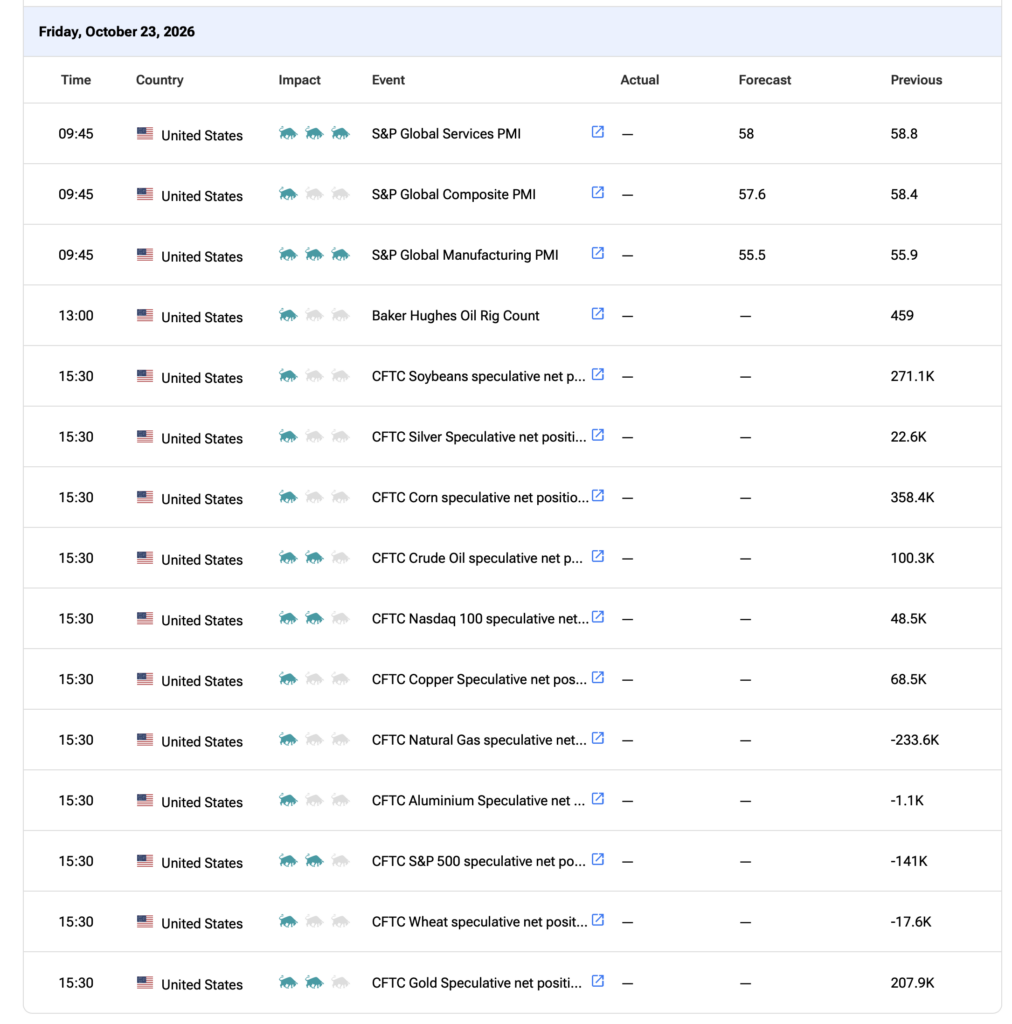
Economic Calendar for Today

Source: TipRanks

BY Doug Kass · Oct 23, 2026, 9:00 AM EDT

The Hard Truth About AI

I have spent an extraordinary amount of time over the last two years analyzing AI — whether AI will really produce productivity, if the capital spending spree will generate a reasonable return on invested capital, etc.

The more than 260 “More Tales From Nvidia” columns I have written are literally the tip of the analytical iceberg. However, the nuts and bolts and intricacies of demand and supply, complicated chip pricing (e.g. rent for the H100 Index closed at $2.88 and rent for the more recent GPU8300 is at $7.65), the depreciation/”half life” of chips (GPUs depreciate in only 4-6 years but the underlying debt lives on much longer!), how soon will broad AI adoption take place and whether the “marginal” neoclouds should even exist (their cost of capital is too high and hyperscalers (Microsoft (MSFT) and Google (GOOGL) have been building data centers for more than two decades and in all likelihood they won’t ultimately need neocloud providers), would send your heads spinning and I would lose most of readers in the first paragraph.

As an aside, one of the reasons I am so critical of the business media’s superficial coverage of AI investing is that I am 100% certain that the AI knowledge base of the circus barkers recommending tech companies on Fin TV is miles long but only inches deep. They generally repeat glittering generalities and made-up Perma Bullish narratives that lack substance and analysis. (This observation also applies to the pied pipers Dan Ives and Tom Lee. No change in financing or fundamentals impedes their eternal optimism!)

Below is from the firm Vital Knowledge — it is an excellent synthesis of what the ongoing and underlying problem is weighing on the AI situation.

Amid all the noise around AI, the underlying problem for the industry is one that’s been present for a while: AI growth is dependent on capex (this is one of the most capital-intensive industries ever) and since capex is dramatically outpacing op. cash flow, companies are reliant on the largess of equity and debt investors to underwrite all the spending, but lately those markets are becoming increasingly less accommodating.

Because the issuance landscape for debt and equity has deteriorated materially, this will inevitably lead to a reduction in aggregate spending (the pool of capital willing to pay for everything is smaller than before, at least for now).

It used to be that investors could focus myopically on the big headline AI numbers (user growth, ARR, backlog, etc.), but that no longer suffices as these top line metrics are impossible to sustain/realize without funding, and that funding is now a lot more precarious.

The biggest players are putting the pedal to the metal, hoping to capitalize on the turmoil to squeeze (via crowding out) weaker vendors – this is why Musk talked about bringing 10GW+ of compute online next year for SpaceX while Meta tweaked up its 2026 capex budget and hinted at another huge number in 2027.

The argument can be made that this funding issue will soon pass because underlying demand is so strong, but it’s important to note that a lot of the demand is a function of that funding (i.e. loss-making companies are fueling a big chunk of token consumption).

It can’t be overstated how important Anthropic and OpenAI are – they remain the suns around which the whole AI world rotates and if these companies can’t come public on the terms anticipated by bulls (in terms of timing and valuations), there will be negative fallout for everyone due to 1) less money available to spend on compute and 2) a lower benchmark for sector valuations.

Compute is fungible, and the capacity being built for Anthropic/OpenAI could be repurposed over time if they don’t fill it, but that process won’t be quick or painless.

Position: None

BY Doug Kass · Oct 23, 2026, 7:45 AM EDT

AI Tweet of the Day

Position: None

BY Doug Kass · Oct 23, 2026, 6:57 AM EDT

Oscillator Modestly Overbought

The S&P Short Range Oscillator remains in a modest overbought at 1.43% vs. 1.56%

I have no index positions on currently.

Position: None

BY Doug Kass · Oct 23, 2026, 6:21 AM EDT