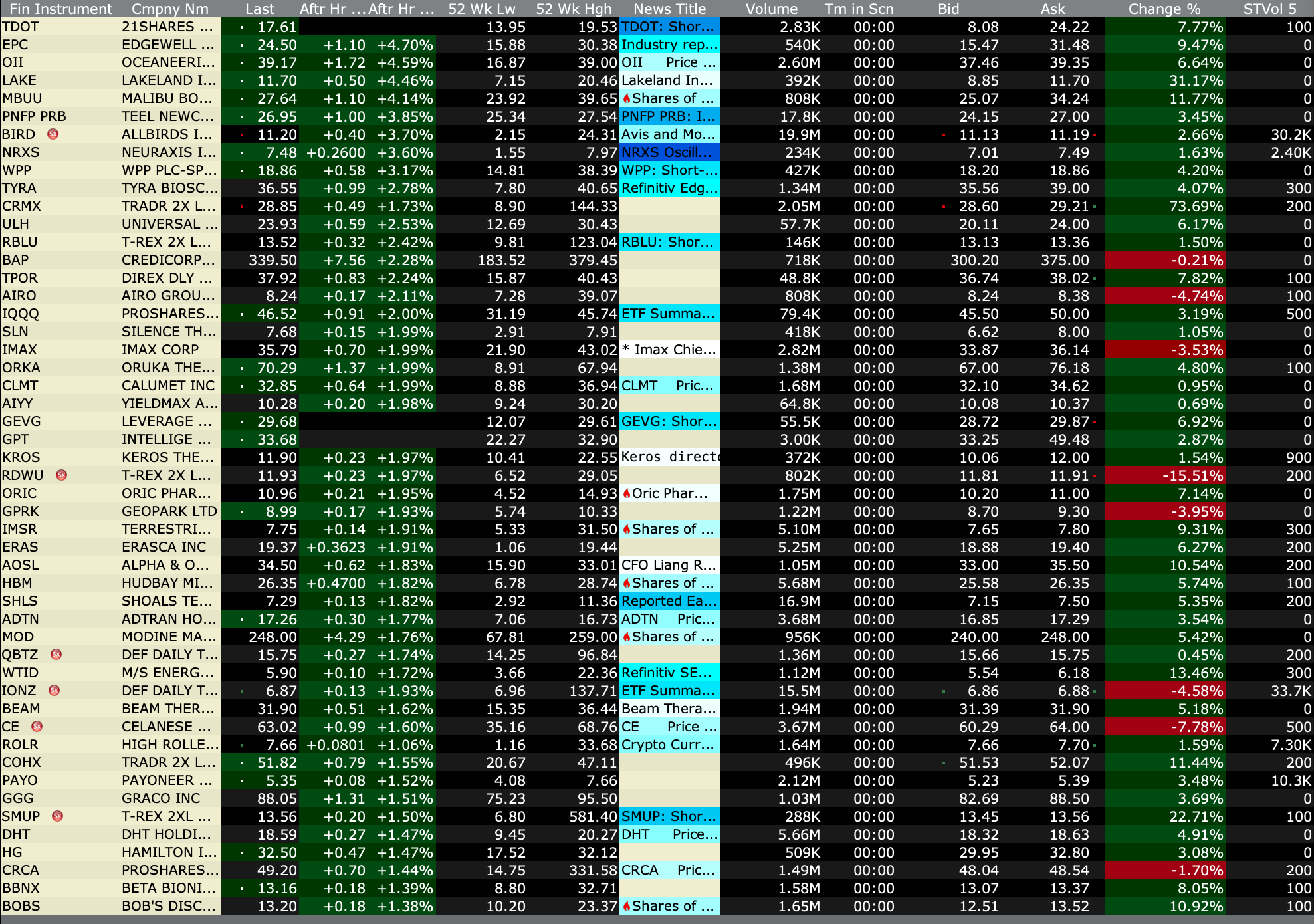
Friday's After-Hours Advancers and Decliners
After-Hours % Advancers
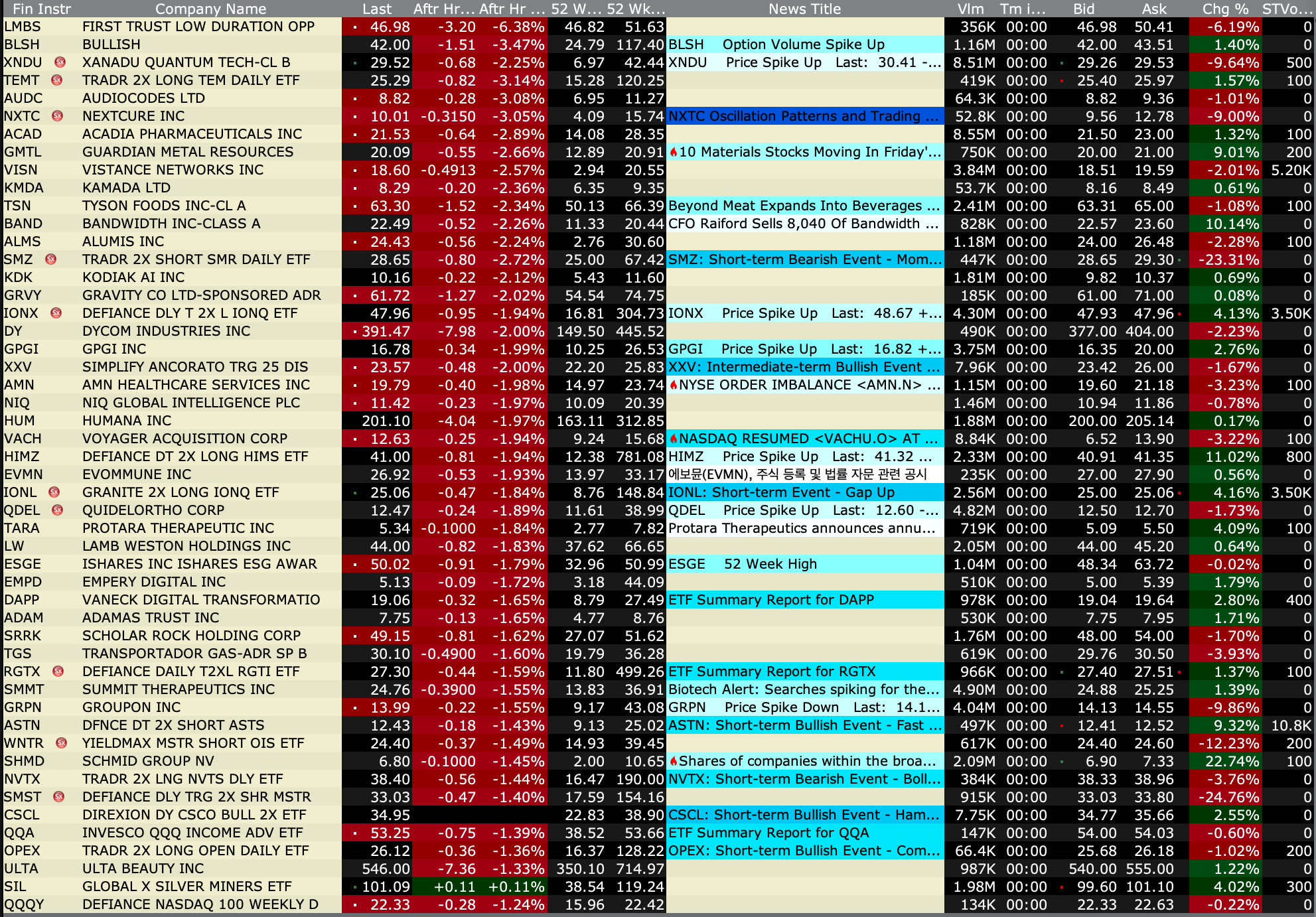
After-Hours % Decliners
BY Doug Kass · Apr 17, 2026, 4:45 PM EDT
 Doug KassDoug Kass
After-Hours % Advancers
After-Hours % Decliners
BY Doug Kass · Apr 17, 2026, 4:45 PM EDT
Closing Volume
- NYSE volume 20% above its one-month average
- NASDAQ volume 13% above its one-month average
- VIX index: down 2.84% to 17.43
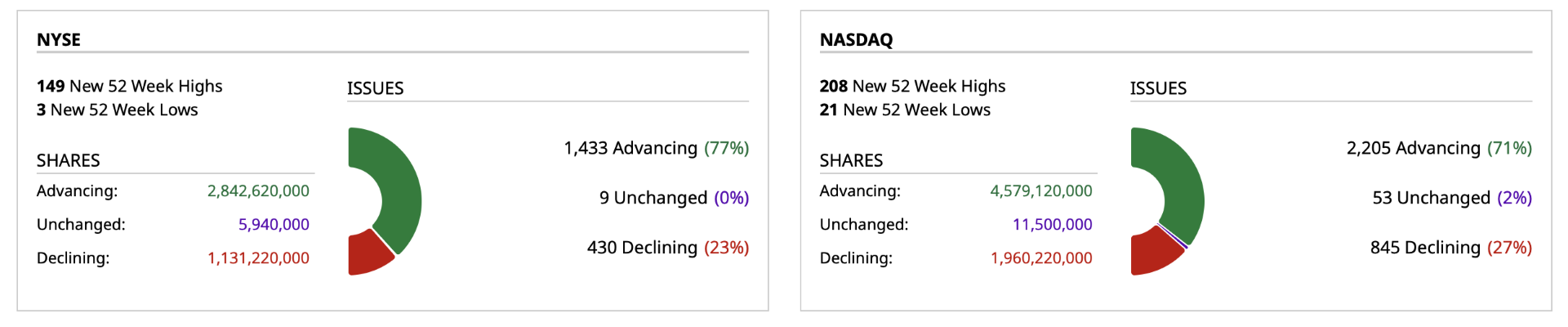
Breadth
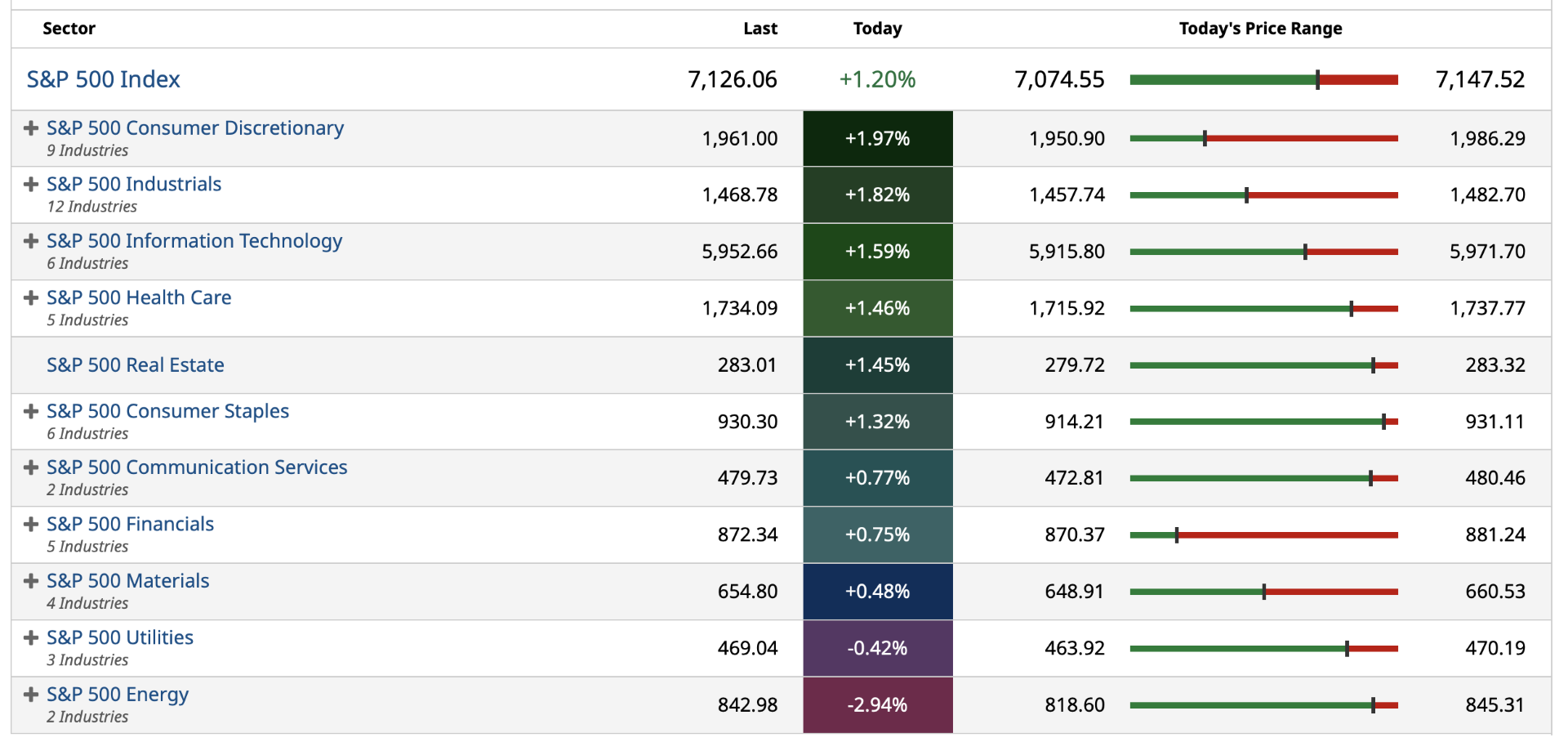
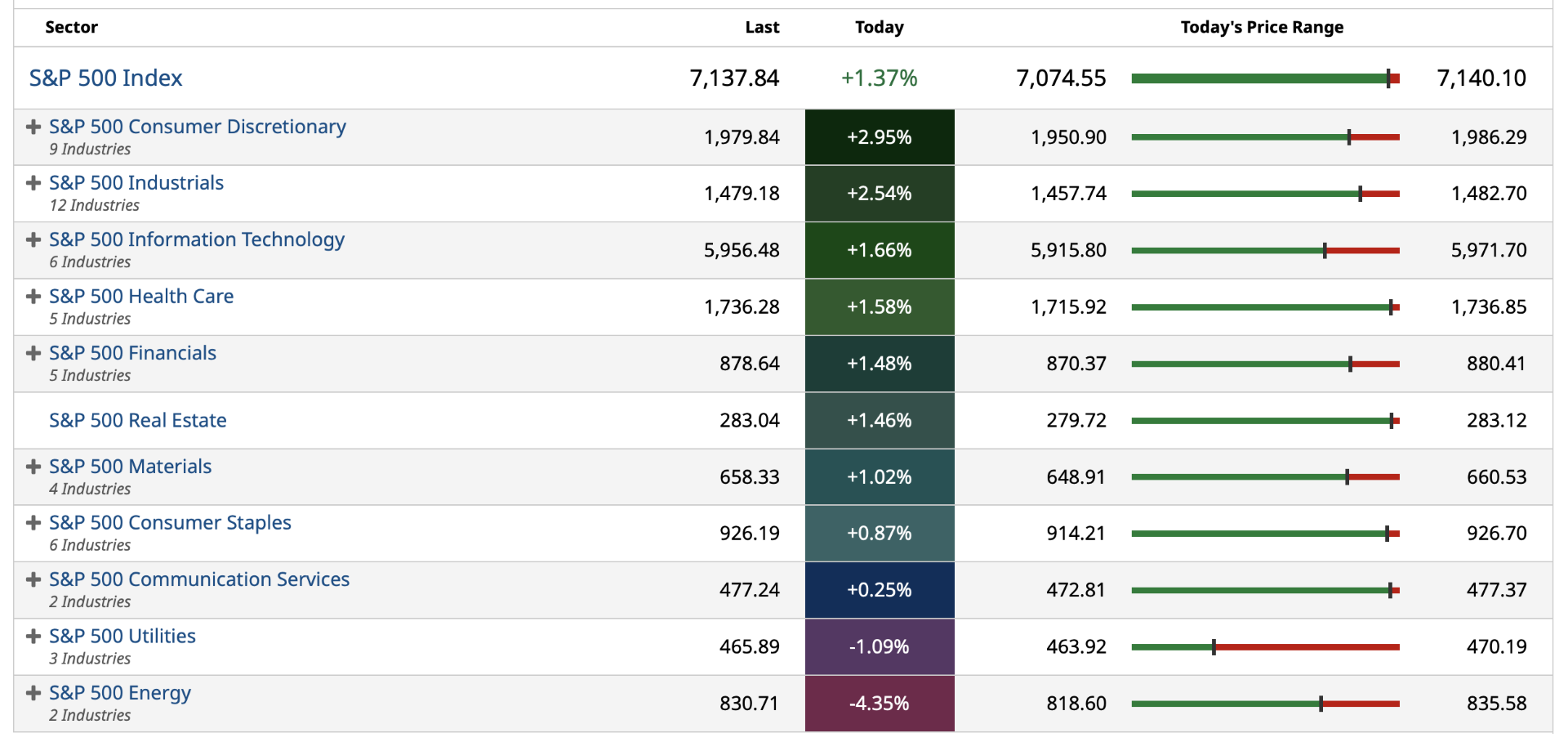
S&P 500 Sectors
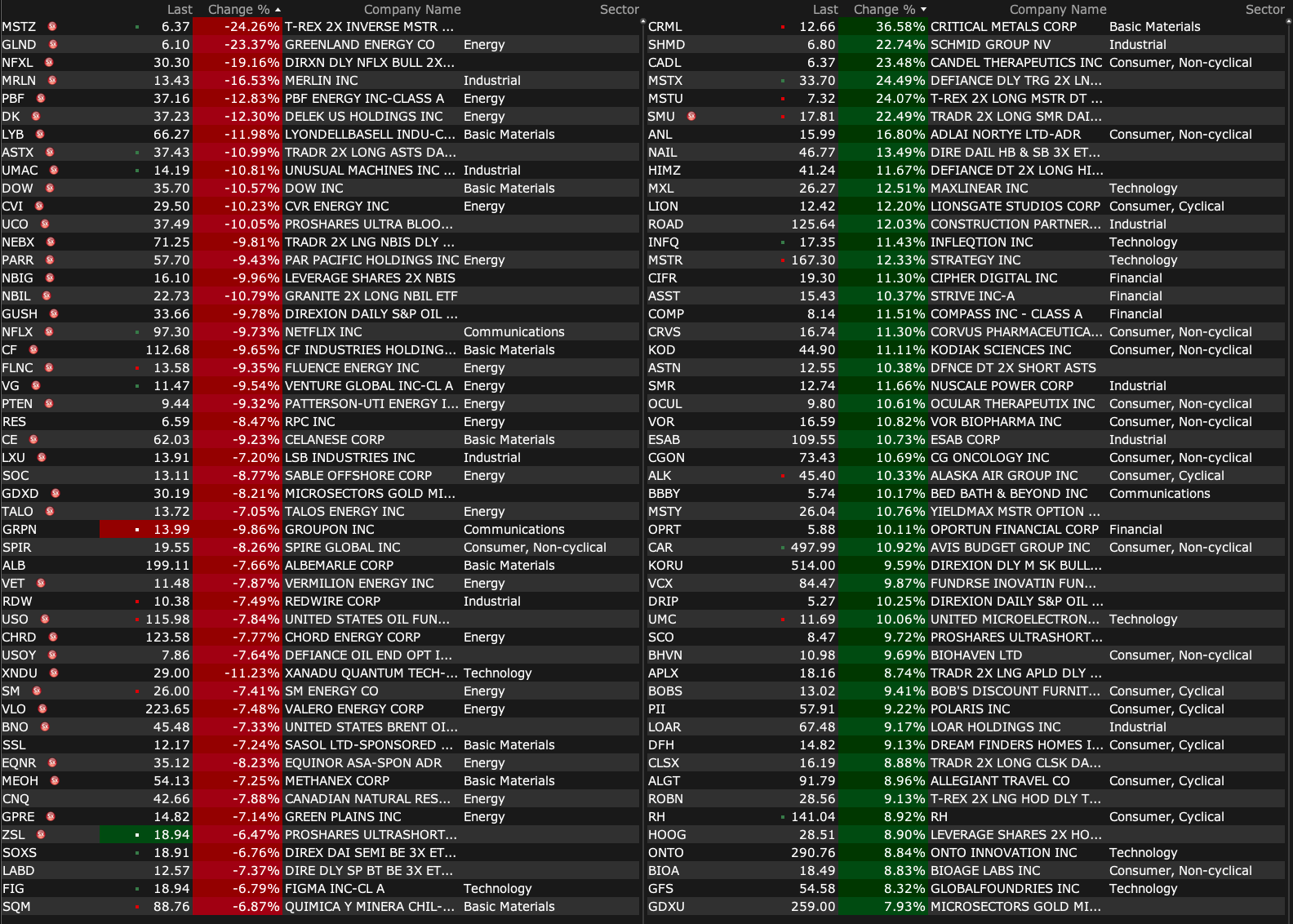
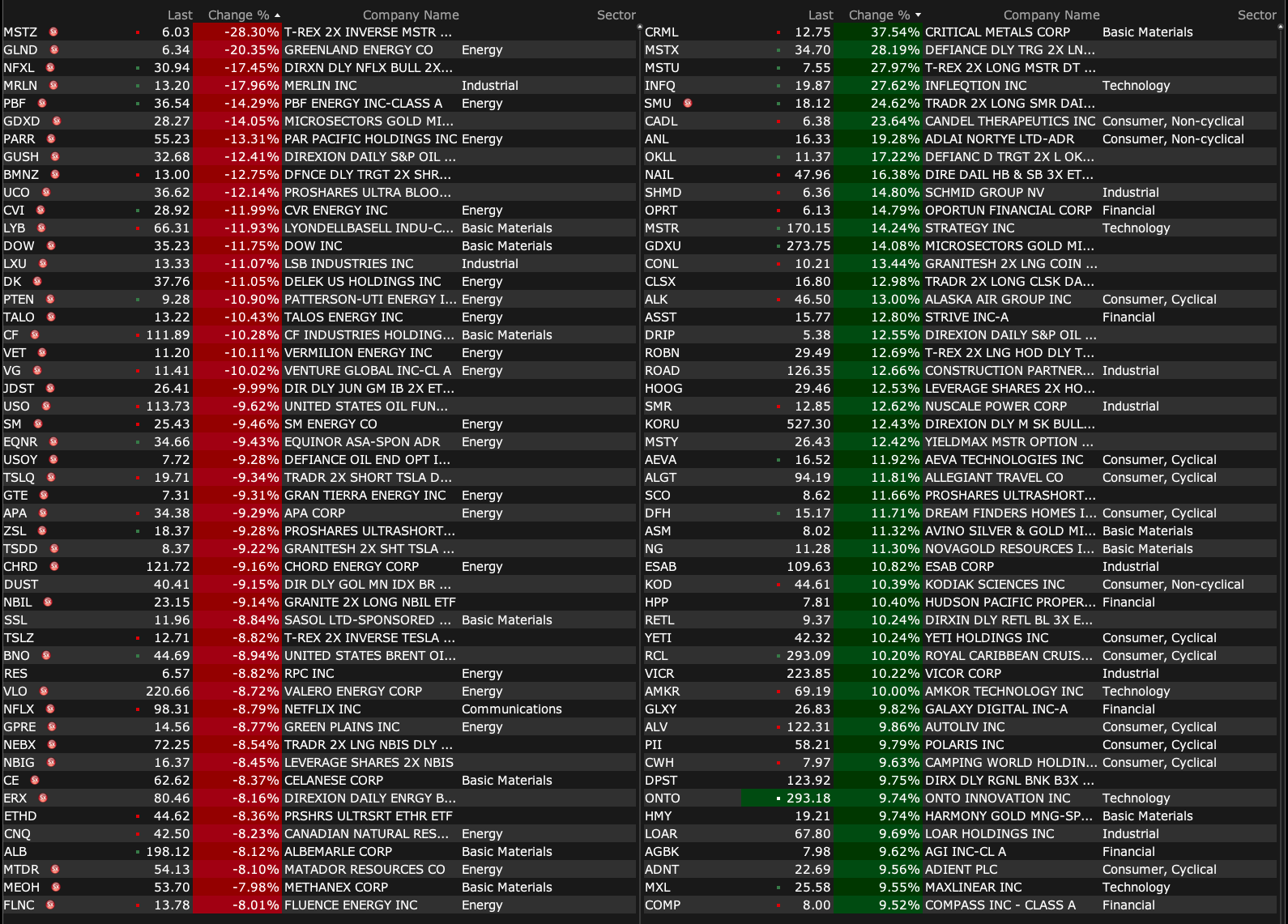
% Movers
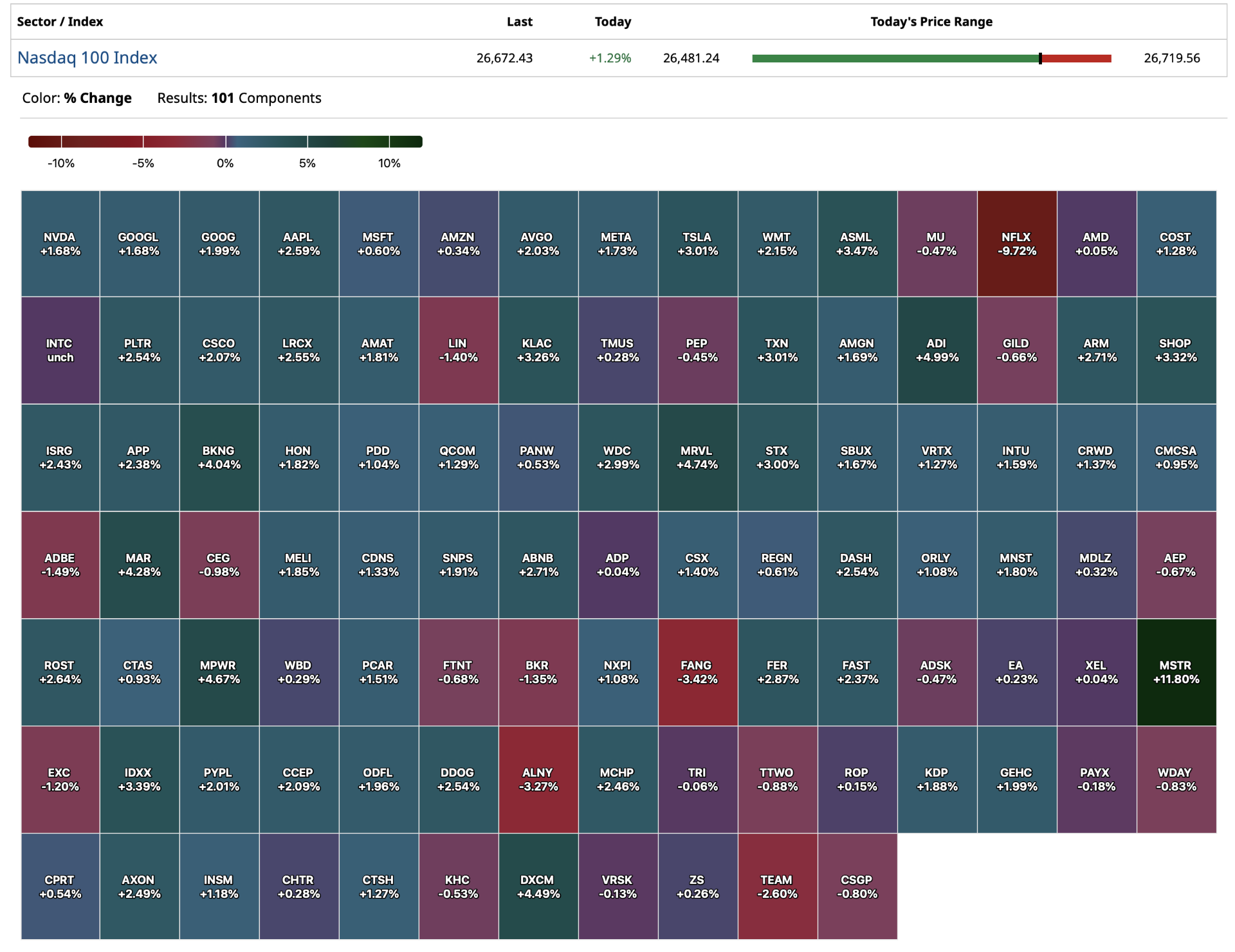
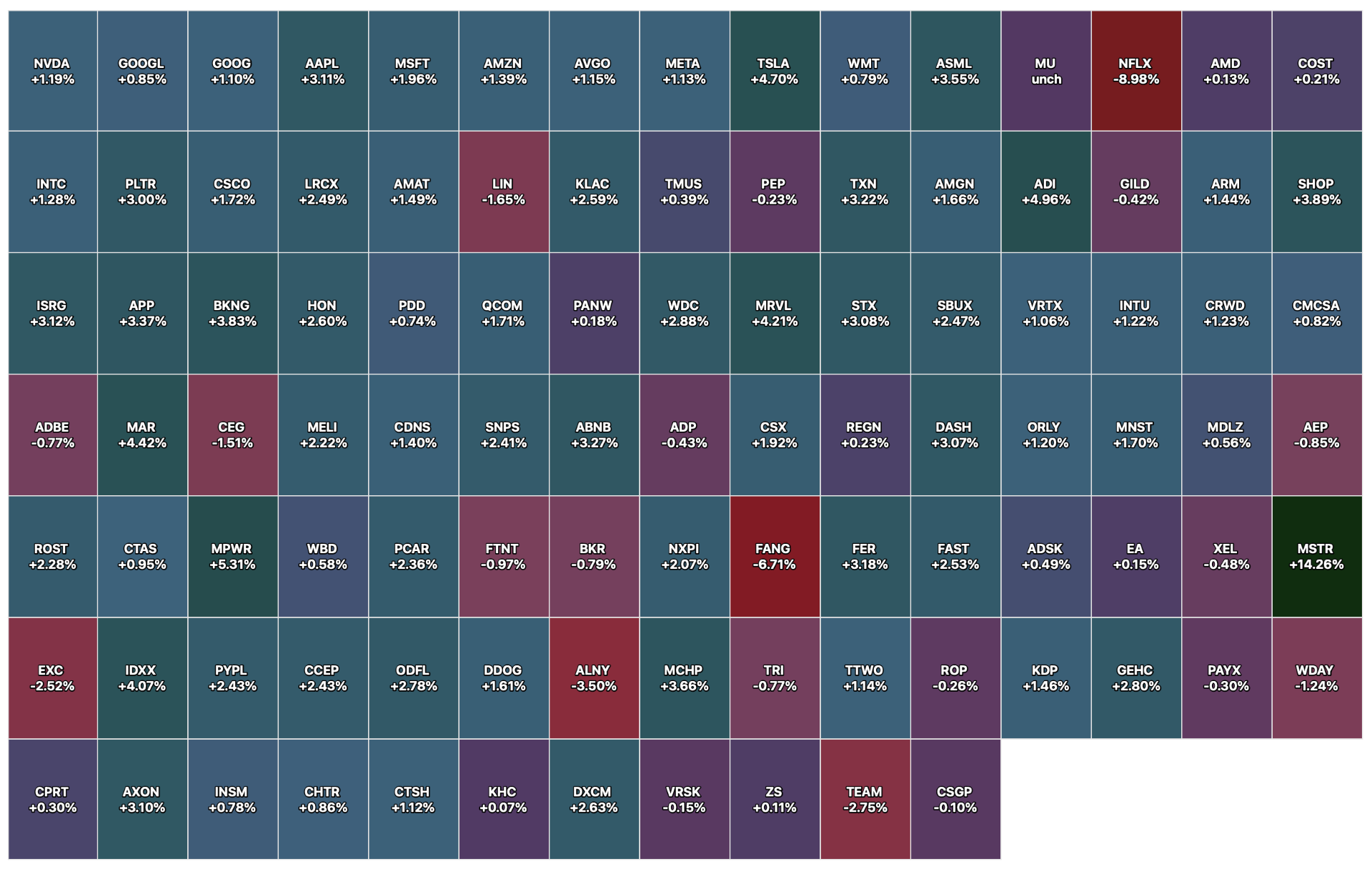
Nasdaq 100 Heat Map
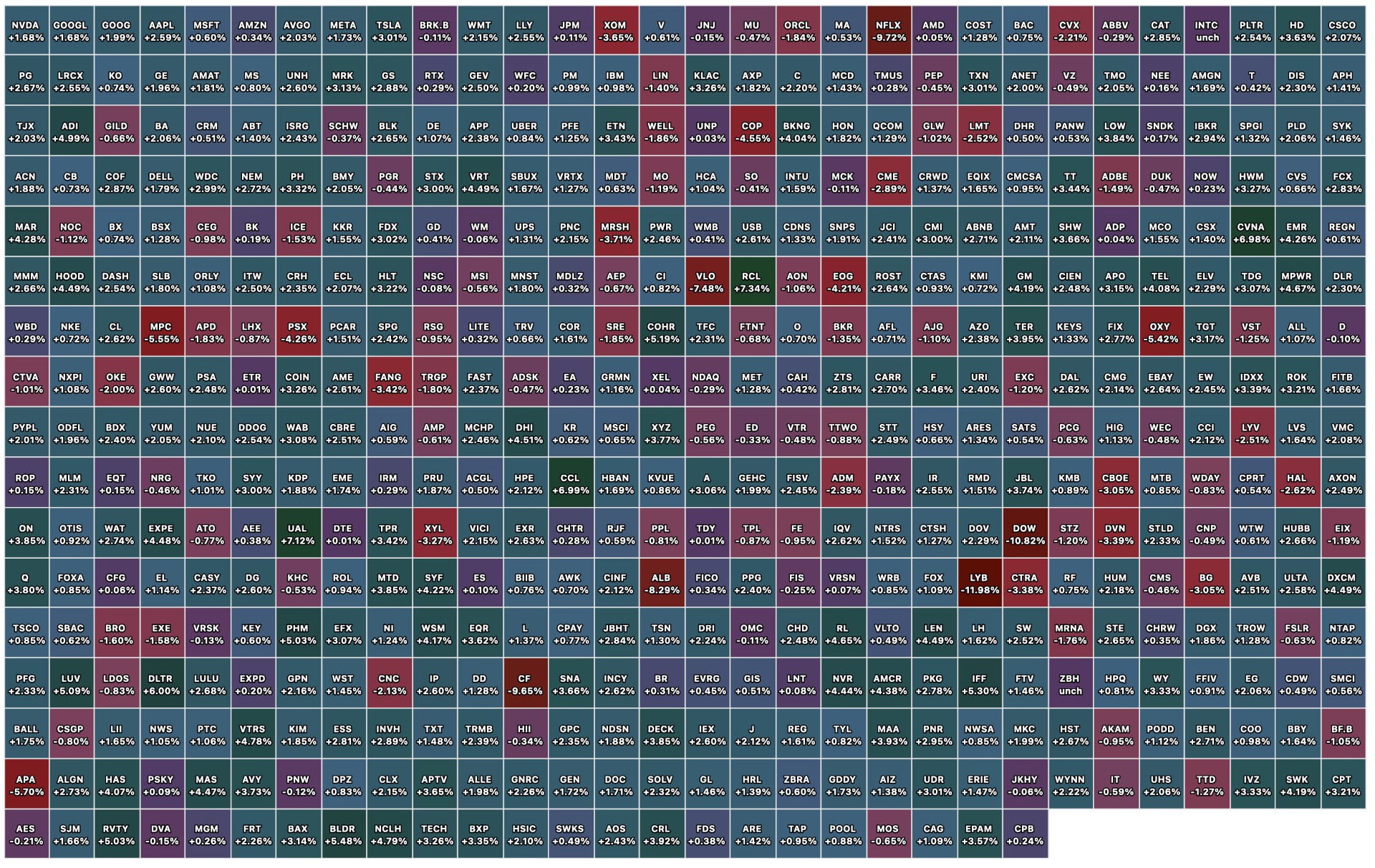
Closing S&P 500 Heat Map
BY Doug Kass · Apr 17, 2026, 4:29 PM EDT
Despite -$5 and -$11 drops from the intraday highs of Amazon (AMZN) and Microsoft (MSFT) (I eliminated both longs yesterday), the Nasdaq remains +300 handles higher.
This points to the magnitude of the broad strength in large-cap technology.
Position: None
BY Doug Kass · Apr 17, 2026, 3:32 PM EDT
BY Doug Kass · Apr 17, 2026, 2:55 PM EDT
Volume
- NYSE volume 49% above its one-month average
- NASDAQ volume 17% above its one-month average
- VIX index: down 2.84% to 17.43
Breadth
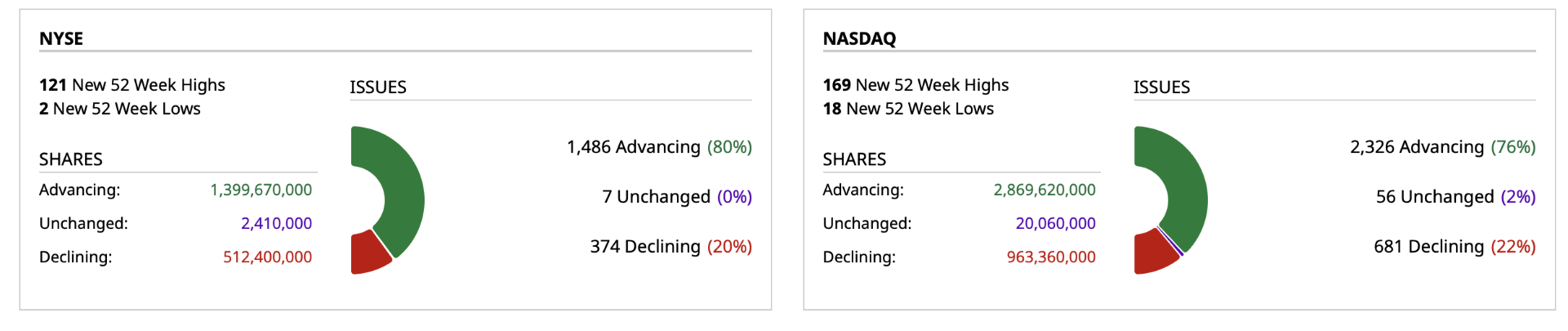
S&P 500 Sectors
% Movers
Nasdaq 100 Heat Map
BY Doug Kass · Apr 17, 2026, 12:45 PM EDT
The observation that I made over the last few days — that the equal-weighted S&P and the Russell were underperforming — has been reversed today:
(SPY) +1.39%
(QQQ) +1.35%
(IWM) +2.66%
(RSP) +1.53%
Position: Short SPY common (S), QQQ common (S)
BY Doug Kass · Apr 17, 2026, 12:33 PM EDT
I have covered my casino shorts ( (CZR) , (WYNN) and (MGM) ) for a breakeven.
Will revisit in the future.
Position: None
BY Doug Kass · Apr 17, 2026, 11:55 AM EDT
I have sold out my (VKTX) (common and calls) for a small profit.
Position: None
BY Doug Kass · Apr 17, 2026, 11:47 AM EDT
From Peter Boockvar:
Positives,
1) The ceasefire is holding, we seem to be close to a deal and the Strait is reopened during the ceasefire according to the Iranian Foreign Minister.
2) Initial jobless claims for the week ended 4/11 fell to 207k from 218k but the 4 week average was 210k vs 209k last week because a print of 205k fell out from 5 weeks ago. Continuing claims lifted back above 1.8mm at 1.818mm but still remaining below the 1.9mm range which has been the upper end of the range since November 2021.
3) The April NY manufacturing index for April rebounded to +11 from essentially zero at -.2 in March and +7.1 in February. New orders jumped to 19.3 from 6.4.
4) The April Philly index rose to 26.7 from 18.1 and above the estimate of 10. As also seen in the NY survey, new orders jumped to 33 from 8.6 and I continue to believe that we have companies that are front running ordering in order to create extra inventories so as not get caught short on any supply shortages.
5) Container shipping prices according to the World Container Index were down w/o/w with the Shanghai to LA route down 3.4% w/o/w after jumping by 9% last week. Shanghai to NY slipped 3% after a 32% rise over the prior six weeks. The price was also down for the Shanghai to Rotterdam trip.
6) March PPI rose another .5% m/o/m after a .5% jump in February but that was well below the estimate of a 1.1% increase and February was revised down by 2 tenths. The core rate was up just one tenth m/o/m vs the forecast of up .4% and vs a .3% gain in February (downwardly revised by 2 tenths) .
7) After a big jump seen in February of .9% m/o/m (revised down from 1.3%) , March import prices rose another .8%, though that was well below the estimate of 2.3%. The y/o/y gain went to 2.1% from 1.3% and that is the most since December 2024. Import prices ex petro rose just one tenth m/o/m but was up .9% in February, .8% in January and .4% in December and still up 2.6% y/o/y. Taking out both fuels and food saw an import price jump of .6% m/o/m vs .9% in February, .7% in January and .3% in December and higher by 3.5% y/o/y.
8) The average 30 yr mortgage rate fell 9 bps w/o/w to 6.42% and that helped refi’s rebound by 5.1% after big declines in the prior four weeks. Purchases were little changed though, down 1% after rising by a like amount last week.
9) From Pepsi: “We’ve had no major issues from a supply chain standpoint. We’re seeing really nice continuity there. The teams are managing it well. I think in times like these, the scale of PepsiCo is really an advantage.” Also, “We do have some systemic hedging programs in place that does give us some near term visibility here. We typically have about 6-12 month hedges in place. Now, our assumption is that inflation will come. The order of magnitude we’re still working through, and I think a lot of that is still to be determined.” And, “From a visibility and guidance standpoint, our assumptions are that we can mitigate what comes our way this year, and that’s really reflected in our assumptions on guidance.”
10) From Manpower: “Within Talent Solutions, our RPO (recruitment process outsourcing) business continues to experience a sluggish permanent hiring environment, but we did see sequential revenue trend improvement.” On the impact of AI on hiring, “I think it’s basically uncertainty related to the economic environment and outlook. Employers are getting buffeted by geopolitical events, tariffs, wars, that are ongoing or started and that clearly drives employer hesitation. So in our mind, the client hesitation is more related to those events than any particular concerns or possible impact of AI into their workforce.”
11) From JB Hunt: “As we moved through the first quarter, the freight environment felt meaningfully different than what we’ve operated in over the past several years. When we spoke last quarter, I described the truckload market as fragile, and that we are testing the elasticity of supply, and that assessment proved accurate. Continued regulatory enforcement to improve safety in our industry has removed non-compliant capacity, and when combined with early signs of improved demand, resulted in a tighter truckload market throughout the quarter. While predicting inflection points is never precise, we believe we are on a path of recovery.” More on the capacity shrink that continues, “What we’re seeing is a freight market that has fundamentally less slack than it did in prior cycles. Capacity has been steadily exiting for an extended period, driven by regulatory enforcement, rising costs, and financial performance that does not support capital reinvestment...Truckload rates, tender rejections, the ISM PMI, and several others are all at their highest levels since 2022. And trucking employment is at the lowest levels since 2022, all proof points of structural change.”
12) From Taiwan Semi: “In terms of material supply, TSMC’s strategy is to continuously develop multi-source supply solutions to build a well diversified global supplier base and to improve the local supply chain. For specialty chemicals and gases, including helium and hydrogen, we source from multiple suppliers in different regions, and we have prepared safety stock inventory on hand. We are also working closely with our suppliers to further strengthen the resiliency and sustainability of our supply chain. Thus, we do not expect any near term impact on our operations from material supply.”
13) From Bank of America: “Our research team continues to see an economy that is resilient, that the core activities of the economy continue to push along even with all the uncertainty that you’ve all written about out there. We see the forward look of GDP growth rates in the US in the 2% range, and we see a faster growth rate around the world...Turning briefly to asset quality, we saw improvement from last year. Net charge-offs, card delinquencies, reservable criticized assets, and non-performing loans, all declined vs the first quarter of ‘25. Provision expense was $1.3 billion compared to $1.5 billion last year, reflecting continued benign credit results.”
14) From JP Morgan: “Notwithstanding the recent volatility in market and gas prices, based on our data, consumers and small businesses remain resilient, with consumer spend growth continuing above last year’s pace.” In their investment banking and M&A business, “Looking ahead, client engagement and pipelines remain healthy, but of course, developments in the Middle East could have an impact on deal execution and timing.” What are they seeing on the US consumer? “There really is not anything new or interesting to say this quarter. We’ve looked at it through every angle, early roll rates, delinquency rates, cash buffer, spend, discretionary spend, non-discretionary spend, it all looks consistent with prior trends and fundamentally healthy…So think gas or energy costs is something like 3% of the typical consumer’s expense – spend expenditure, at least in our portfolio. So, it’s not nothing, but it’s not overwhelming. We’ve looked to see if there’s kind of evidence in there of people trading, decreasing other discretionary spending to adjust for higher gas prices, but it’s just kind of not enough yet to be visible.”
15) From Wells Fargo: “While the markets have reacted to macroeconomic uncertainty, our actual credit performance in the first quarter remains strong. Our net loan charge-off ratio was stable from a year ago and increased 2 bps from the fourth quarter. Commercial credit continues to perform well, and we are not seeing signs of systemic weakness.” With their consumer loan book, “We continue to closely monitor our portfolios for signs of weakness, but have not observed recent deterioration or meaningful shifts in trends.”
16) China’s economy grew by 5% y/o/y in Q1 vs the estimate of 4.8% with strength in industrial production. Retail sales remain lackluster as the consumer is still managing the decline in residential real estate prices. Though prices are falling at the slowest pace in a year and are now rising m/o/m in Shanghai, Shenzhen and Guangzhou while flat in Beijing vs continued declines in 2nd and 3rd tier cities.
17) The UK economy in February rose .5% m/o/m, well better than the estimate of up .1% with help from services and construction.
Negatives
1) Another week of lost shipments of so many needed things but hopefully no more.
2) Within the Philly manufacturing index, not surprisingly, prices paid jumped to 59.3 from 44.7 and that is the most since last August. Prices received also rose to the highest since August at 33.5 vs 21.2 in the month before. In the NY survey, there was the 14.4 pt jump in prices paid to 51, the highest since last October but those received were little changed, for now, up .4 pts to 21.8.
3) The April NY Fed’s services index for that region remained in contraction at -14 but less so and vs -22.6 in March.
4) Dry bulk shipping prices rose for the 9th straight day by another 5.5% to 2,484, the highest since December according to the Baltic Dry Index.
5) The US oil patch is still not responding to higher prices and again, looking at the back end crude oil futures market rather than front month in making drilling decisions. The Baker Hughes crude oil rig count was unchanged w/o/w and up just 4 since the war broke out, still hovering around the lowest level since September 2021.
6) This is how the Fed’s Beige Book summarized the US economy over the past six weeks, “Overall economic activity increased at a slight to modest pace in eight of the twelve Federal Reserve Districts, while two Districts reported little change and two Districts reported slight to modest declines. The conflict in the Middle East was cited as a major source of uncertainty that complicated decision-making around hiring, pricing, and capital investment, with many firms adopting a wait-and-see posture.” Quite the mixed bag.
7) The April mood of homebuilders softened further to 34 from 38 in March. The estimate was 37. The Present Situation fell 4 pts m/o/m to 37 while the Future look was down by 7 pts to 42. Prospective Buyers Traffic is not helping with it down 3 pts to just 22 after rising by 3 pts in March. Higher energy prices have had an immediate impact from a construction perspective. The NAHB said “With oil prices higher in the US, 62% of builders reported suppliers have increased building material costs due to higher fuel prices, including gas and diesel. With near-term economic risks elevated, 70% of builders reported challenges pricing homes given uncertainty about material costs.” As for the demand side and that depressed level of interested buyers, “buyers face ongoing elevated interest rates and growing economic uncertainty. The year started with hopes for housing momentum growth, but risks with respect to the Iran war, energy costs, and declines for consumer confidence have slowed the market.”
8) The NFIB Small Business Optimism index for March fell 3 pts m/o/m to 95.8 and that is the lowest since April 2025. From Bill Dunkelberg at the NFIB, “The 20% Small Business Deduction and other supportive small business tax provisions in the Working Families Tax Cut Act have had many positives for small business owners,” said NFIB Chief Economist Bill Dunkelberg. “However, the dramatic spike in oil prices has spooked consumers and owners alike. Small business owners are having to absorb those higher input costs and pass them along to their customers.”
9) From Knight Swift Transportation: “While the winter weather negatively impacted volumes and operating costs more than typical for a first quarter, it also exposed the reduction in truckload capacity to all stakeholders, which is very meaningful for ongoing bid activity. Similarly, the rapid increase in fuel costs was a headwind to earnings in March, but we believe this will add to the existing downward trend in supply in the truckload industry. The truckload market continues to tighten, and the bid environment is rapidly evolving.”
10) From Alcoa: Broadly with the effective Strait closure, “more than 2.5 million tons of annual smelting capacity and nearly 2 million tons of refining capacity are offline year-to-date. That’s a meaningful disruption to the global system. Alumina refineries in the region are integrated with aluminum smelters. However, approximately half the region’s bauxite requirements are imported from outside the Middle East. This structure leaves the regional aluminum system particularly exposed to shipping disruptions and logistical constraints. And it doesn’t stop at bauxite and alumina. Several smelters in the region also rely on imported anodes, calcined coke, and coal tar pitch. With transit through the Strait restricted, these materials are harder to move, raising costs and increasing uncertainty. Given the Middle East’s important role in global green petroleum coke exports, these disruptions are already rippling through the global calcined coke market...The takeaway is clear. Structural dependencies in the Middle East mean that disruption there doesn’t stay local. It moves quickly through the aluminum value chain, tightening supply, increasing cost volatility and elevating risk well beyond the region itself.”
11) From Fastenal: “Industrial economy remains somewhat challenging with US manufacturing PMI averaging around 52.6, which is an improvement, but still moderate overall. We really didn’t see much of a tailwind. We gained share through focused execution. Largely, we won new business with key accounts, we expanded customer site presence and we strengthened our value added services and solutions.” What disappointed the Street, “We were approximately 40 bps below our own Q1 gross margin target, as pricing actions did not keep up with cost increases as the quarter played out...Tariff related costs moved through the P&L faster than our pricing...On pricing, we realized approximately 3.5% y/o/y and that compares to 3.3% in the fourth quarter, not enough to offset inflation.”
12) From Citigroup: “Switching gears, the global macroeconomy to date has weathered shock after shock. However, the impact of the Middle East conflict is hitting Asia and Europe harder than countries such as the US and Brazil, which are more insulated from energy shocks. Clearly, the longer this goes on, the more pronounced the second and third order impacts are going to be around the world. And inflation is now a greater risk to growth that will likely cause central banks to lean towards more restrictive monetary policies.”
13) From Wells Fargo: “Client sentiment is cautious but engaged as macro and geopolitical uncertainty has increased and clients have largely shifted to a more selective and defensive posture.”
14) From Carmax: “Our EPS during the quarter was impacted by restructuring costs as well as by a non-cash goodwill impairment, while our margins decreased from the prior year quarter as we continue our focus on targeted price reductions and driving sales.” On their auto finance business, “Consistent with the third quarter, credit losses in the fourth quarter were in line with our expectations.” But, “With regard to roll rates and delinquencies, I think across the auto lending industry, lenders would say, customers, maybe absent exception of the highest credit quality, the 800 plus FICO, they certainly are feeling the stress of affordability, inflation, etc...So, those customers from mid-Tier 1 all the way down to deep subprime are feeling the stress, delinquencies are higher, roll rates are higher, and for us as a lender, our job is to support them, help to service them, and then set the reserve accordingly in preparation for that...But there is a stressed customer out there, and we are thoughtful on that.”
15) From Albertson’s: “In grocery, units and ID sales in Q4 remained pressured in our lowest income cohorts. Egg deflation also created a meaningful sales headwind as we cycled the significant egg shortages from a year ago, a dynamic that we expect persist into the first quarter of 2026.”
16) From Kering: Group revenue fell 6%, “impacted by the strengthening of the euro, and stable y/o/y on a comparable basis. This stabilization represents an important first milestone and a further sequential improvement. It was delivered in a challenging and uncertain environment, with low visibility and continued pressure on consumer confidence. Geopolitical tensions, notably in the Middle East, also weighed on traffic and performance during the quarter.”
17) From LVMH: “LVMH continued to grow organically in Q1 with improved trends across most businesses. The quarter was impacted by the ongoing conflict in the Middle East, which had a tangible incidence on demand in the region in March after a good start of the year, and this accounted for a negative 1 percentage point on the growth of the quarter. So, excluding this impact, organic growth would have been plus 2%...Elsewhere, Q1 saw solid growth in China and Asia at large as well as in the United States...The euro strength against key currencies generated a negative 7% currency impact in Q1, which continued to have also an unfavorable impact for tourist sales, especially in Europe.”
18) Lending Tree released an updated analysis on Buy Now, Pay Later and they said this, “A growing percentage of buy now, pay later (BNPL) users say they’ve paid late on one of these loans in the past year. Now, 47% of BNPL users have done so, up six percentage points from 2025 and 13 percentage points from two years ago...That’s just one of the troubling findings...We asked consumers about their behaviors and perspectives regarding these popular loans. Along with increased late payments, we found that more users are buying groceries with these loans and carrying three or more BNPL loans at once, and that more than half of BNPL users say they wouldn’t be able to make ends meet without them.”
19) The March slowdown in global trade was seen in the China trade data where exports were up 2.5% y/o/y, well below the estimate of up 8.6%. Imports jumped by 28% as I’m sure importers were rushing to get things. That’s twice the forecast of a rise of 14%.
None.
BY Doug Kass · Apr 17, 2026, 11:20 AM EDT
I have sold the balance of my (PG) long at $146.75 (+$3.68)
Position: None.
BY Doug Kass · Apr 17, 2026, 10:36 AM EDT
Over $106 I will consider writing some calls against (DIS) common.
Position: Long DIS S
BY Doug Kass · Apr 17, 2026, 10:33 AM EDT
Out of (MSOX) now for the same reason I plan to add to individual cannabis names.
Position: None.
BY Doug Kass · Apr 17, 2026, 10:12 AM EDT
I am moving out of my large (MSOS) long (sold calls against the common) for the purpose of emphasizing and adding to specific and individual cannabis names (VNRO, (CURLF) , (GTBIF) , GLASF).
Positions: MSOS L VNRO S CURLF VS GTBIF VS GLASF VS; Short: MSOS
BY Doug Kass · Apr 17, 2026, 9:53 AM EDT
Seasonal MACD Sell Signal Update
As of today’s close, MACD indicators applied to DJIA and S&P 500 are positive. DJIA would need to drop 4770.50 points (–9.82%) in a single day to turn its MACD indicator negative while S&P 500 would need to decline 941.01 points (–13.36%) to turn its MACD indicator negative.
The full report can be found here:
Position: None
BY Doug Kass · Apr 17, 2026, 9:35 AM EDT
From Peter Boockvar:
With this incredible and rapid two week rally, the CNN Fear/Greed index has risen to 63, in the middle of the ‘Greed’ section and well up from the late March bottom of 10 when it was in ‘extreme fear.’ The Daily Sentiment Index fell to just 12 at the end of March and was at 78 yesterday according to my friend Helene Meisler. The SPX stands at 76. The NAAIM Exposure Index closed yesterday at 79 vs 60 in March. Investors Intelligence (covering sentiment last Friday so I’m sure the Bull/Bear spread has widened much further) saw Bulls rise to 39.6 from 33.3 and Bears dropped to 22 from 27.8 and vs 31.5 in the week before. Last weekend saw the Citi Panic/Euphoria index back in Euphoria land at .43. The outlier to this bullish shift in line with the market rally is the very volatile and fickle AAII retail survey, my least favorite, where Bulls fell 4 pts to 31.7 vs Bears at 42.8 that was little changed.
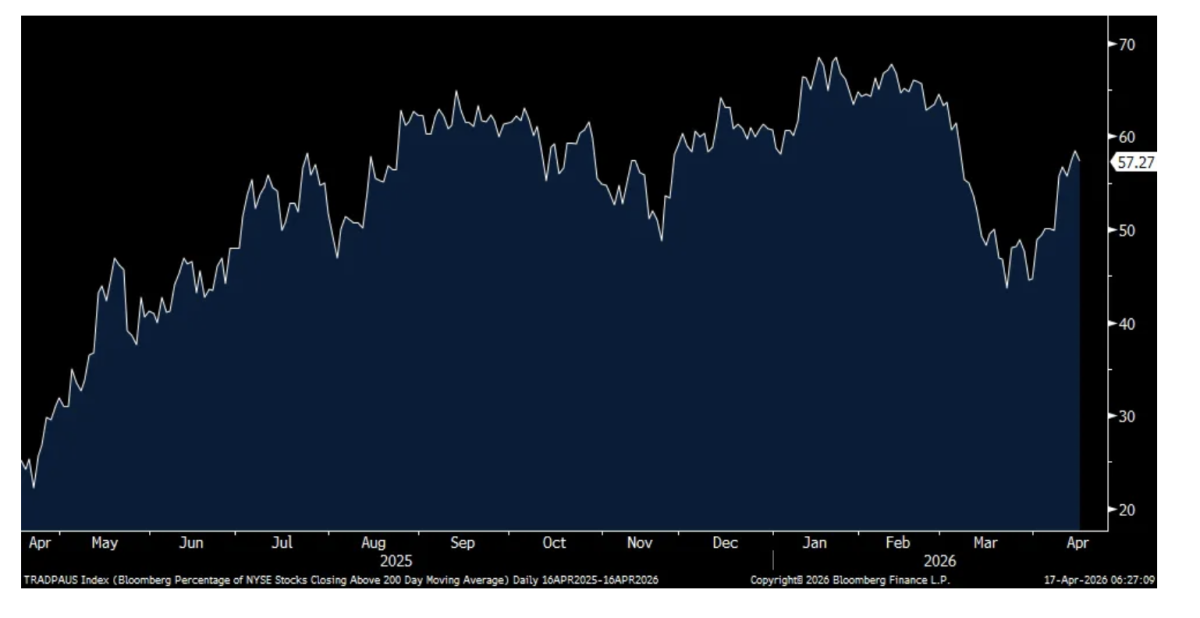
Bottom line, record highs certainly brought back the Bulls and they came stampeded in but there is nothing extreme here yet. The breadth though has been lacking. In January, 68% of NYSE stocks were trading above its 200 day moving average. Yesterday at index record highs that figure stood at 57%.
cnn.com/markets/fear-and-greed
% of NYSE Stocks trading above its 200 day MA
The indexes are of course acting as if the war never happened but it did and the construction of a data center includes the need for steel, aluminum (see what Alcoa had to say below), copper, cement, HVAC, transformers, electrical equipment, etc..., along with the needed permitting, workers, financing, and electricity. Similar to a story in Bloomberg a few weeks ago, FT has one today titled “Data center delays threaten to choke AI expansion.” The piece went on to say “Delays to a swath of new US data centers threaten to slow the rollout of AI by the world’s biggest tech companies, with almost 40% of all projects due this year at risk of falling behind schedule.”
Further, “Major projects for Microsoft, OpenAI and other tech groups are likely to miss completion dates by more than three months, according to data shared with the FT by SynMax, a satellite and AI analytics group. More than a dozen industry executives said campuses targeting hundreds of megawatts are being held up by permitting hurdles, and chronic shortages of labor, power and equipment.” Three months of course is not a big deal if it is just that. Source: ft.com/
Allbirds, this won’t be easy for you. I mean, NewBird AI.
Shifting for a second to private credit. Putting aside the questions over the quality of credits, redemptions and so forth, what we’re going to see regardless is a rise in the cost of capital for borrowers. Bloomberg News had a piece yesterday titled “Private Credit Funds Face More Pressure as Banks Swap Collateral.” In response to banks that are becoming more discerning on warehouse loans to private credit, in addition to scrutinizing every loan that is backing the collateral, “banks have been ratcheting up the interest rates they charge for back leverage. Some rates are now topping 3 percentage points over the Secured Overnight Financing Rate benchmark, representing an increase of 50 to 150 basis points, according to people with knowledge of the arrangements.”
This then crimps returns unless private credit then raises the lending rates to its borrowers, thus raising their cost of capital.
‘Back leverage’ by the way is when banks loan out money to private credit firms with the private credit loans being the collateral.
Before I start with a small snippet of note from the Pepsi call, a stock we own, along with other earnings calls, I want to mention what I believe to be the most hated part of the stock market (this is not investment advice...). That being consumer food and product companies.
We own Kraft Heinz and have been recently adding. Talk about hated. There are 23 analysts on Wall Street that follow it and just one has it as a buy. One. A new CEO, a commitment to investing in their products after 10 years of market share declines and with iconic brands like Heinz ketchup, Philadelphia cream cheese, and Kraft Mac & Cheese trading at about 10x EPS and EV/EBITDA of 9x with a dividend yield of 7% that they seem committed to.
Conagra, the largest frozen food company in the US at a time where consumers want value and convenience. They also have a great franchise with beef jerky, owning Slim Jim. Trading at a P/E ratio of 8 and EV/EBITDA also at 8 along with a 10% dividend yield that even if it gets cut in half (which I don’t think it will), it’s generous. They just announced a brand new CEO and two Directors bought stock yesterday. You want to hear how hated? Of the 18 analysts that follow it, one has it as a buy. One.
I know all about the challenges these businesses face in terms of intense competition, changing consumer eating habits, GLP-1 drugs, reduced pricing power as inflation costs have risen dramatically, etc... but these companies aren’t standing still and their stocks have been absolutely bludgeoned as has the entire sector and we own some others in the space like Kimberly Clark, Reynolds Consumer Products and International Flavors & Fragrances (more of a picks and shovels into the consumer food/product space)
Ok, that said, to a question of what Pepsi is seeing post war with supply chains:
“We’ve had no major issues from a supply chain standpoint. We’re seeing really nice continuity there. The teams are managing it well. I think in times like these, the scale of PepsiCo is really an advantage.”
Also, “We do have some systemic hedging programs in place that does give us some near term visibility here. We typically have about 6-12 month hedges in place. Now, our assumption is that inflation will come. The order of magnitude we’re still working through, and I think a lot of that is still to be determined.”
“From a visibility and guidance standpoint, our assumptions are that we can mitigate what comes our way this year, and that’s really reflected in our assumptions on guidance.”
Manpower also reported yesterday and this is what they said on the labor market:
“Within Talent Solutions, our RPO (recruitment process outsourcing) business continues to experience a sluggish permanent hiring environment, but we did see sequential revenue trend improvement.”
On the impact of AI on hiring, “I think it’s basically uncertainty related to the economic environment and outlook. Employers are getting buffeted by geopolitical events, tariffs, wars, that are ongoing or started and that clearly drives employer hesitation. So in our mind, the client hesitation is more related to those events than any particular concerns or possible impact of AI into their workforce.”
This was a positive sector wise that Manpower talked about, “you can see the manufacturing environment improving across both the US and Europe by looking at the PMI, and we’ve really seen that be a positive evolution over the last three months or so. So I think that gives you an idea that there are different sectors, of course, that are stronger than others, one sector that we feel very good about is the aerospace and defense where we have a very strong position in Europe, and we expect that this is going to grow in terms of the share of our business with the increased spending on defense.” On the flip side, “There are a number of industries that are struggling a bit, like automotive, logistics has been a bit weak in some of the markets across Europe. But more broadly speaking, the economy is resilient. The labor markets are resilient, and PMI from a manufacturing perspective is improving both in Europe and in the US.”
Knight Swift Transportation is further confirming the tightening trucking market:
“While the winter weather negatively impacted volumes and operating costs more than typical for a first quarter, it also exposed the reduction in truckload capacity to all stakeholders, which is very meaningful for ongoing bid activity. Similarly, the rapid increase in fuel costs was a headwind to earnings in March, but we believe this will add to the existing downward trend in supply in the truckload industry. The truckload market continues to tighten, and the bid environment is rapidly evolving.”
Alcoa is trading down pre market and said this:
Broadly with the effective Strait closure, “more than 2.5 million tons of annual smelting capacity and nearly 2 million tons of refining capacity are offline year-to-date. That’s a meaningful disruption to the global system. Alumina refineries in the region are integrated with aluminum smelters. However, approximately half the region’s bauxite requirements are imported from outside the Middle East. This structure leaves the regional aluminum system particularly exposed to shipping disruptions and logistical constraints. And it doesn’t stop at bauxite and alumina. Several smelters in the region also rely on imported anodes, calcined coke, and coal tar pitch. With transit through the Strait restricted, these materials are harder to move, raising costs and increasing uncertainty. Given the Middle East’s important role in global green petroleum coke exports, these disruptions are already rippling through the global calcined coke market.”
“The takeaway is clear. Structural dependencies in the Middle East mean that disruption there doesn’t stay local. It moves quickly through the aluminum value chain, tightening supply, increasing cost volatility and elevating risk well beyond the region itself.”
And with its aluminum business, “LME prices rose approximately 10% sequentially and have continued to increase...Announced curtailments have already tightened the 2026 balance and any further disruption in the Middle East has the potential to constrain supply even more. And that matters because the Middle East is the largest primary aluminum exporting region in the world. Disruptions to metal flows from the region are not only lifting LME prices, they’re also driving higher regional premiums across Europe, North America, and Asia. Higher oil prices and the resulting impact on raw materials are increasing production costs globally.”
“Underlying market conditions remain largely consistent with packaging and electrical markets leading demand growth while automotive and construction remain soft. Most importantly, our core regions, North America and Europe, remain in substantial deficit and are particularly exposed to potential supply disruptions due to their strong reliance on imports from the Middle East.”
Again, good luck Allbirds with their pivot to constructing data centers now. Sorry, NewBird AI.
None.
BY Doug Kass · Apr 17, 2026, 9:25 AM EDT
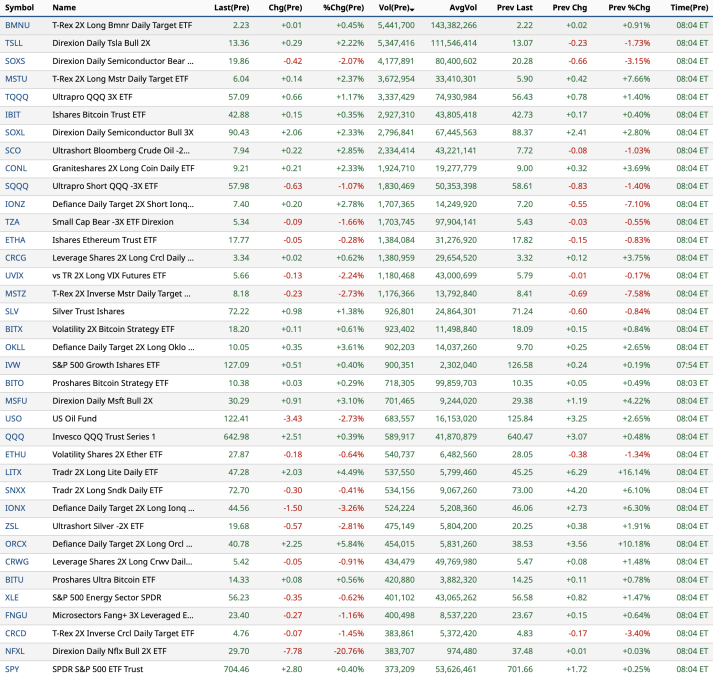
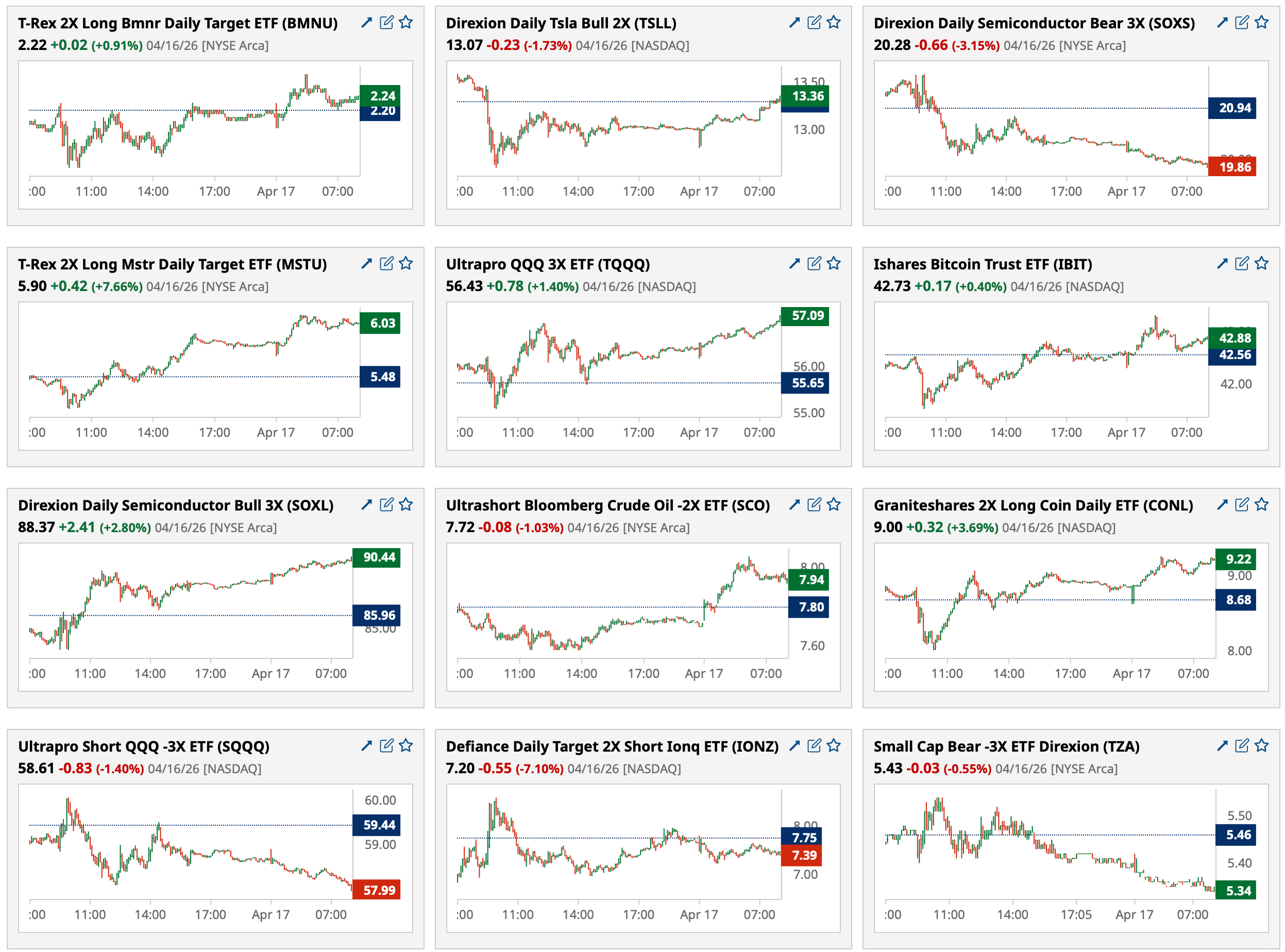
None.
BY Doug Kass · Apr 17, 2026, 9:15 AM EDT
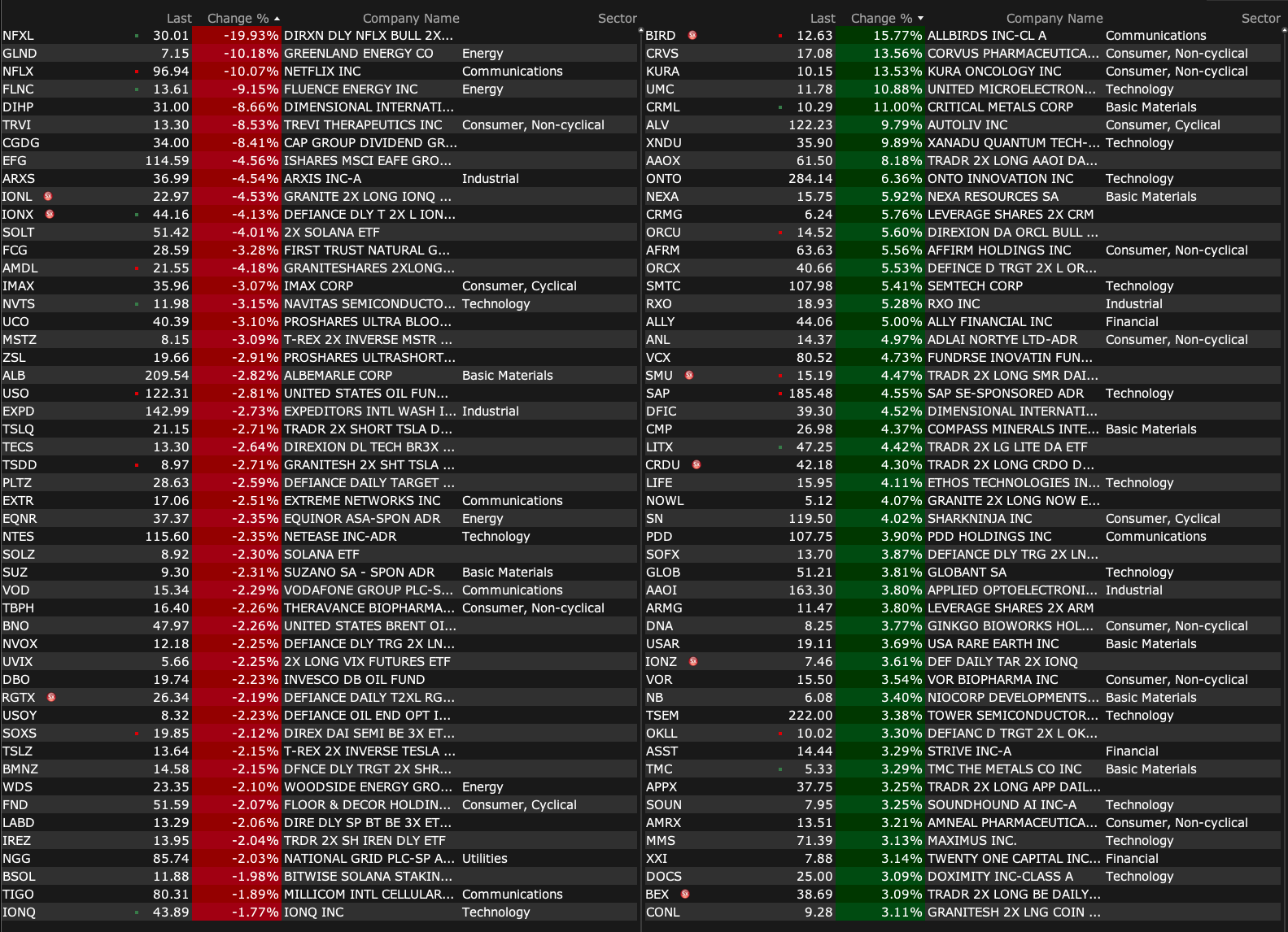
-RPAY +38% (receives $4.80/shr all-cash offer from Forager Capital Management)
-MYSE +23% (accepted into AMD AI Developer Program)
-CRVS +16% (Goldman Sachs Initiates CRVS with Buy, price target: $40)
-KURA +13% (reports Darlifarnib plus Cabozantinib Demonstrates Robust Activity in Patients with Clear Cell Renal Cell Carcinoma Previously Treated with Cabozantinib)
-ALV +10% (earnings, guidance)
-ONTO +6.0% (Stifel Nicolaus Raised ONTO to Buy from Hold, price target: $350)
-NI +4.1% (signed long-term energy agreement with an Alphabet subsidiary will support development and operation of a large-scale data center in northern Indiana)
-PDD +3.9% (China reportedly fines 7 e-commerce platforms including PDD for CNY 3.6B over food delivery scandal)
-ALLY +3.1% (earnings, guidance)
-ORCL +2.6% (strength in software names)
-NFLX -10% (earnings, guidance)
-FLNC -8.0% (UBS Cuts FLNC to Sell from Neutral, price target: $8)
-TRVI -6.5% (prices 11.6M shares at $13.00/share; gross proceeds $150M)
-IONQ -2.2% (profit taking)
BY Doug Kass · Apr 17, 2026, 9:05 AM EDT
None.
BY Doug Kass · Apr 17, 2026, 8:50 AM EDT
11:30 a.m.: Fed Bank of San Francisco Daly (Non-Voter) participates in a moderated discussion at the University of California-Berkely's Fisher Center for Real Estate & Urban Economics' Spring Policy Advisory Board Meeting (No prepared remarks. Audience Q&A expected. No group media interview. Livestream here);
12:15 p.m.: Fed Bank of Richmond President Barkin (Non-Voter) speaks before the 2026 CDI Citadel Directors Institute hosted by the Tommy and Victoria Baker School of Business at The Citadel, Charleston, SC (Audience Q&A expected. No media Q&A. No livestream);
2:00 p.m.: Fed Board Governor Waller (Voter) speaks on the economic outlook before the Auburn University Department of Economics David Kaserman Memorial Lecture event, Auburn AL (Text available. Q&A from moderator. Livestream available
None.
BY Doug Kass · Apr 17, 2026, 8:33 AM EDT
Meet The Cannabis Industry’s Trump Whisperer
Position: Long TCNNF (VS)
BY Doug Kass · Apr 17, 2026, 7:35 AM EDT
BY Doug Kass · Apr 17, 2026, 7:25 AM EDT
BY Doug Kass · Apr 17, 2026, 7:10 AM EDT
🇺🇸 S&P 500
— ISABELNET (@ISABELNET_SA)
It's a rare burst of momentum: the S&P 500 has gained more than 10% in just 11 sessions, something that's happened only 15 times this century. Moves like this remind us how unpredictable markets can be
👉 https://t.co/yIk7SZYp6p@DeutcheBank $spx #spx #stocks #equity pic.twitter.com/SUjcXI6Zji
BY Doug Kass · Apr 17, 2026, 7:00 AM EDT
Chart of the Day: S&P 500
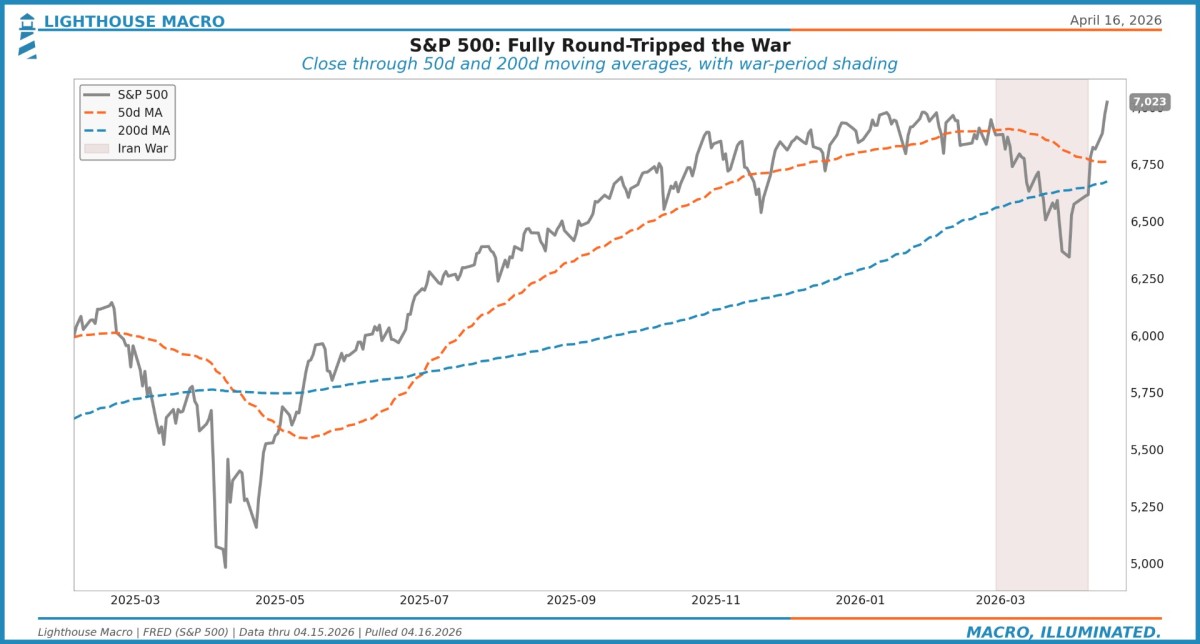
The S&P 500 is hitting record highs while the AAII bull-bear spread sits at -11.1%, with bears still outnumbering bulls for the ninth-consecutive week.
Surprisingly, this week is showing an even larger amount of bears compared to last week, even with record momentum from the indices.
Consumer sentiment is also at all-time lows, and these factors combined show that the "wall of worry" remains firmly intact as investors hesitate to fully embrace the rally.
The Takeaway: Despite the historic move off the lows, sentiment still remains far from euphoria.
- (3) Lighthouse Macro (@LHMacro) / X
$SPX: Rapid 10% rallies in 10 days historically show strong follow-through. Data indicates a +0.6% average move 1 week later, +2.5% at 1 month, and +17% after a year. Even in exceptions like 2000, the trend holds for the first 3 months before pathways diverge. $QQQ $NDX $SPY $VIX pic.twitter.com/2pOLhXBnbk
— SmartReversals📈 (@SmartReversals)
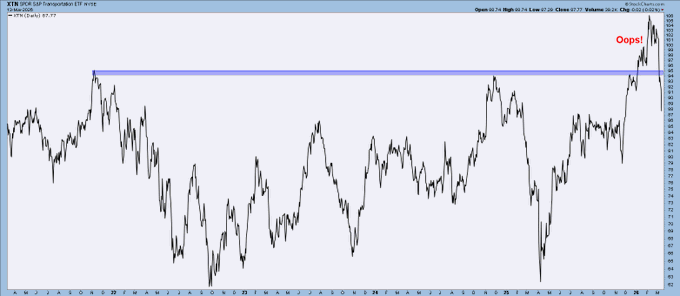
Transportation - $XTN
— Jim Knarr (@ChartMonitor)
Ripping to ATHs this month after a couple head fakes this year. In the end, it is the higher highs and higher lows which matter. https://t.co/rrNx6NVggc pic.twitter.com/KFZbTFBClE
2025 was driven by talk of rotation to international markets and away from US. This simple chart of SPY / VEU ratio shows a solid Fib support zone being tested twice and holding. Looks like we move higher and US outperformance resumes. pic.twitter.com/iG3qkyQmkE
— Todd Gordon (@ToddFGordon)
Gasoline daily I'd think this is the most imp of the 4 pic.twitter.com/uFsvuW36XK
— Arun S. Chopra CFA CMT🧐 (@FusionptCapital)
$OIH Daily. Compared to the other two oil stock ETFs, $XLE $XOP, the oil service/equipment names in the $OIH have barely budged during this pullback. Cup and "high handle" bullish setup pic.twitter.com/d3Xqf5ZBxn
— Chess (@chessNwine)
BY Doug Kass · Apr 17, 2026, 6:45 AM EDT
🇺🇸 Sentiment
— ISABELNET (@ISABELNET_SA)
With the Fear & Greed Index at 63, markets are tilting toward greed. Not extreme yet, but spirited enough to keep the rally going
👉 https://t.co/jJ1iAXzd0Y@CNNBusiness $spx pic.twitter.com/iW3QLeNgR7
BY Doug Kass · Apr 17, 2026, 6:35 AM EDT
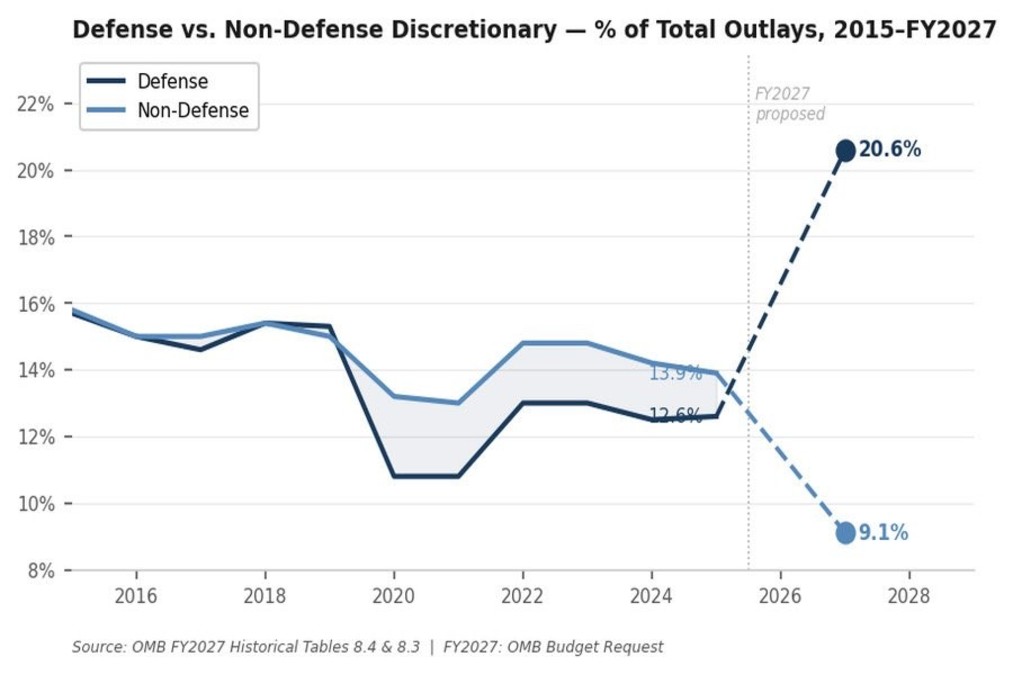
For the first time in history the U.S. government will spend more (of the share of the annual budget) on defense than on domestic programs:
BY Doug Kass · Apr 17, 2026, 6:25 AM EDT
"Group Stink" has a foul odor on Fin TV... and cheerleading has a place on the floors of athletic events and not in the business media.
— Dougie Kass (@DougKass)
After the close $NFLX reduced guidance and the shares fell by about nine percent (-$10).
In the last two months (mid-February to mid-April…
BY Doug Kass · Apr 17, 2026, 6:15 AM EDT
The S&P Short Range Oscillator remains in a deep overbought at 6.68% vs. 7.37%.
Position: Short SPY common (S), QQQ common (S)
BY Doug Kass · Apr 17, 2026, 6:05 AM EDT
Former Treasury Secretary Hank Paulson called on US authorities to prepare a back-up plan to avert a potential collapse in demand for Treasuries.
— Bloomberg TV (@BloombergTV)
Tune into Wall Street Week Fridays at 6pm ET https://t.co/7eVkiT8zVb pic.twitter.com/GsNsiyxTi4
BY Doug Kass · Apr 17, 2026, 5:55 AM EDT
Wolf Street howls about housing prices.
BY Doug Kass · Apr 17, 2026, 5:42 AM EDT
🇺🇸 S&P 500 It's a rare burst of momentum: the S&P 500 has gained more than 10% in just 11 sessions, something that's happened only 15 times this century. Moves like this remind us how unpredictable markets can be 👉 isabelnet.com/?s=S%26P+500 @DeutcheBank $spx #spx #stocks #equity

🇺🇸 Sentiment With the Fear & Greed Index at 63, markets are tilting toward greed. Not extreme yet, but spirited enough to keep the rally going 👉 isabelnet.com/?s=sentiment @CNNBusiness $spx

Gasoline daily I'd think this is the most imp of the 4

2025 was driven by talk of rotation to international markets and away from US. This simple chart of SPY / VEU ratio shows a solid Fib support zone being tested twice and holding. Looks like we move higher and US outperformance resumes.

Former Treasury Secretary Hank Paulson called on US authorities to prepare a back-up plan to avert a potential collapse in demand for Treasuries. Tune into Wall Street Week Fridays at 6pm ET bloom.bg/3EMZYZX
Transportation - $XTN Ripping to ATHs this month after a couple head fakes this year. In the end, it is the higher highs and higher lows which matter.


Transportation - $XTN This one goes into the bearish side of the ledger.