Daily Diary

Doug KassDoug Kass
DATE:

Happy Passover

I am leaving early for the Jewish Holiday.

To those that celebrate...Chag Sameach!

May the joy of Passover fill your heart, the warmth of family surround you and the blessings of tradition enrich your life.

BY Doug Kass · Apr 1, 2026, 3:25 PM EDT

Trade of the Week Update

On Monday I made Meta  (META)  my Trade of the Week at $525.

Now trading at $591, the shares are +$19 on the day and +$66 over the last 48 hours!

I would take this week's sharp rise and sell the shares.

From Monday:

Trade of the Week - Buy META ($525.72)

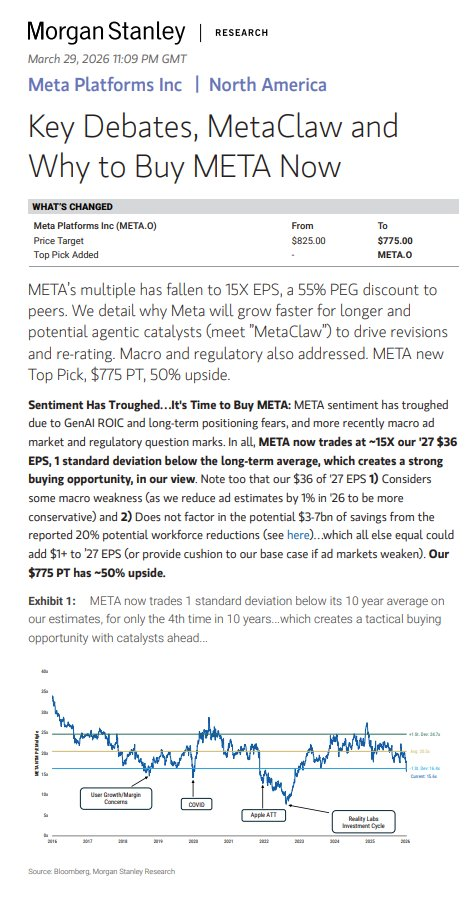
*For only the fourth time in the last decade, META's valuation is one standard deviation below its average P/E ratio....

I am generally in agreement with Morgan Stanley's buy recommendation on (META) (over the weekend):

Long META S/M

BY Doug Kass  Mar 30, 2026, 8:35 AM EDT

Position: Long META (VS)

BY Doug Kass · Apr 1, 2026, 1:40 PM EDT

Boockvar on March ISM and More

From Peter Boockvar:

US manufacturing, supply constraints and higher prices start to show up

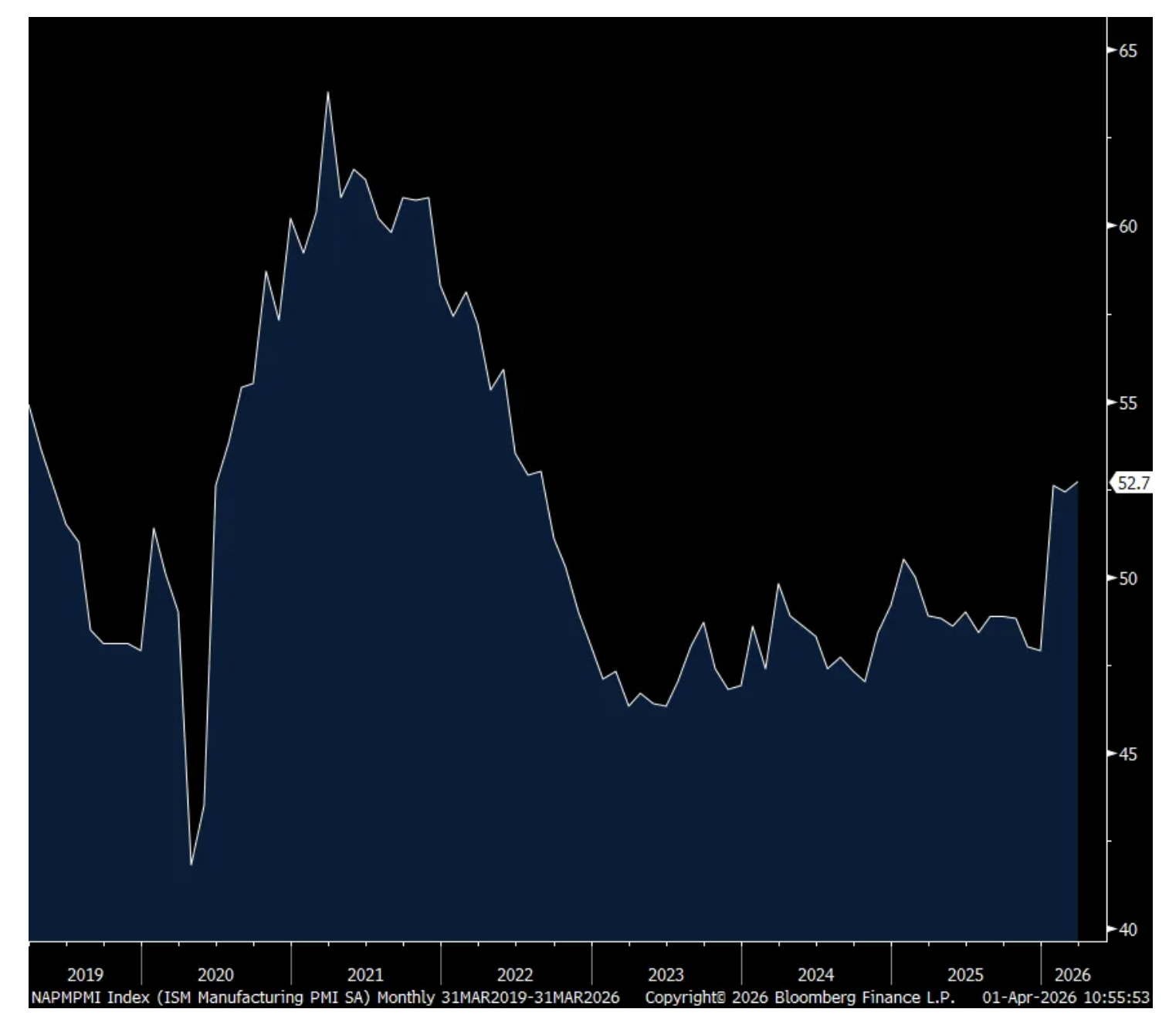
The March ISM manufacturing index ticked up by .3 pts to 52.7 m/o/m and that was better than the expected slight dip to 52.3. The internals were a bit mixed though as new orders fell to 3 month low and backlogs gave back some of the February gain. Inventories remained negative at 47.1, down 1.7 pts while only at 40.1 at the customer level. With new orders specifically, ISM said ”Demand sentiment was mixed, with a 1-to-1 ratio of positive to negative comments in March, a marked decrease from last month where there were two positive comments for every negative one.”

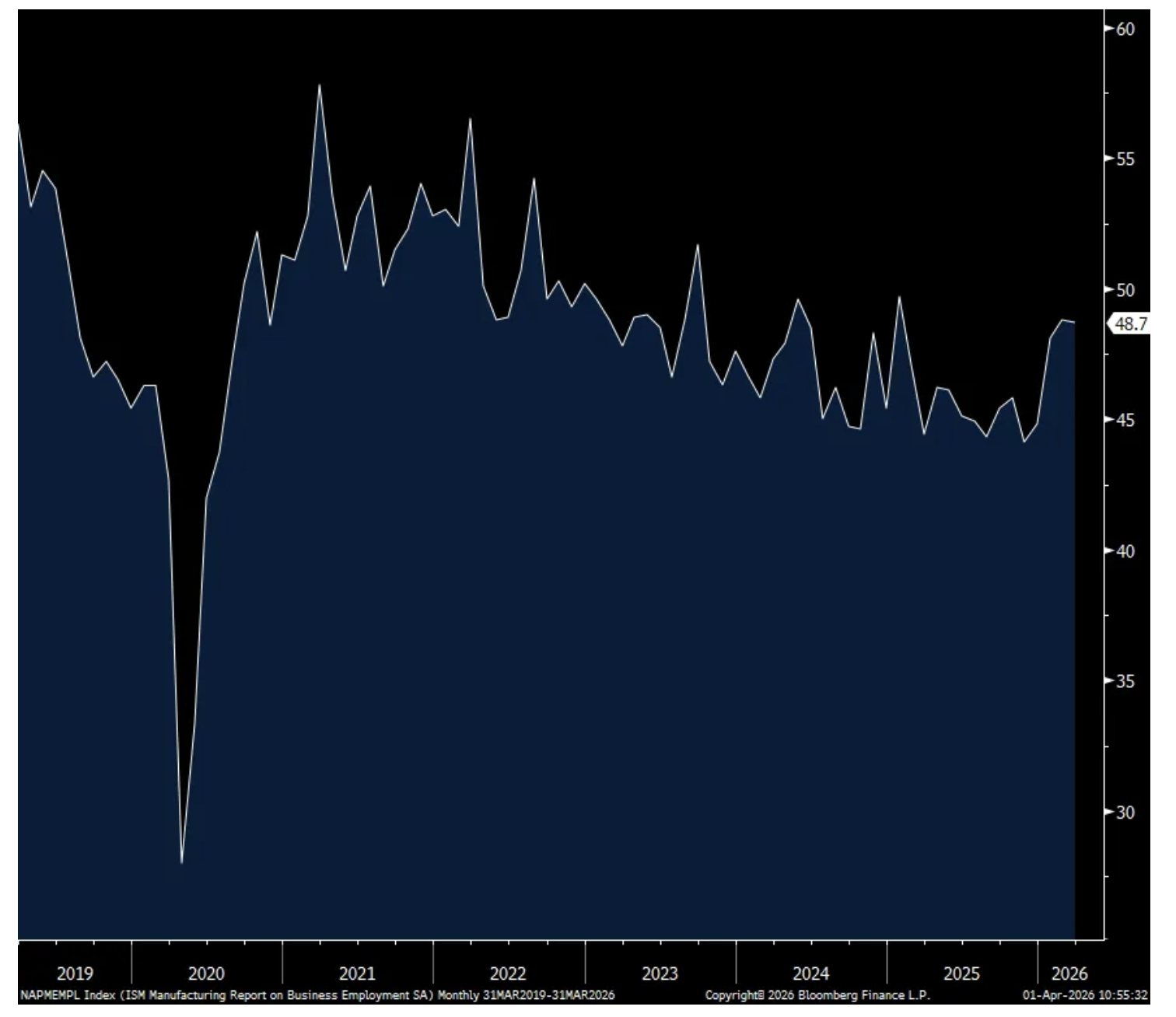
Employment remained below 50 at 48.7 and the last time it was above 50 was in September 2023.

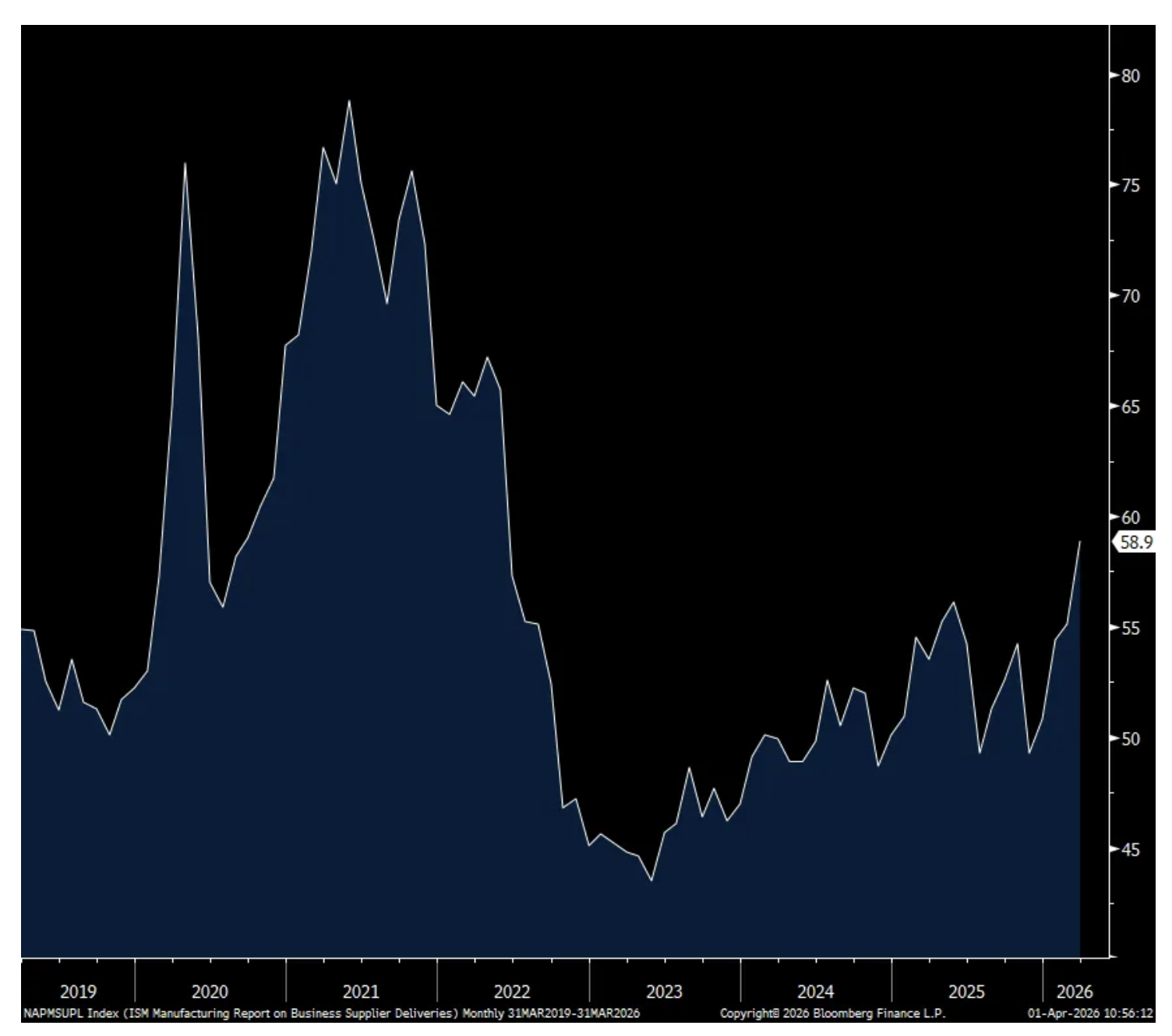
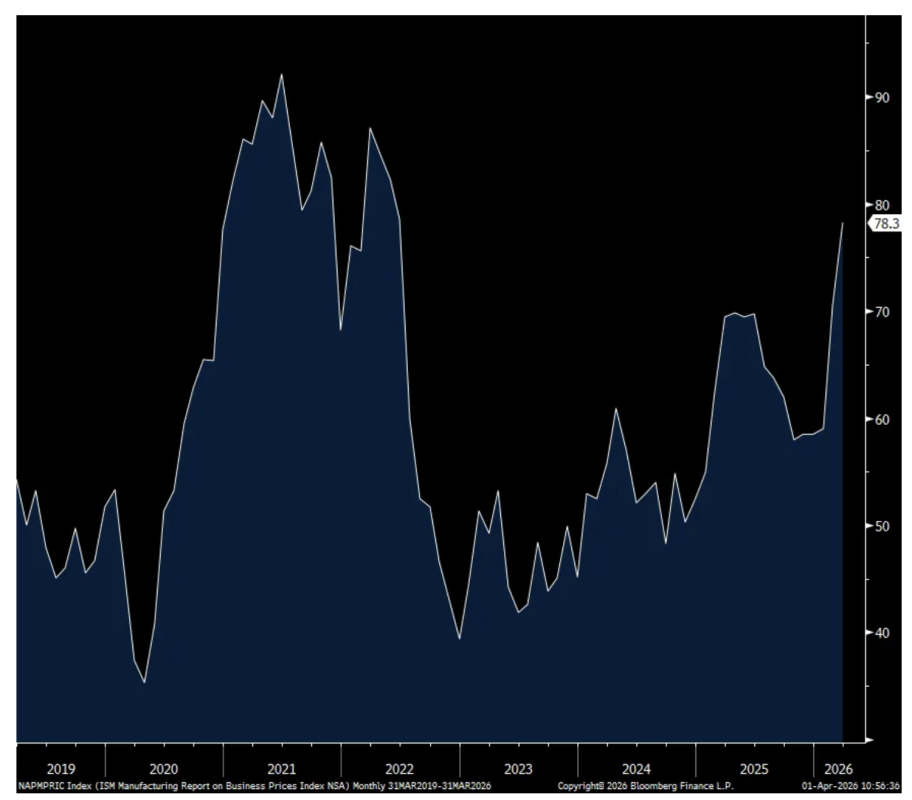
Evidence of the war impact was seen in the jump in supplier deliveries (reflecting strained supply chains) which rose to 58.9, up 3.8 pts to the highest since the supply strains in 2022. Also, prices paid jumped almost 8 pts to 78.3, also the highest since 2022. Of the 18 industries asked, 17 are now paying higher prices vs 14 in February and 11 in January. ISM said “The Prices Index reading continues to be driven by (1) increases in steel and aluminum prices that impact the entire value chain, (2) tariffs applied to many imported goods and now (3) increases in petroleum-based products as a result of the recent Middle East conflict.”

Export orders were about 50 at 49.9 after getting back above it in the two prior months.

With respect to industry breadth, 13 industries saw growth vs 12 in the month before.

ISM said generally on the state of their survey, “This month also marks the first report with panelists citing the Iran war as a new impact to their business, along with ongoing uncertainty with U.S. economic policy, despite the recent Supreme Court ruling striking down International Emergency Economic Powers Act (IEEPA) tariffs. In March, 64 percent of comments overall were negative. Among the negative comments, about 20 percent cited tariffs and about 40 percent the war in the Middle East. (Some panelists referenced both topics within a single comment or in mixed sentiment.)”

Bottom line, just as there were signs of a bottoming in manufacturing, another global supply disruption hits the industry where soon volume and supply constraints become more relevant than price.

Here is some of what respondents are saying with war talk now filtering in to the conversation:

“This is expected to be a transition year for the U.S. trucking market, with gradual stabilization driven by capacity tightening and replacement demand instead of growth. Demand should stay constrained by weak carrier profitability and high equipment costs but improve modestly late in the year.” [Transportation Equipment]

“Changes in the tariff structure are bringing cautious opportunities to offset significant costs for the balance of 2026. The actions in Iran, however, add a new wrinkle to energy costs throughout the world, including India. We continue to try and plan for the unpredictable and unexpected.” [Transportation Equipment]

“We’re seeing steady increases in activity, but geopolitical issues and the Iran war are already waning sentiment.” [Fabricated Metal Products]

“Customer orders have increased considerably as the construction market remains strong, resulting in higher production volume and increased forecasts to suppliers.” [Machinery]

“Current Middle East unrest is already starting to impact business operations by increasing lead times, costs, container delays and the like.” [Food, Beverage & Tobacco Products]

“Lots of relief from Supreme Court striking down (emergency) tariffs, particularly with organic cane sugar from Brazil.” [Food, Beverage & Tobacco Products]

“Geopolitical tensions related to the conflict in Iran are contributing to rising manufacturing supply costs, and ongoing tariff uncertainty is negatively impacting purchasing strategies and cost forecasts.” [Chemical Products]

“Ongoing geopolitical instability has emerged as a persistent factor influencing global trade dynamics. We anticipate strategic realignment of supply chains as organizations respond to energy market volatility and shifting trade policies. In light of these macroeconomic headwinds, we — like most organizations — are maintaining a cautious posture regarding investment commitments while continuing to monitor market conditions closely. Our purchasing strategy is being recalibrated to address supply chain vulnerabilities exposed by energy market volatility and evolving trade protectionism.” [Chemical Products]

“Metal commodity prices continue to put pressure on mechanical commodities. Memory price escalation is causing large cost increases that cannot be mitigated in other areas of the product cost.” [Computer & Electronic Products]

“The Middle East war has created domestic and global turmoil for the olefins and polyolefins business. Feedstocks and finished product pricing are accelerating dramatically as Middle Eastern and Asian producers suffer from shipping blockages. Global customers for packaging resins are scrambling to cover needs from North America and South America in the face of supply chain complications.” [Plastics & Rubber Products]

ISM

Employment

Supplier Deliveries

Prices Paid

BY Doug Kass · Apr 1, 2026, 12:30 PM EDT

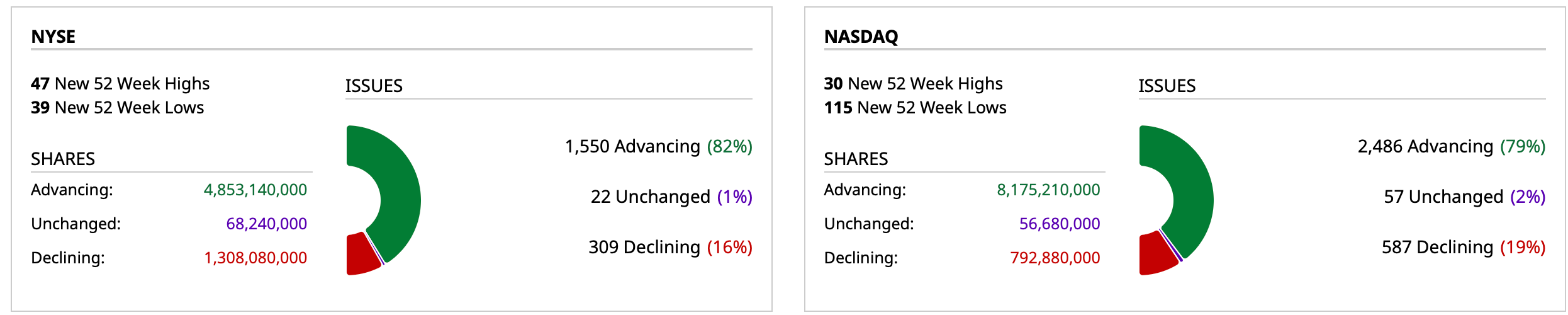
Late A.M. Market Stats and Charts

- NYSE volume 12% above its one-month average;

- Nasdaq volume 15% above its one-month average;

- VIX index: down 5.62% to 23.83

None.

BY Doug Kass · Apr 1, 2026, 11:35 AM EDT

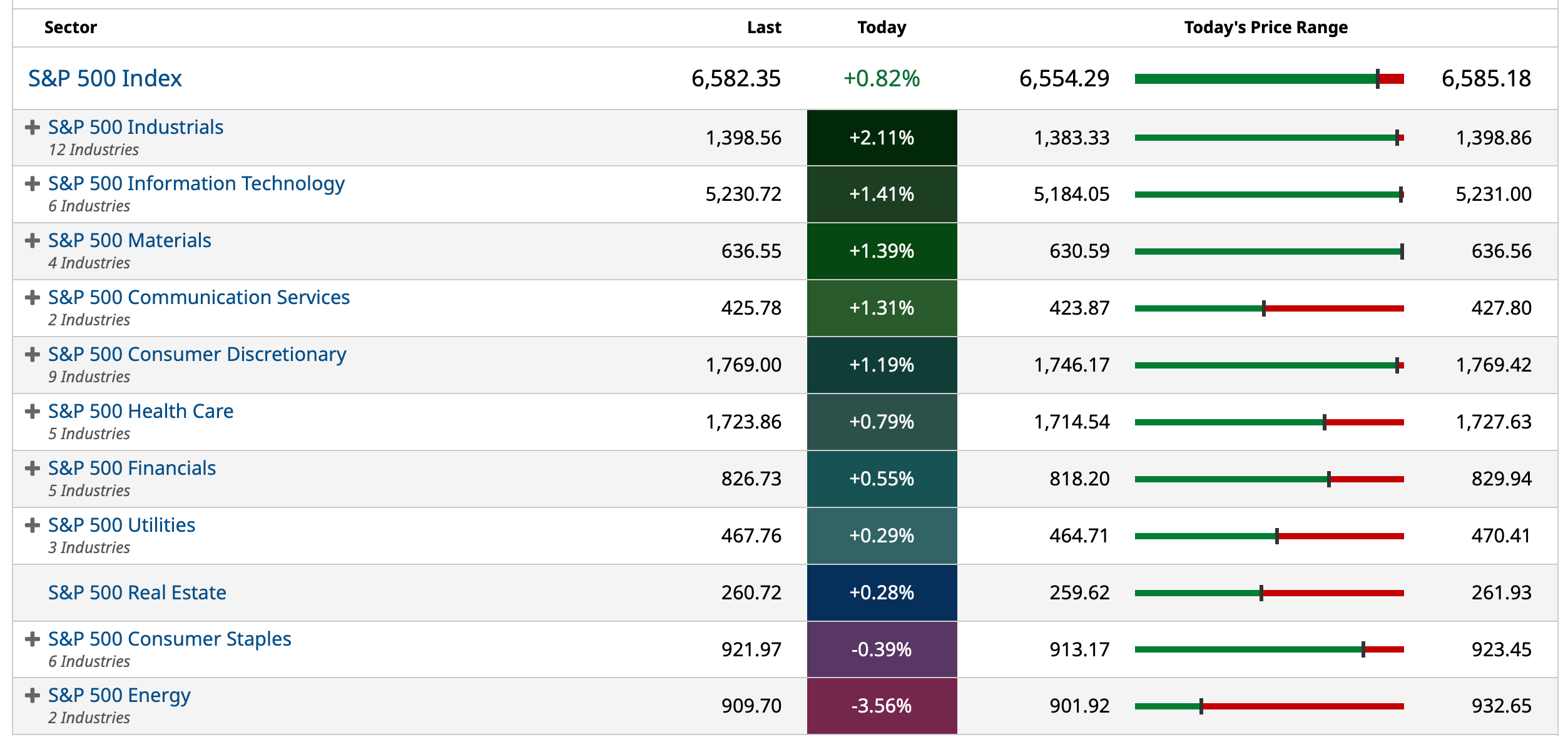
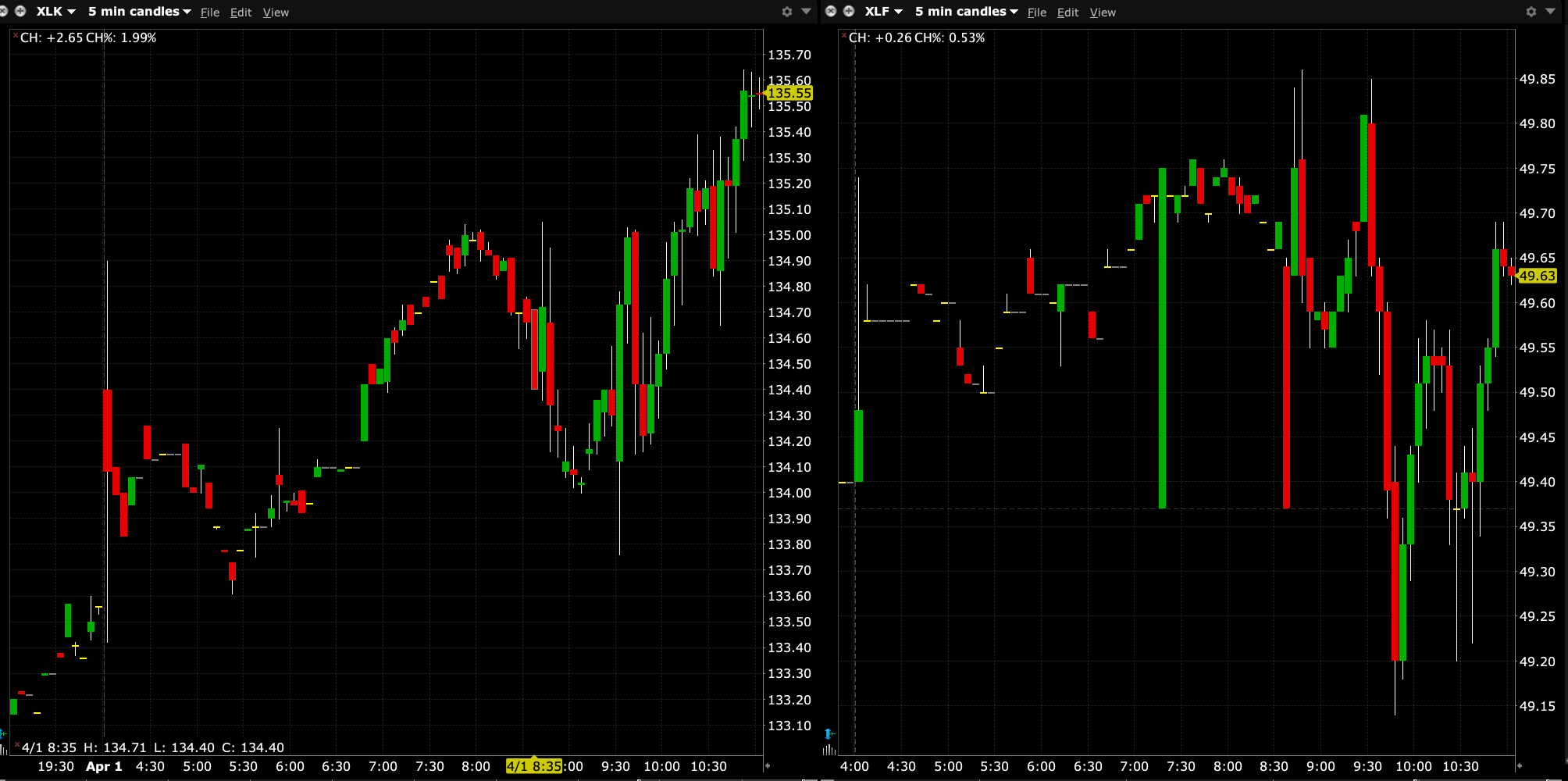
Tech (XLK) Vs. Financials (XLF)

Chart from 11 a.m. ET

None.

BY Doug Kass · Apr 1, 2026, 11:10 AM EDT

From the Street of Dreams

American Express  (AXP)  added to Q2 Tactical Ideas List at Wells Fargo Wells Fargo added American Express to the firm's Q2 Tactical Ideas List. The firm sees a Q1 revenue/EPS beat, as the U.S. Platinum refresh drives incremental card spend and new accounts. Wells believes strong affluent spend will enable AI job loss fears to fade. Stock trades at 15 times price-to-earnings on 2027 EPS, which the firm finds attractive for a mid-teens EPS grower. Wells has an Overweight rating on the shares with a price target of $425.

Morgan Stanley  (MS)  price target lowered to $153 from $175 at HSBC HSBC lowered the firm's price target on Morgan Stanley to $153 from $175 and keeps a Hold rating on the shares. The firm says markets have "quickly repriced" higher downside macro risk and renewed credit concerns into the U.S. bank stocks. The multi-year return on equity expansion is now "less clearly priced in" for the universal banks, creating opportunities, the analyst tells investors in a research note. As a result, HSBC upgraded both Bank of America and Wells Fargo to Buy.

Citi  (C)  price target lowered to $130 from $139 at HSBC HSBC analyst Saul Martinez lowered the firm's price target on Citi to $130 from $139 and keeps a Buy rating on the shares. The firm says markets have "quickly repriced" higher downside macro risk and renewed credit concerns into the U.S. bank stocks. The multi-year return on equity expansion is now "less clearly priced in" for the universal banks, creating opportunities, the analyst tells investors in a research note. As a result, HSBC upgraded both Bank of America and Wells Fargo to Buy. 

JPMorgan  (JPM)  price target lowered to $288 from $319 at HSBC HSBC lowered the firm's price target on JPMorgan to $288 from $319 and keeps a Hold rating on the shares. The firm says markets have "quickly repriced" higher downside macro risk and renewed credit concerns into the U.S. bank stocks. The multi-year return on equity expansion is now "less clearly priced in" for the universal banks, creating opportunities, the analyst tells investors in a research note. As a result, HSBC upgraded both Bank of America and Wells Fargo to Buy.


Long AXP VS MS VS C VS BAC VS WFC VS

BY Doug Kass · Apr 1, 2026, 10:36 AM EDT

God Only Knows

* Or maybe the Sphinx can solve the market riddle...

* If you put a gun to my head I would say we are in a broadening trading range with a negative bias over the intermediate term (measured in months)...

"What walks on four legs in the morning, two legs at noon and three legs in the evening?"

- Greek Mythology

I may not always love you
But long as there are stars above you
You never need to doubt it
I'll make you so sure about it

God only knows what I'd be without you

If you should ever leave me
Well, life would still go on, believe me
The world could show nothing to me
So what good would living do me?

God only knows what I'd be without you

- The Beach Boys, God Only Knows 

I have made the case over the last two weeks that equities (especially of a Mag 7-kind) are oversold and buyable — as they arguably represent a more favorable reward vs risk at any time in a while.

The Riddle of the Sphinx, among the most famous riddles in Greek mythology, symbolizes the stages of human life and encapsulates profound themes of humans:

* Crawling on all fours as a baby (morning)

* Walking on two legs as an adult (noon)

* Using a cane in old age (evening)

The Sphinx posed this riddle to travelers and those who could not answer were said to be devoured.

While there are many pretenders who confidently predict the stock market's future, I am often wrong and always in doubt.

Truthfully, it is likely that the Sphinx and God only know if Tuesday's rally foreshadows continued strength.

My greatest concerns are that the war in Iran (which eventually will be "resolved") will have knock-on consequences to economic growth (weaker), inflation (stronger and more persistent), tighter-than-expected (Fed) monetary policy (so interest rates will be "higher for longer") and produce something of a supply shock (for a vast array of critical materials and products).

The bottom and the middle of the K-shaped U.S. economy are bound to be even more pressured in the months ahead as general affordability is materially threatened by a weakening jobs market and stubbornly higher costs (and inflation).

Importantly, corporate profit growth expectations (of about +15% year over year) will have to be ratcheted down despite protestations from the cabal of (ostrich-like) perma-bulls:

With interest rates staying above consensus expectations and S&P profits below elevated consensus forecasts — the equity risk discount will grow ever larger — providing a backdrop for future greater-than-expected valuation contraction.

I also remain concerned about U.S. foreign policy and what it means for our alliances (trade and political).

These above factors are not valuation friendly and, at the very least will likely constrain the enthusiasm and upside that was demonstrated Tuesday.

My Strategy

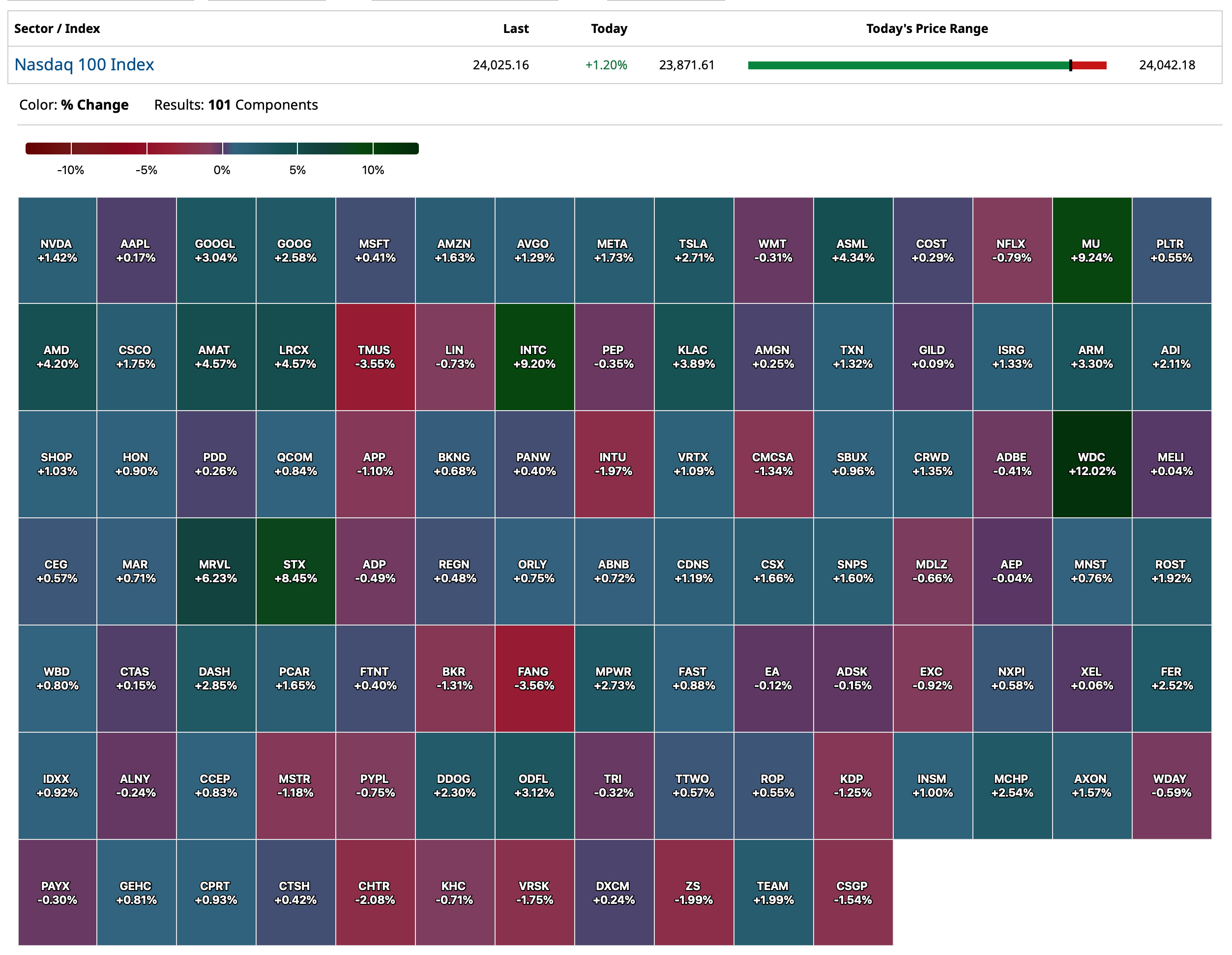
I remain modestly net long in exposure but I start Wednesday much less long than I started Tuesday — given the rapidly changing reward vs. risk prospects, which are an outgrowth of a +3% advance.

That reduced reward/risk ratio is clear to me given the outsized gain in tech stocks over the last 24 hours.

Bottom Line

"God Only Knows" is among the finest ever sung by The Beach Boys and has been praised critically as among the greatest songs of all time. From their innovative 1966 album Pet Sounds, it was written by Brian Wilson. It is a baroque-style love song featuring harmonic innovation and complexity, unique instrumentation which upended typical popular music conventions both musically and lyrically.

While I may assign my own probabilities to market scenarios (based on dutiful analysis), given all the possible economic and geopolitical outcomes, many of them negative — the Sphinx and God may only know what lies ahead for the markets.

And, to be sure, I am not and will not pretend to be God.

My investment strategy will be stay vigilant and to be flexible and opportunistic.

If you put a gun to my head I would say we are in a broadening trading range with a negative bias over the intermediate term (measured in months).

I continue to see 2026 as a negative year for the broad averages— with most rally attempts failing or being constrained by persistent inflation, moderating corporate profit expectations, relatively tight Fed policy (and higher than longer interest rates), inconsistent and poorly framed U.S. leadership/policy and declining valuations.

BY Doug Kass · Apr 1, 2026, 9:30 AM EDT

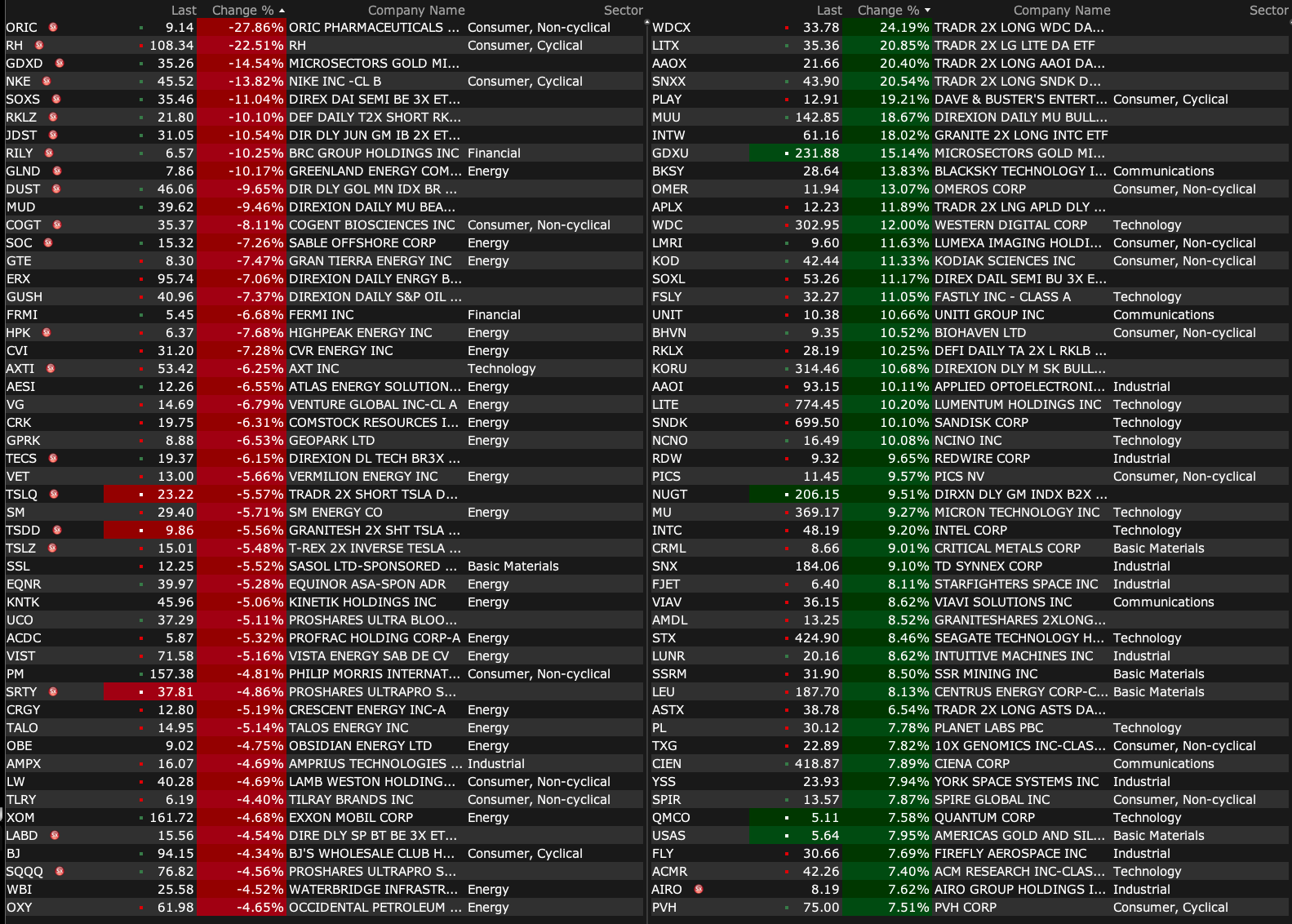
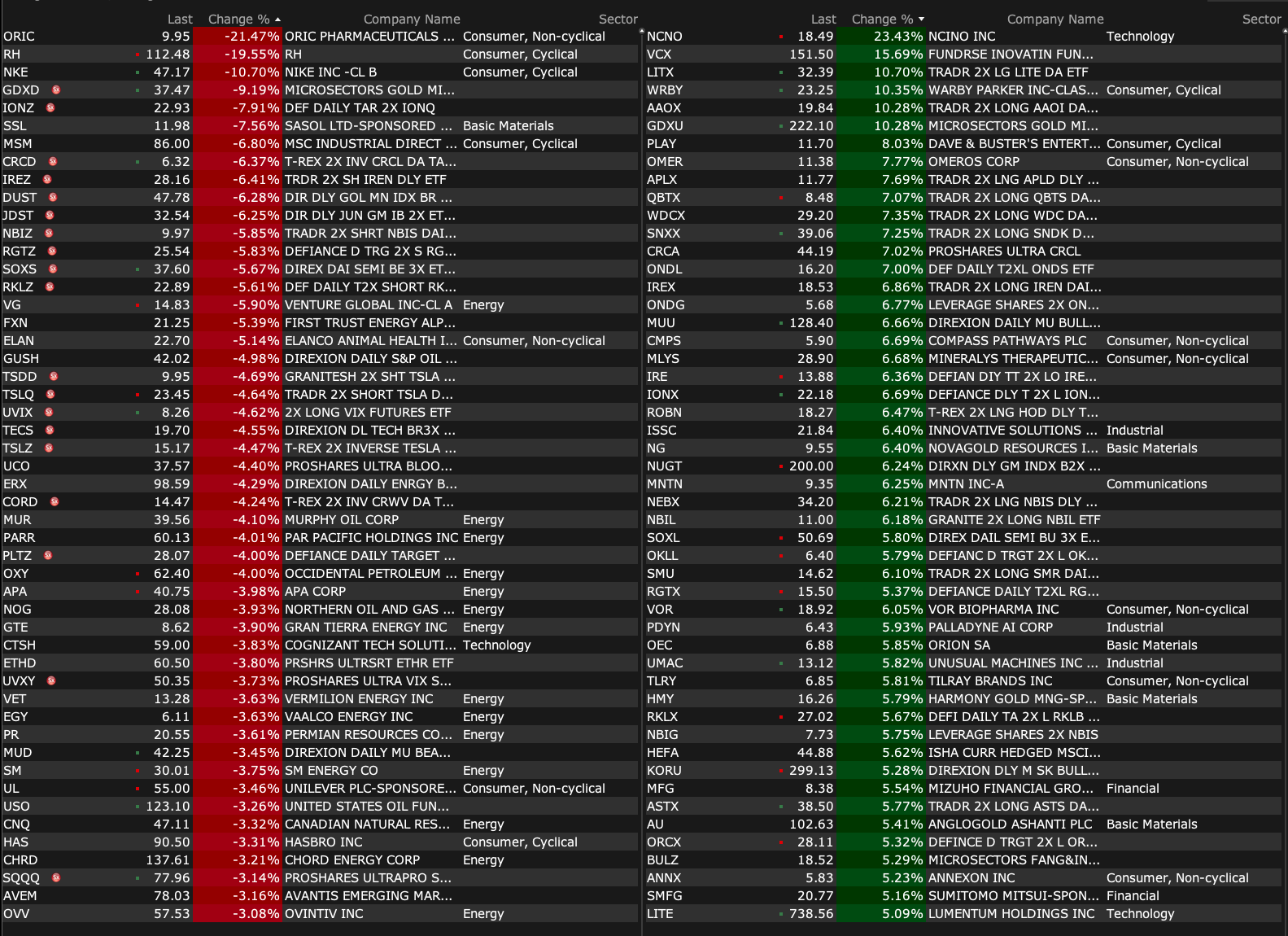
Upside, Downside Movers in the Morning

Upside:

-TH +33% (secures hyperscaler data center contract)

-SHAZ +27% (signs $1.25B AI infrastructure agreement with ESDS Software Solutions)

-NCNO +23% (earnings, guidance)

-ADGM +7.8% (Ultralow Temperature Ablation U.S. Pivotal Study Results to be presented in Late-Breaking Session at Heart Rhythm Society 2026)

-TLRY +5.9% (earnings, guidance)

-NUVB +5.1% (acquires Japan rights to Safusidenib from Daiichi Sankyo)

-CALM +4.4% (earnings, color)

-LI +3.9% (reports March deliveries)

-NIO +3.5% (reports March deliveries)

-NEM +3.0% (gold strength)

-ORCL +2.5% (commences lay off of thousands to support AI buildout)

-RIVN +2.5% (DA Davidson Raised RIVN to Neutral from Underperform, price target: $14)

Downside:

-RH -20% (earnings, guidance)

-ORIC -18% (reports early-stage trial data for prostate cancer therapy)

-NKE -11% (earnings, guidance)

-BYND -7.1% (earnings, guidance)

-HAS -2.5% (cybersecurity incident disrupts operations)

BY Doug Kass · Apr 1, 2026, 9:15 AM EDT

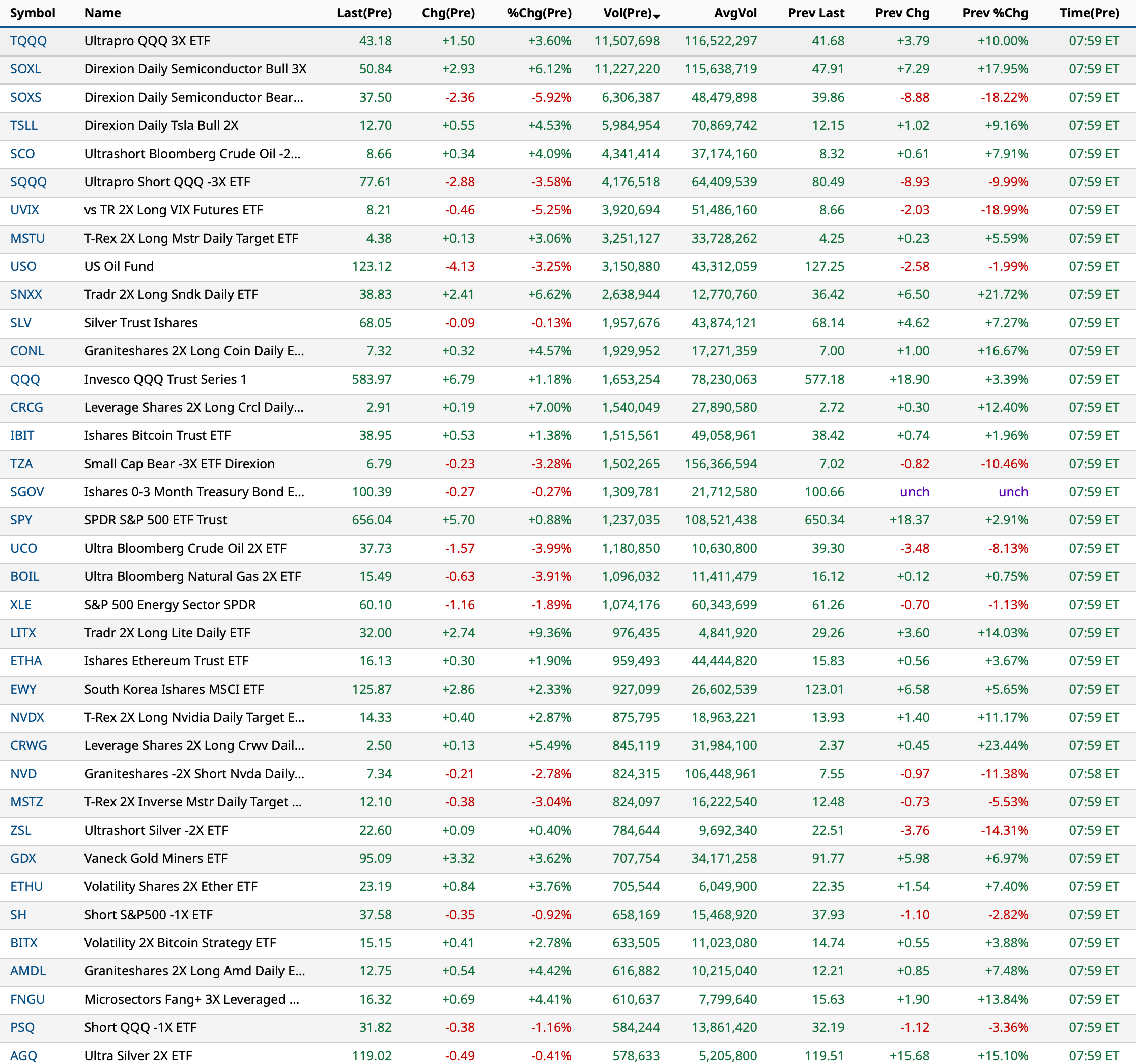
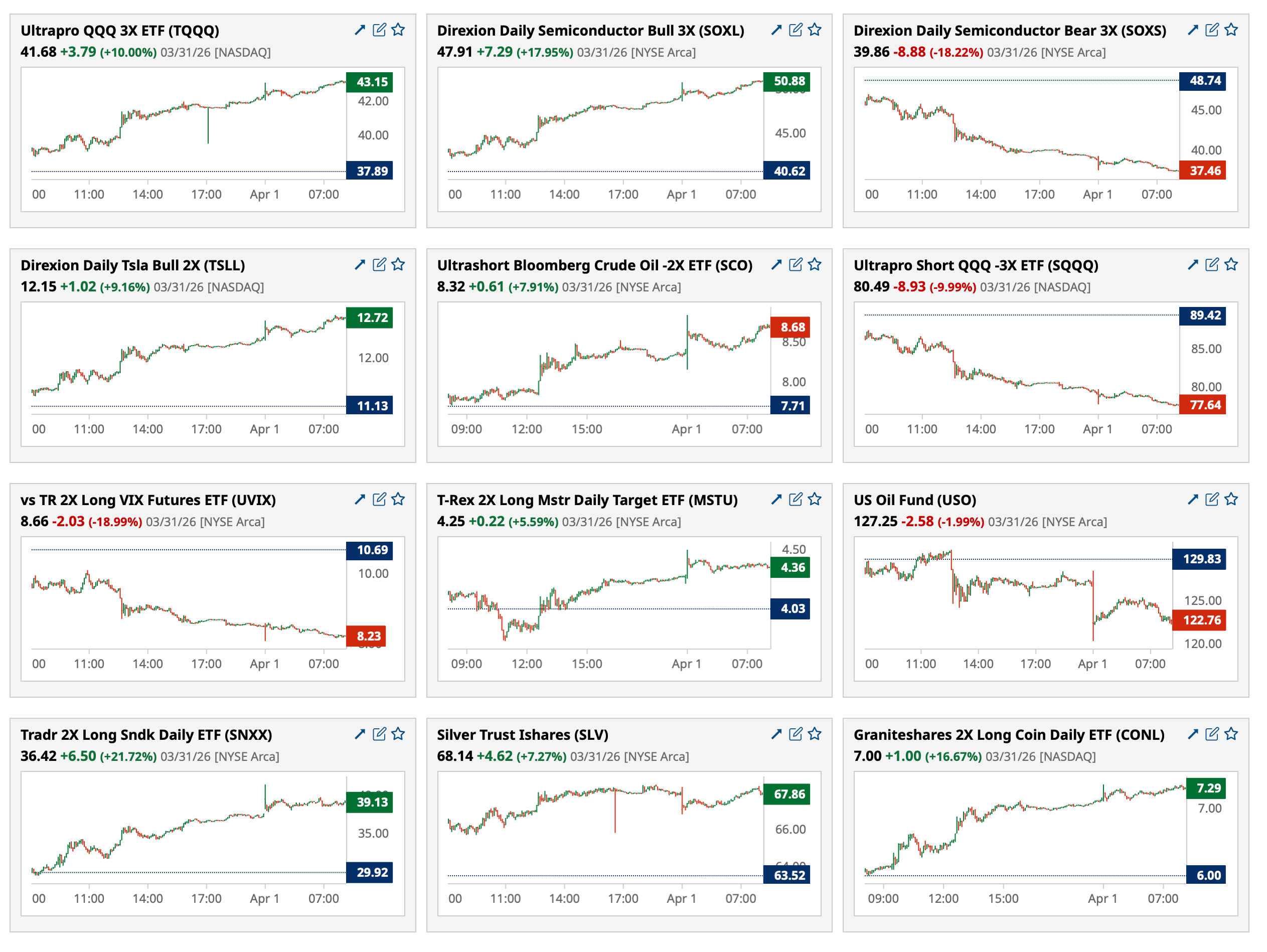
ETF Action in the A.M.

BY Doug Kass · Apr 1, 2026, 9:05 AM EDT

Charting the Morning Percent Movers

BY Doug Kass · Apr 1, 2026, 8:55 AM EDT

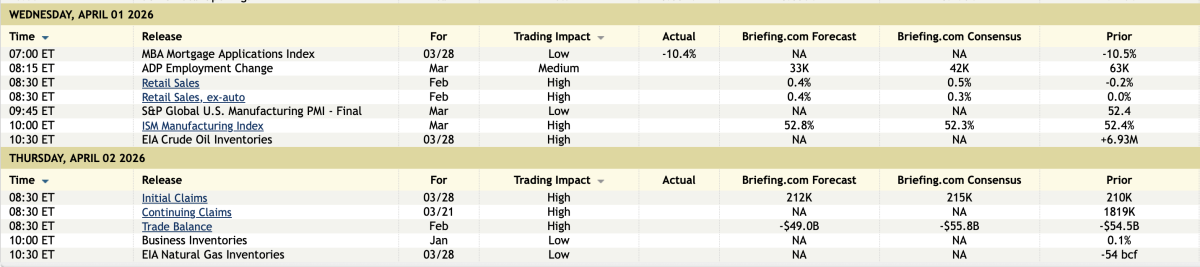
Fed Speakers, Treasury Auctions, Economic Calendar

Fed Speakers

9:05 a.m.: Fed Bank of St. Louis President Musalem (Non-Voter) speaks and participates in moderated conversation on the U.S. economy and monetary policy before the American Enterprise Institute, Washington, DC (Text anticipated. Media availability follows);

9:10 a.m.: Fed Governor Barr (Voter) speaks on "AI and Consumer Issues" at the National Fair Housing Alliance 2026 Responsible AI Symposium, Washington, DC (No text. Q&A from moderator. Livestreamed at here).

Treasury Auctions

11:30 a.m.: Treasuryhosts a $69B 17-Week Bill Auction;

2:00 p.m.: Treasury buyback (cash mgmt) Auto sales

Economic Calendar

None.

BY Doug Kass · Apr 1, 2026, 8:45 AM EDT

Boockvar on the War Trade, Dave & Buster's, Manufacturing PMIs

From Peter Boockvar:

"Out of clutter, find simplicity; from discord, find harmony; in the middle of difficulty lies opportunity"

The war trade is of course reversing again with stocks, bonds, commodities, the US dollar and gold. The CNN Fear/Greed index has risen to 14 from the 10 level I mentioned last week that was a great set up for the rally that only needed a nudge from any indication of an end to the war. I do want to reiterate my belief that even with a cessation in the war and the immediate drop in commodity prices, particularly crude and crops, that would follow, we’re in a commodity bull market and prices are not going back to where they were pre-war and we are positioned as such. With respect to the S&P 500, 6638 is the 200 day moving average and a spot we can trade to on this bounce which will then get tested again, particularly because of the faltering GenAI tech trade, especially with the hyperscalers because of their shrinking free cash flows which I’ve talked about.

The war trade is of course reversing again with stocks, bonds, commodities, the US dollar and gold. The CNN Fear/Greed index has risen to 14 from the 10 level I mentioned last week that was a great set up for the rally that only needed a nudge from any indication of an end to the war. I do want to reiterate my belief that even with a cessation in the war and the immediate drop in commodity prices, particularly crude and crops, that would follow, we’re in a commodity bull market and prices are not going back to where they were pre-war and we are positioned as such. With respect to the S&P 500, 6638 is the 200 day moving average and a spot we can trade to on this bounce which will then get tested again, particularly because of the faltering GenAI tech trade, especially with the hyperscalers because of their shrinking free cash flows which I’ve talked about.

I’ll go right to Nike, a stock we’ve recently bought, and what they said on their call of note that has the stock down 10% pre market:

The main angst is the revenue guide of down 2-4% rather than the expected increase of about 2% for the fresh quarter we’re now in “with modest growth in North America despite lapping of value liquidation in the prior year, largely offset by declines in Greater China and Converse.”

“Order books are growing and we are taking back shelf space. However, sell-through trends are not yet where we want them to be. Despite making progress versus a year ago, digital is still too promotional. Markdowns across the marketplace remain elevated. Our teams are pulling levers to manage inventory and protect brand health, but this continues to be a headwind to gross margin profitability.”

“North America is leading our comeback and is well positioned to sustain the momentum as we move forward...While sell-through has been below plan, sell-through improved in February, and we drove positive growth in all channels in the geography for the first time in two years.” North American sales rose 3%.

EMEA sales fell 7%. “Given the softness in sportswear, traffic patterns, and promotions across Europe, as well as recent disruption in the Middle East, we anticipate ending the fourth quarter with elevated inventory.”

“In Greater China, Q3 revenue declined 10%” but, “we made forward progress in Greater China.” The rest of Asia saw sales down 2% but “we saw bright spots with running up double digits and growth in training and football, while sportswear declined double digits.”

“While the tariff environment has been uncertain, assuming no significant changes, we expect the first quarter of fiscal ‘27 to be the final quarter where higher tariffs continue to be a material y/o/y headwind to gross margin.” And why again do we have tariffs on sneakers and apparel that we will never make here?

Finally of note from Nike, “We’re not seeing a consumer reaction to what’s going on in the Middle East at this point in time in North America.”

The other key earnings call was RH and from its CEO Gary Friedman and whose stock is down 18% this morning. Gary said this of note:

“Albert Einstein’s three rules of work - out of clutter, find simplicity; from discord, find harmony; in the middle of difficulty lies opportunity - seem especially relevant at this moment. We’re compounding clutter from tariffs, global discord as a result of war, and the most dire housing market in decades can make it difficult to separate the signal from the noise.”

In the coming years, he’s banking on rich people to spend on RH furniture. “There are two important factors that will meaningfully expand the size of our market over the next 10 years. One is the exponential spending of high and ultra high net worth consumers on the home. Ultra high net worth consumers, with a net worth above $20 million, own an average of 3.7 homes; billionaires own 10. Ultra high net worth consumers spend 6.4x more on home furnishings than a consumer with a single primary residence.”

“Two is the estimated $30 trillion to $38 trillion wealth transfer projected to take place over the next 10 years, which is more than double the past 10 years.”

In terms of the stock fall, a lot has to do with the drop in margins as “we’re in peak investment cycle and trough economic cycle, especially from a home point of view” and “you’ve had the whole kind of chaotic tariff cycle that’s caused kind of significant disruption on the business...So, it’s all of those things together...So, this is a good time to buy our stock. This is when people create generational wealth, right? This is no different than trough times in a real estate market, trough times in any kind of a transitional time for an industry or business.”

With the macro and the housing market, “do we have the housing market getting worse? I’d say we have embedded in this, the current environment right now, which I believe is worse, and mostly from a geopolitical point of view and a perception of view of more things can go wrong than maybe can go right. And I think that’s how the markets generally risk times likes these when you’ve got uncertainty and you’ve got global tensions and war and oil issues and the endless amount of things that oil impacts, right?”

“But did the housing market get better when interest rates came down somewhat? Not really. Is the housing market going to get worse if they go back, if we get 25, 50, 75 basis points, you get three hikes? I don’t think it gets much worse. I think you’ve got to think back at history and say in 1978, we there’s 4.06 million homes sold, and that was a low point. And in 2003, 2004, and 2005 you had 4.06 million homes sold...And that’s with 53% more people, right? So, it’s hard to believe it gets worse than this because you get worse than this for a small period.”

“I mean, none of us have seen a world war in our lifetimes, right? Is there risk of world war? I don’t think so. I mean, I think cooler heads will prevail, but this is uncertain times.”

Dave & Buster’s is rallying pre market and said this of note:

“As we discussed on our Q3 call, we saw improvement in same store sales throughout last quarter. I’m encouraged to share that excluding the three days of impact from Winter Storm Fern in January, we also saw improvement throughout the fourth quarter.”

“Our F&B same store sales have now been positive for the last six fiscal months through February 2026. In addition to our new menu, our improved execution around our Eat & Play combo offering has also been a powerful driver.”

On the macro, “obviously there’s a lot going on from a macro perspective, from gas prices, from consumer sentiment, and the like, it’s just hard for us to parse through what’s impacted the macro versus some of these holiday shifts with spring break and Easter. So, as typical for a business, we kind of like to get through this spring break period of time and try to get a better read on things, but we certainly know it’s out there, but it’s too early for us to really parse through what impact that’s having.”

“We have spoken to our customers, we have spoken to our teams to understand what our guests are saying. And one of the things that they’ve been craving for is more games, more experiences and more immersive experiences. So, we’re going to give it to them, not only through like the typical arcade game, but through culturally relevant IPs.”

Shifting to some data. Mortgage applications fell 10.4% w/o/w with almost all of that due to a 17% drop in refi’s because of another rise in mortgage rates to 6.57% on average from 6.43% in the week before, 6.3% the week before that and 6.19% in the week before that. It was at 6.09% in the last week of February. Purchase applications fell for a 2nd week, by 2.6%.

Here are some of the March manufacturing PMI’s released today ahead of the ISM at 10am est and most fell m/o/m not surprisingly:

China 50.8 vs 52.1

Japan 51.6 vs 53

Australia 49.8 vs 51

Taiwan 53.3 vs 55.2

Vietnam 51.2 vs 54.3

South Korea 52.6 vs 51.1

Indonesia 50.1 vs 53.8

Thailand 54.1 vs 53.5

Philippines 51.3 vs 54.6

Malaysia 50.7 vs 49.3

With China specifically, Rating Dog said “Notably, cost pressures intensified significantly. The rate of input price inflation accelerated to the highest since March 2022. Driven by this, output prices also increased at the sharpest in four years. Concurrently, supply chains faced notable disruptions, with suppliers delivery times lengthening to the greatest extent since December 2022, posting challenges to operational efficiency.”

The final Eurozone manufacturing PMI was 51.6 vs 51.4 initially and vs 50.8 in February. S&P Global said, “The war in the Middle East has already left its mark on euro area manufacturing. Suppliers’ delivery times have risen sharply as logistics markets re-adjust to maritime disruption, while surging oil and energy prices have pushed factory input cost inflation up to its highest level since late 2022...we saw some of the war driven inflation impulse being passed straight through to final prices in March.”

The UK final manufacturing PMI was 51 vs 51.7 in February.

None.

BY Doug Kass · Apr 1, 2026, 8:37 AM EDT

Fed Speakers, Treasury Auctions, Economic Calendar

Fed Speakers

9:05 a.m.: Fed Bank of St. Louis President Musalem (Non-Voter) speaks and participates in moderated conversation on the U.S. economy and monetary policy before the American Enterprise Institute, Washington, DC (Text anticipated. Media availability follows);

9:10 a.m.: Fed Governor Barr (Voter) speaks on "AI and Consumer Issues" at the National Fair Housing Alliance 2026 Responsible AI Symposium, Washington, DC (No text. Q&A from moderator. Livestreamed at here).

Treasury Auctions

11:30 a.m.: Treasuryhosts a $69B 17-Week Bill Auction;

2:00 p.m.: Treasury buyback (cash mgmt) Auto sales

Economic Calendar

BY Doug Kass · Apr 1, 2026, 8:21 AM EDT

Tweet of the Day (Part Deux)

BY Doug Kass · Apr 1, 2026, 7:00 AM EDT

'Slugflation' Likely Lies Ahead

BY Doug Kass · Apr 1, 2026, 6:45 AM EDT

Day 32

BY Doug Kass · Apr 1, 2026, 6:20 AM EDT

Oscillator Remains Oversold

The S&P Short Range Oscillator remains in oversold at -3.92% vs. -4.59%.

Position: Long SPY common (S), QQQ common (S); Short SPY calls (S), QQQ calls (S)

BY Doug Kass · Apr 1, 2026, 5:55 AM EDT

Tweet of the Day

BY Doug Kass · Apr 1, 2026, 5:45 AM EDT