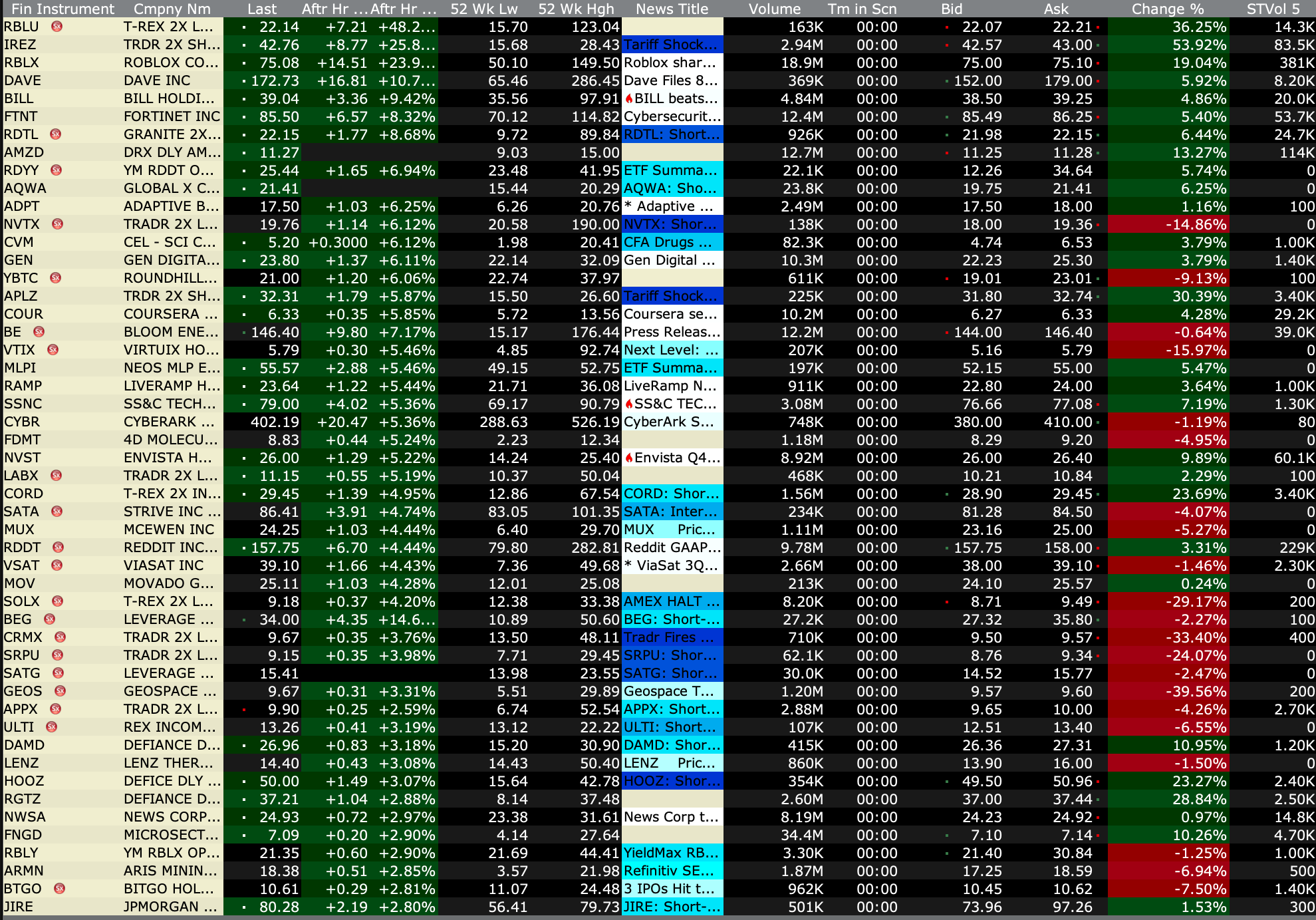
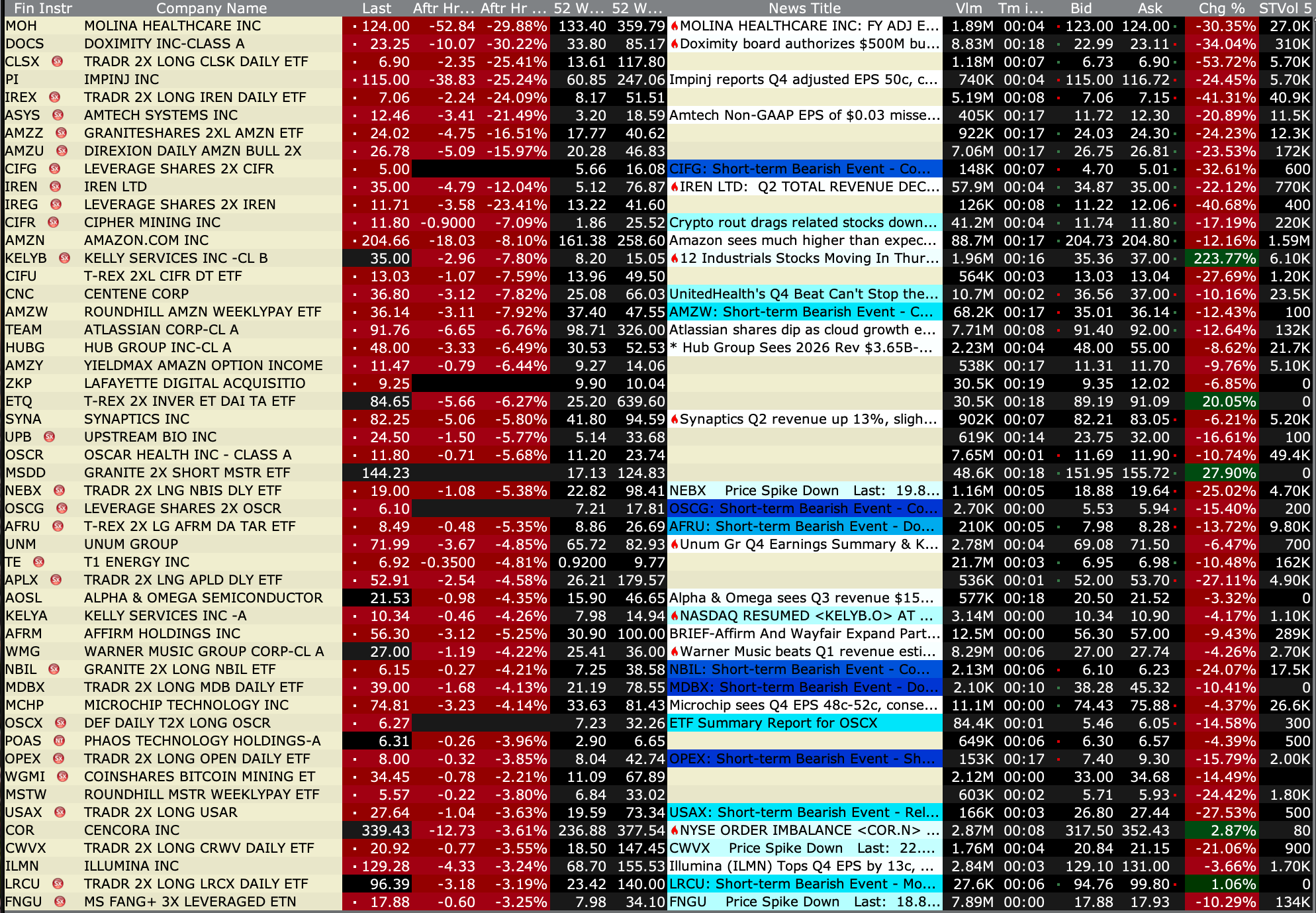
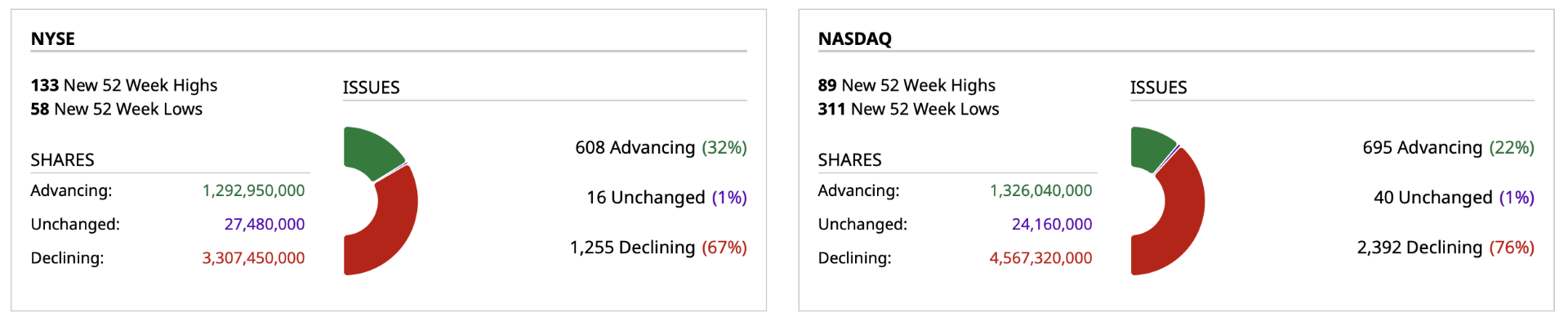
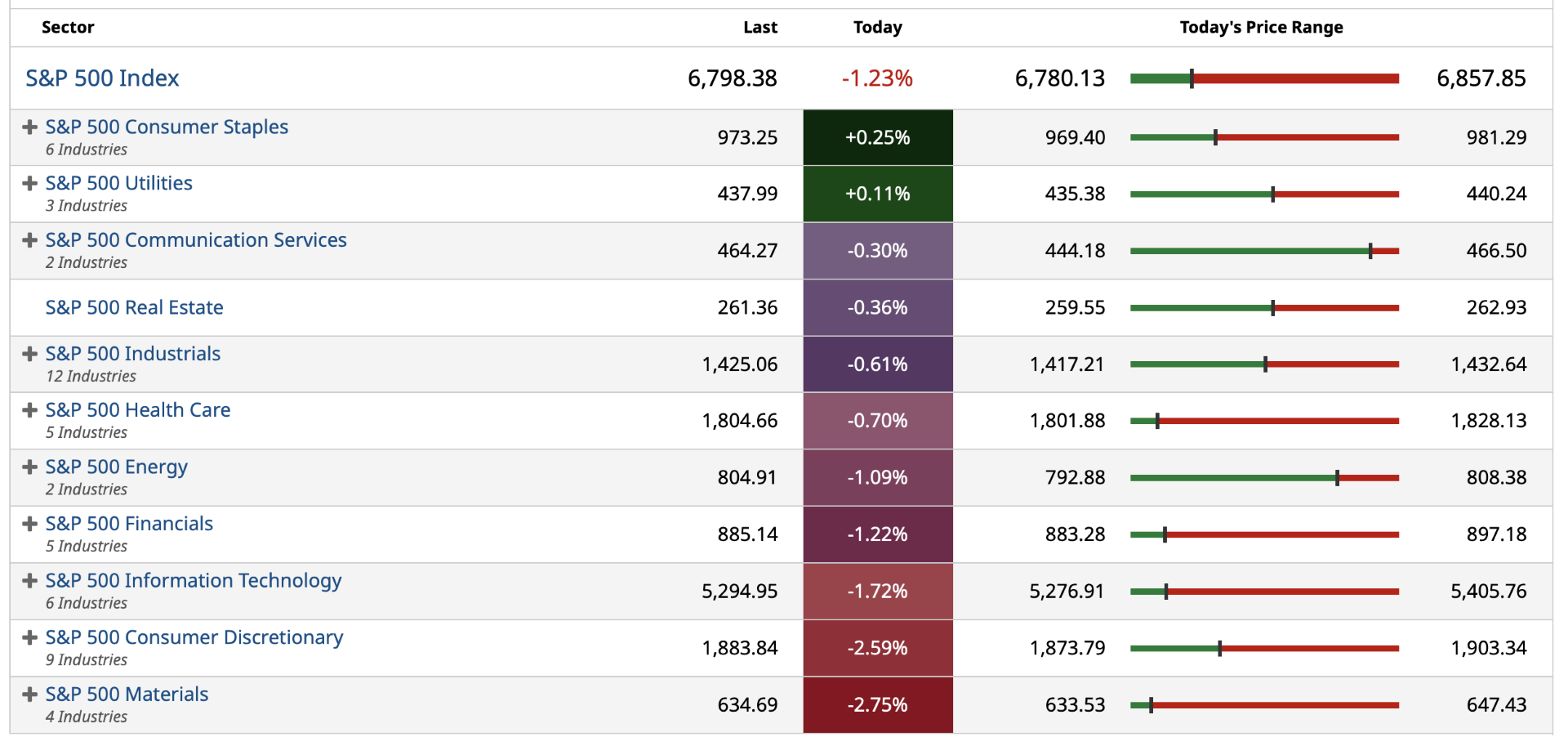
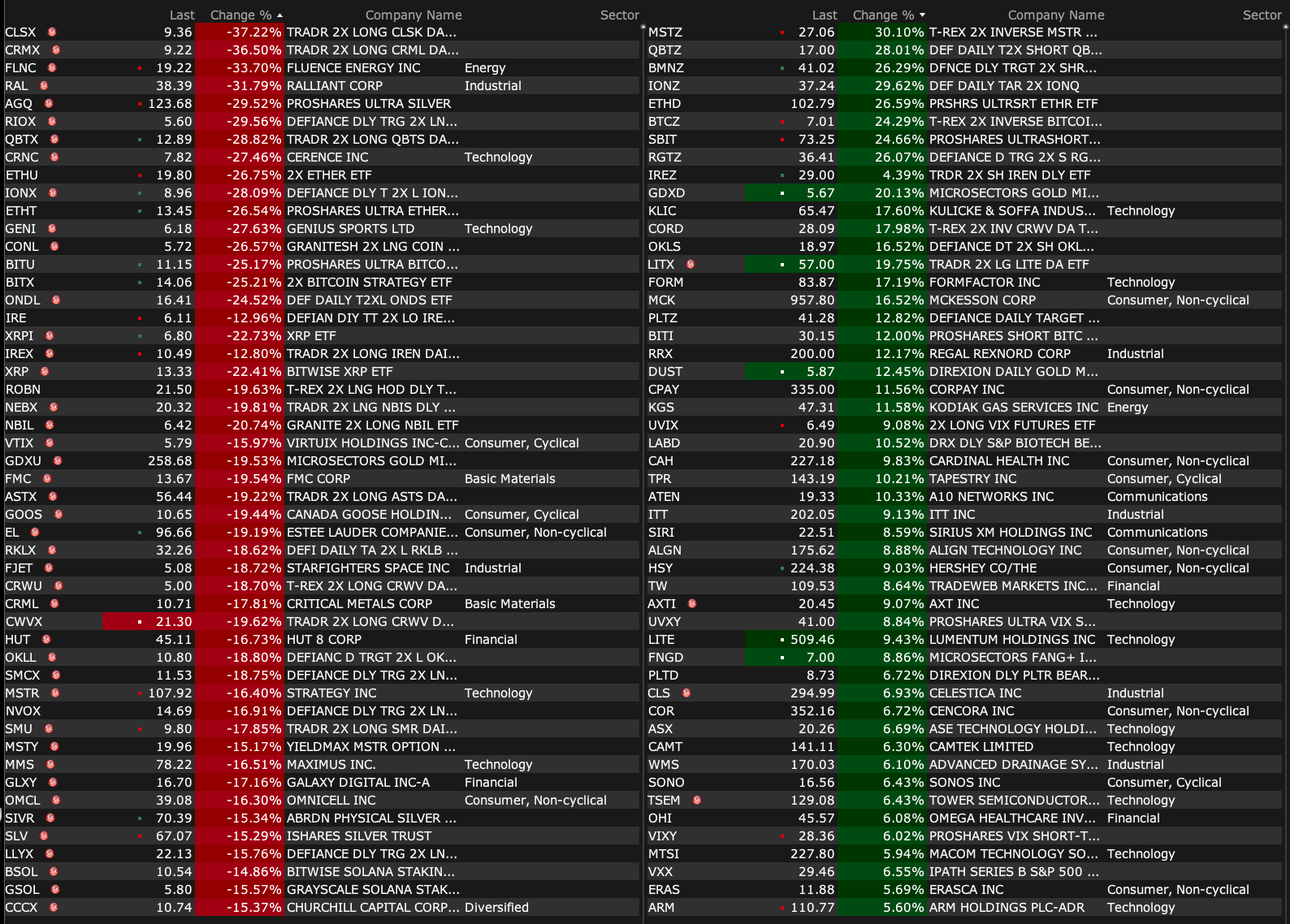
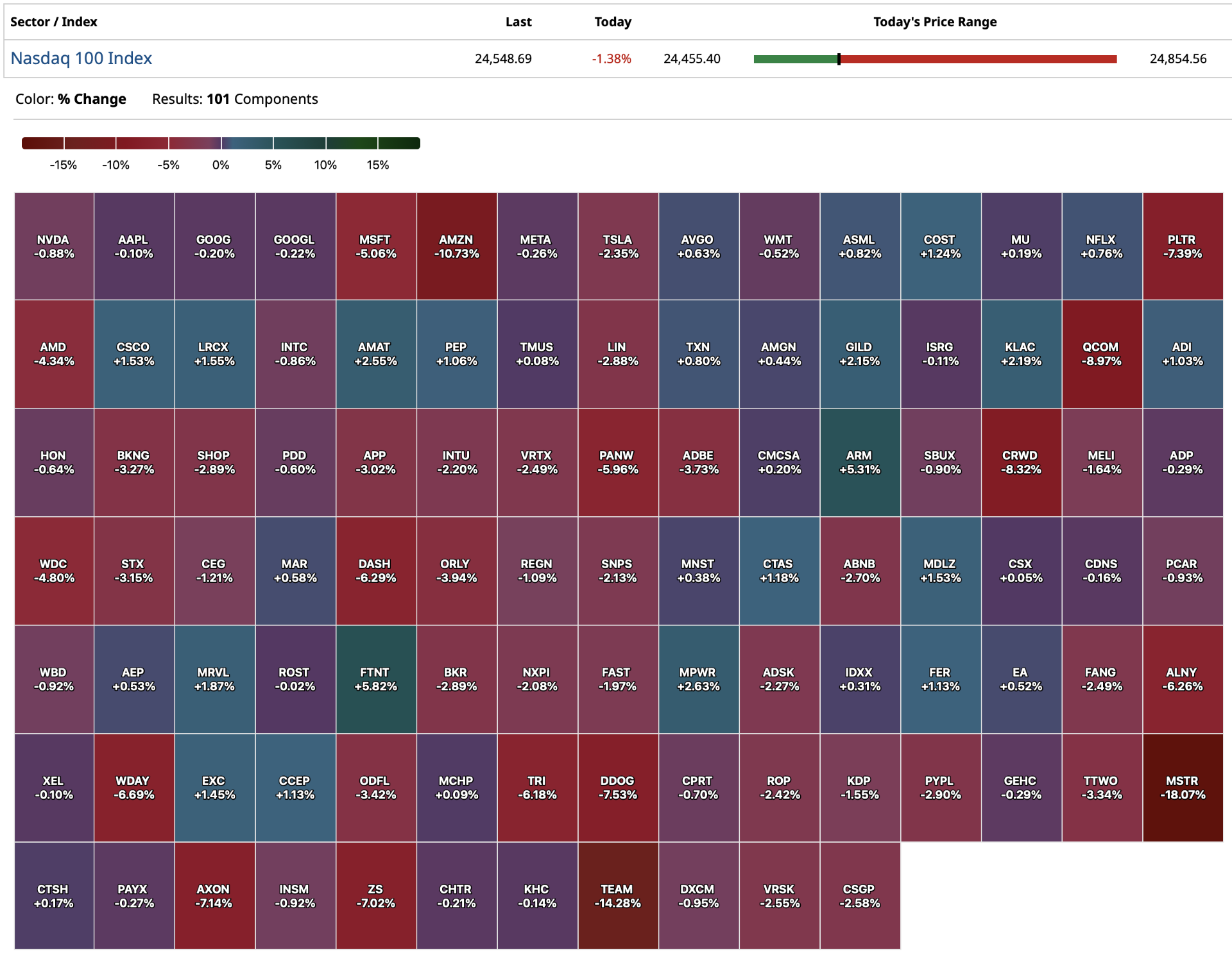
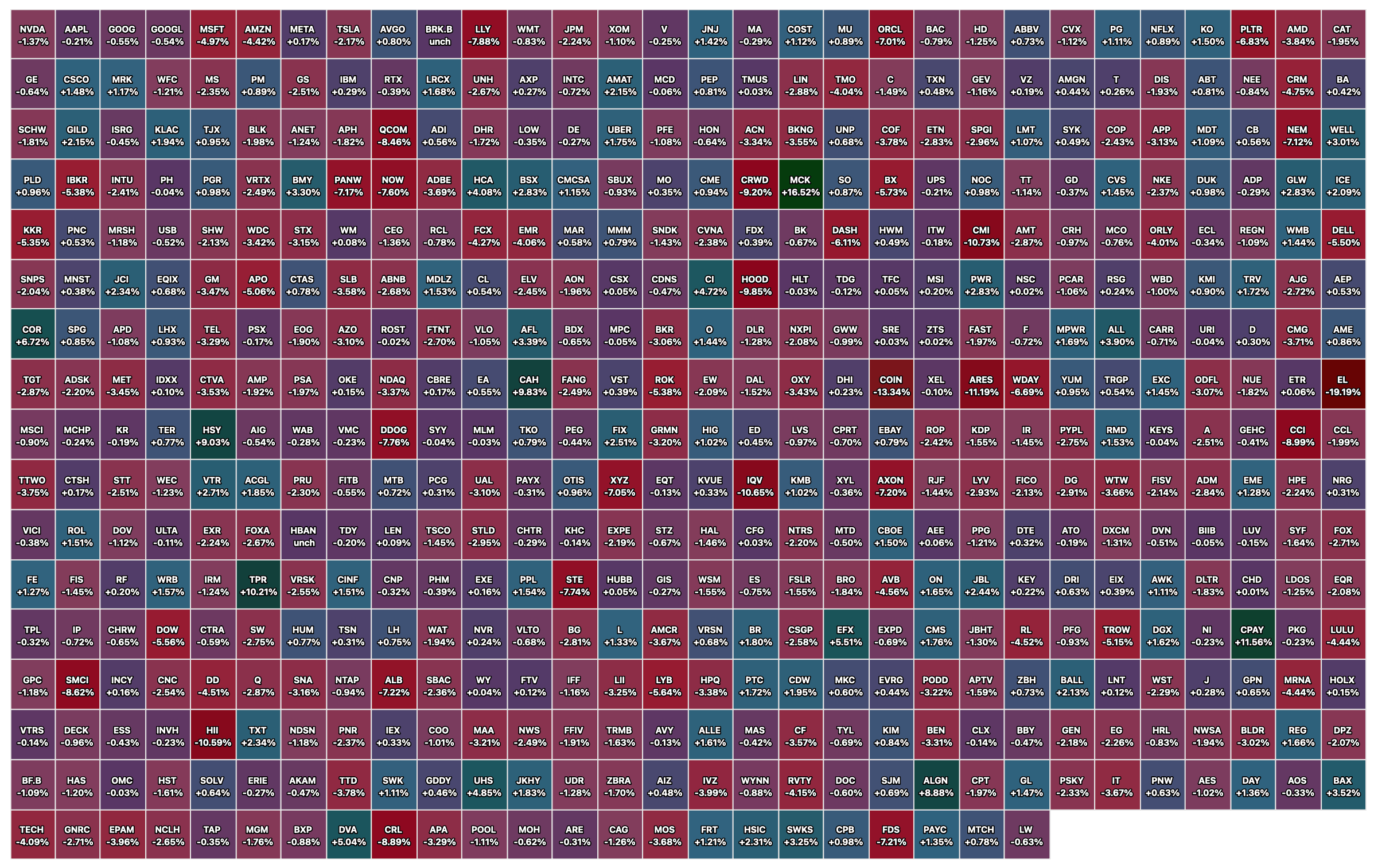
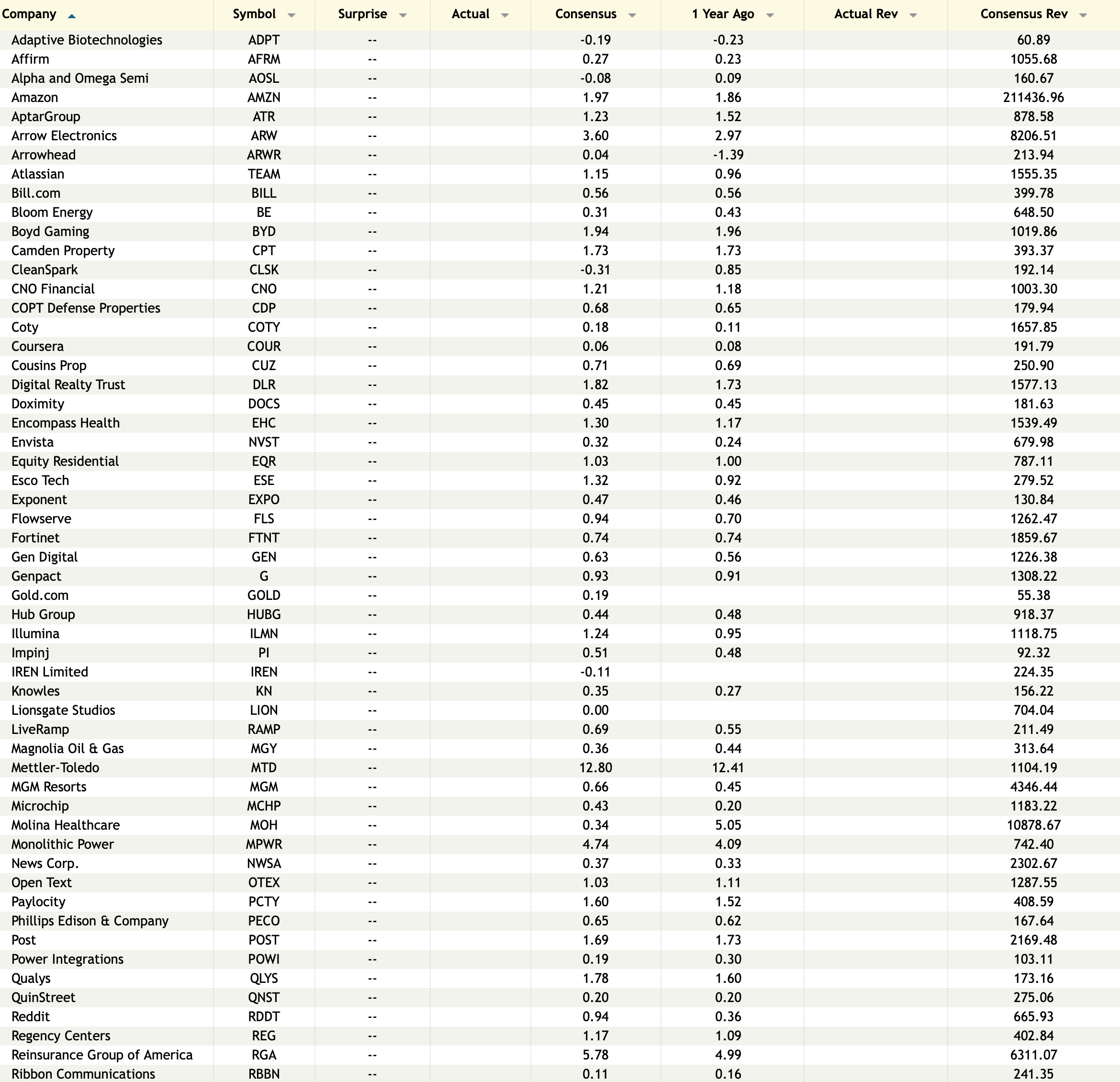
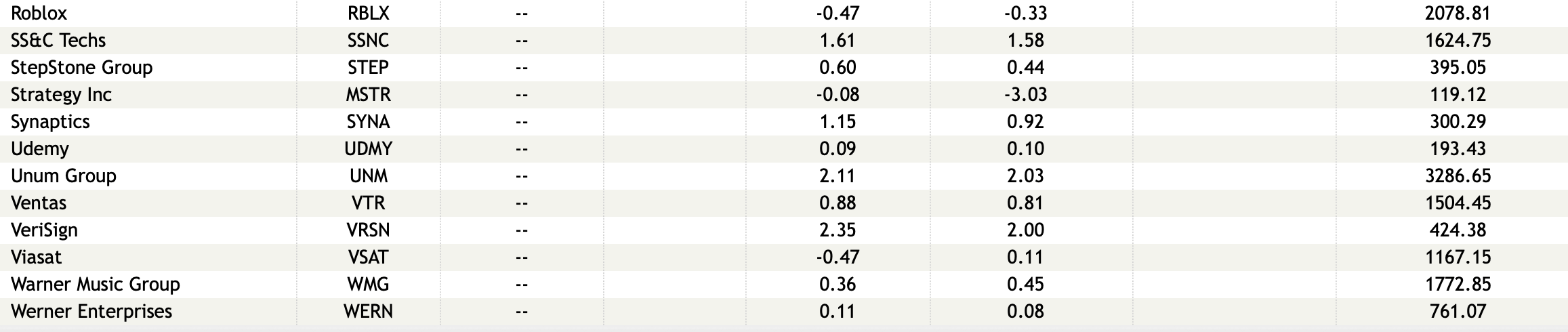
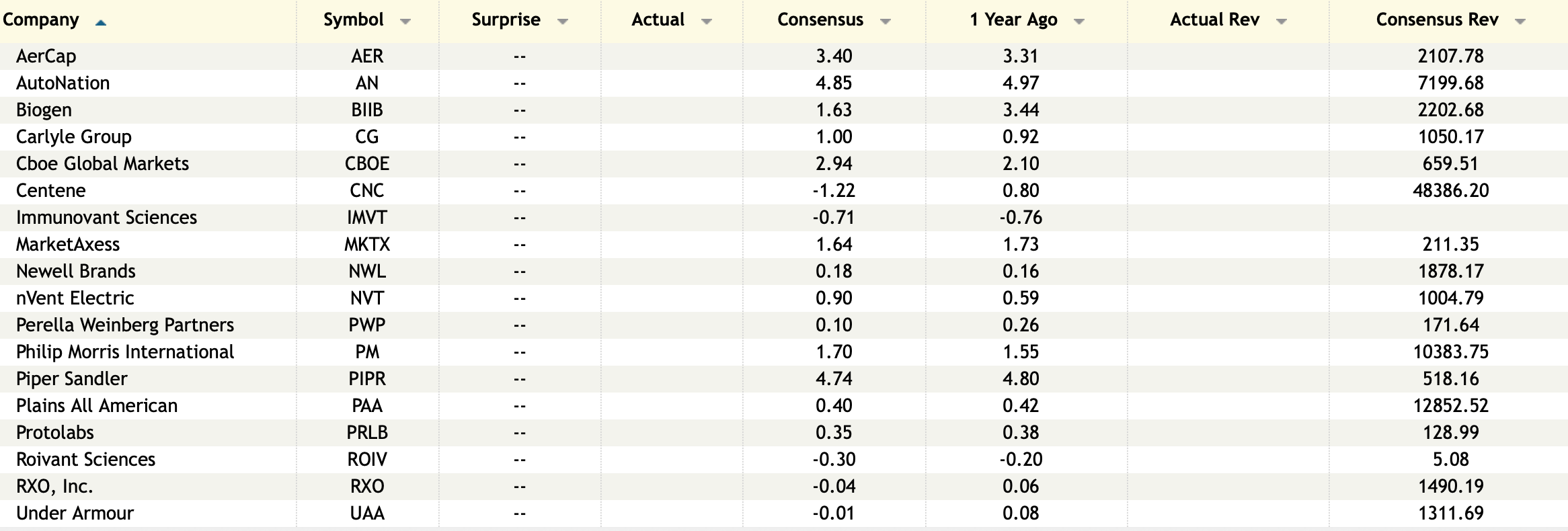
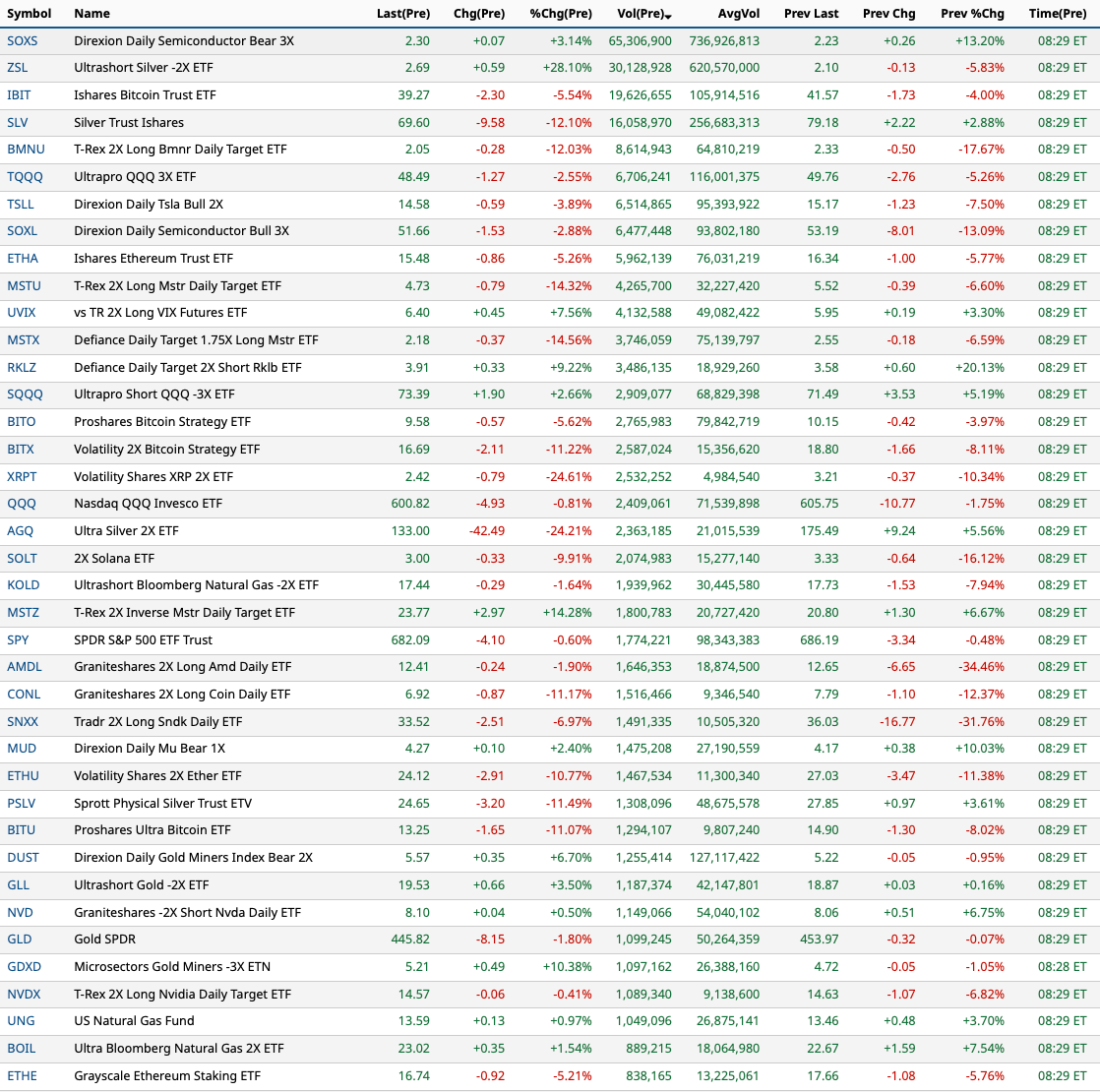
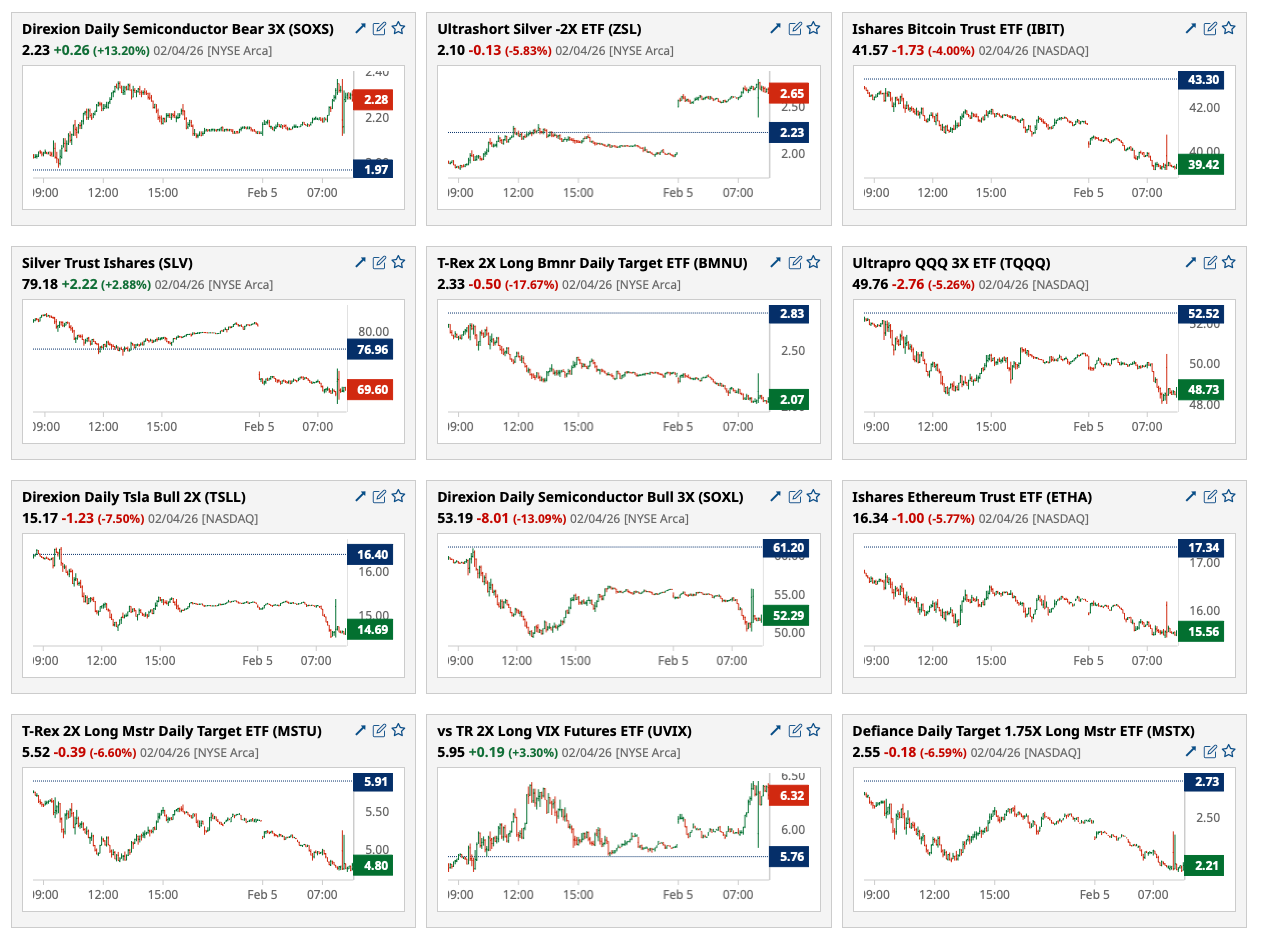
Good sale yesterday on my remaining Amazon (AMZN) at $237.50 (now $200.50). I will be digesting the Amazon report tonight (no instant "analysis" from this guy), and will report back in the morning.
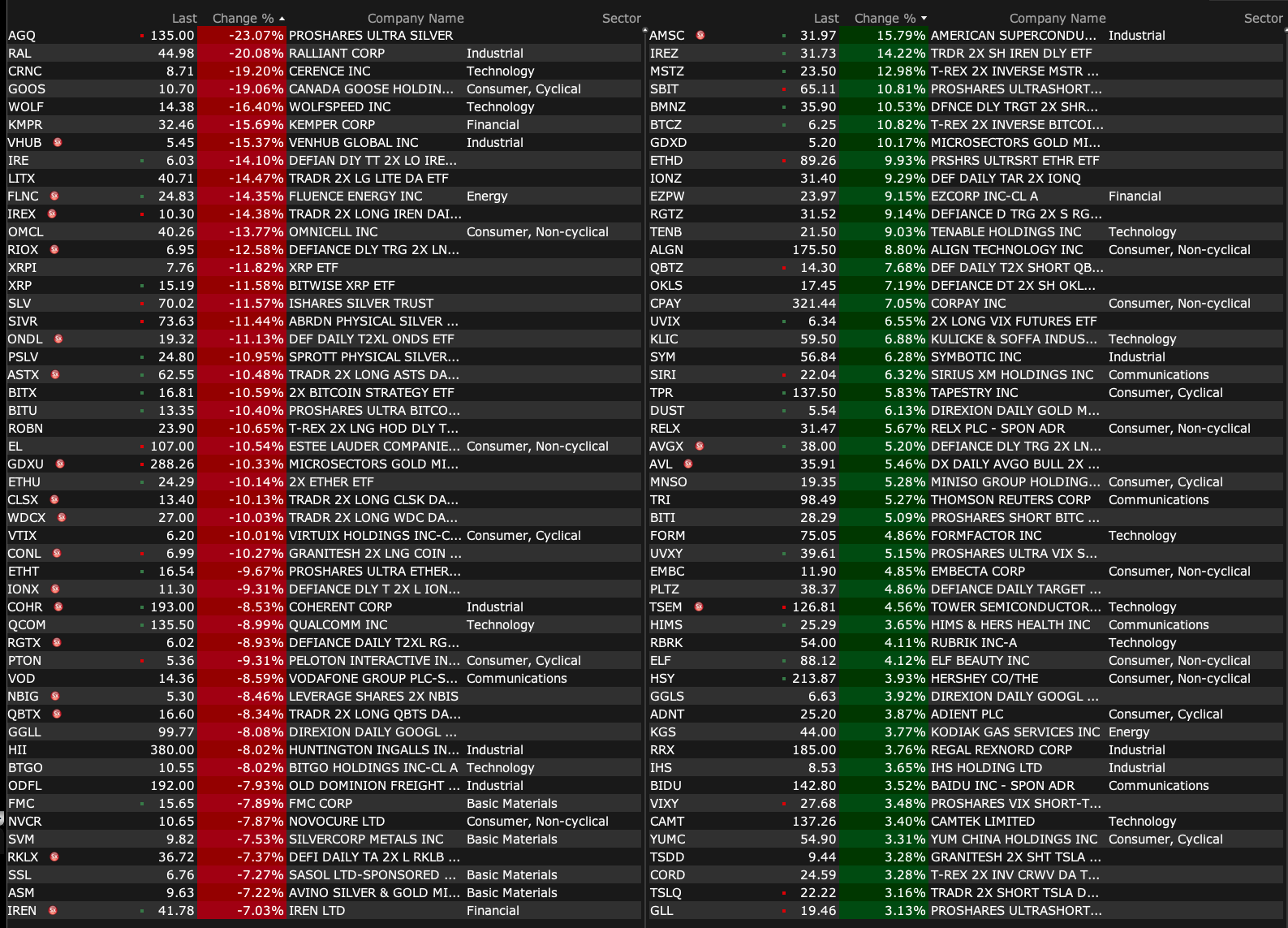
In the after hours I have taken a trading long rental in bitcoin ( (IBIT) at $35.72) on the oversold and potential panic and selling climax. Will remain flexible on trading it.
My Super Bowl Indicator Says These Stocks Might Flourish in 2026
*The heavier the Super Bowl advertising by a company or industry, the more likely its stock or sector will underperform....and vice versa. If an industry is under represented it may outperform the major indexes.
* This year, my 'Stock Market Super Bowl Indicator' says to buy financials and automobile manufacturers — both of which are massively under represented in Super Bowl ads.
* Last year we observed that there were some striking developments: Automobile ads had only total two spots (General Motors (GM) had the least ad space positioning in decades!) and large-cap technology (Google (GOOGL) and Microsoft (MSFT) ) completely abandoned Super Bowl advertisements in 2025.On cue, our Super Bowl Indicator was prescient as General Motors, Microsoft and Google were meaningful overperformers in 2025.
* On the negative side and for the second year in a row, my 2025 Stock Market Super Bowl Indicator called for caution in consumer products companies that, again, dominated (60%) all advertising spots. (Again), on cue, consumer equities were meaningful underperformers in 2025.
* For the fourth year in a row, Apple (Music) (AAPL) is the halftime sponsor — PepsiCo (PEP) remains on the sidelines (I should probably short AAPL and hold on to my PEP!)
"2020 was a great year... Not! It really sucked donkey. We just wanted to say we will see you soon for the game. We will see you on the Big Bowl..."
On Sunday, one of the grandest sporting events of the year will take place: Super Bowl 60.
Back 26 years ago in January 2000, I created a brand new stock market Super Bowl indicator as a contrary indicator, very similar to the cover of Time magazine.
My indicator dictates that the more intense the Super Bowl TV advertising by a group of companies, particularly in a specific industry, the more likely the stocks of those companies will perform poorly in the year ahead. Conversely, a reduction in an industry's Super Bowl commercials augurs well for the stocks in that sector.
My great pal, Barron's Alan Abelson (RIP), was kind enough to include and highlight my newly minted indicator in his "Up and Down Wall Street" column during the weekend of the 2000 Super Bowl — and writing this makes me so nostalgic regarding my weekly conversations with him.
Twenty-six years ago, my Stock Market Super Bowl Indicator gave a clear warning alarm to the end of the dot-com bubble.
As the late Alan Abelson wrote at the time:
"As it happens, last week's tech wreck was accurately forecast by a remarkable new stock-market indicator, one we're proud to print for the first time anywhere, the Stock Market Super Bowl Indicator.
Before you start yapping about it being old hat -- or old helmet -- we respectfully suggest you cool it. Pure and simple, our new indicator has nothing to do with the old Super Bowl indicator. Unlike the latter, its predictive power doesn't depend on the outcome of the Super Bowl or, more specifically, whether the winner represents the National Football League's American Conference or the National Conference.
Our brand-new Stock Market Super Bowl Indicator is a contrary indicator, kind of like the cover of Time. Its critical components are the commercials carried on television coverage of the event and the identity of the companies doing the advertising. Its virtue is not as a forecaster for the market as a whole, but for individual sectors of the market.
The indicator is the handiwork of Doug Kass, a kindly hedge-fund operator who, despite a propensity to short quantum leapers, wound up last year with an improbable performance matching Nasdaq's improbable performance.
Simply put, the more intense the Super Bowl TV advertising by a group of companies, the more likely the stocks of those companies -- and others of a kindred ilk -- will do poorly in the year ahead. For 2000, we're sorry to report, the indicator is flashing red for the Internet crew.
By Doug's count, roughly 12 of the 30 companies shelling out an average of $2 million for 30-second spots are dot.coms. That's four times the number of 'Net outfits that made their pitch on Super Bowl TV last year and compares with only one in each of the prior two years.
What's more, for the first time, an Internet company, E*Trade, is sponsoring the half-time show. That's known in locker-room lingo as piling on.
If nothing else, the greater the number of look-alike or sound-alike companies doing the shilling, the less the impact of the individual shills. And in fact, there seems to be more than a modicum of evidence that for the viewer, the link between the commercial and the sponsoring Web company barely registers.
Making the auguries all the darker for those dozen dotcoms is the sad history of the sole 'Net TV advertiser during Super Bowls XXXI and XXXII, autobytel.com. A '99 IPO, the stock peaked at $48 and, last we looked, was a hair under 17.
Without Wall Street, Silicon Valley would not have been able to remove the burden of salaries from its operating statements and substitute stock options for cash compensation. Without the lovely boost to earnings afforded by the incredible lightness of labor costs, earnings growth would be considerably less, and so the multiples awarded that growth would be merely ridiculous instead of absurd. There would be only a quarter as many West Coast billionaires and half as many millionaires.
In like manner, since the vast bulk of Internet companies are bereft of even a hint of cash flow, Wall Street has, via stock offerings, endowed them with the means of promoting their wares, not only on TV during the Super Bowl breaks but also in newspapers and magazines, on billboards and in subway cars and every other space known to advertising man.
If, indeed, we are rapidly reaching the point of cognitive congestion where the consumer is under such assault from so many dot.coms that they have begun to merge in his psyche into one big indivisible glob, that spells trouble in capital letters. And not only for the 'Net companies, but also for the media on which that vast flow of lucre has been lavished."
- Alan Abelson, Barron's (January 2000)
Of course, the rest was history, as one of the largest stock market declines, especially of a technology and Internet kind, occurred during the subsequent few years.
For 30 Seconds of Your Time
Here is the recent Super Bowl commercial price history (30-second spot):
2019: $5,300,000
2020: $5,600,000
2021: $5,500,000
2022: $6,500,000 Estimated. (Ads were sold out on Feb 3. Several 30-second spots went for as high as $7 million!)
2023: $7,000,000 (One 30-second spot went for as high as $10 million!)
2024: $7,000.000
2025: $7.000,000 (10 30-second spots went for $8 million!)
2026: $8,000,000 (several 30-second spots have gone for prices exceeding $10 million!)
The List
Here is a complete list (and ranking) of 2026 Super Bowl advertisers:
For the fourth time since 2013 PepsiCo (PEP) is not sponsoring The Half Time Show — and as they have since 2022 Apple (Music) (AAPL) is taking its place. I should probably hold on to my PEP!
Reviewing Super Bowl Advertisers of the Recent Past
As mentioned, my 2025 "Stock Market Super Bowl Indicator" was prescient — calling for strength in technology (especially Alphabet (GOOGL) and Microsoft (MSFT) )/automobile (particularly General Motors (GM) ) equities and weakness in consumer staples stocks.
My 2023 and 2024 Stock Market Super Bowl Indicator also called for caution on Apple.
My 2022 Stock Market Super Bowl Indicator called for a bitcoin short as cryptocurrency companies were conspicuous advertisers. That was quite prescient as bitcoin more than halved and its largest player, FTX, filed for bankruptcy. Cryptocurrency companies are conspicuous by their absence this year after making a splash).
A year earlier, my 2021 Super Bowl Indicator said to short beer and food stocks — as well as Robinhood (HOOD) — and to buy auto stocks which were underrepresented for the first time in years. Beer and food were indeed 2021 market laggards and Robinhood's shares peaked at $83. On the other hand, my Indicator said to buy under represented auto stocks — Ford's (F) stock rose by about +135% and General Motors' shares gained about +39% in 2021, far in excess of the +26% advance in the S&P Index.
Some Super Bowl Concerns to Be Aware Of
Here are two separate columns that merit rereading — as they document consistent themes I look for in the pattern of Super Bowl ads:
Cryptocurrency Exchange FTX Joins Super Bowl for First Time
Several years ago I wrote that cryptocurrency was here to stay. With Crypto.com buying naming rights to the Staples Center and NBA star Kevin Durant partnering with Coinbase (COIN) , the new technology and sporting world have formed a fast and friendly relationship. Cryptocurrency exchange FTX was getting in on the action, purchasing a Super Bowl Ad for LVI, but it has not released any creative details yet. Valued at $25 billion, FTX recently purchased the naming rights to an arena in Miami for $135 million. The company has also recently named stars Tom Brady, Gisele Bündchen, Stephen Curry and Shohei Ohtani brand ambassadors.
Crypto.com Adds to Cryptocurrency Blitz; Will Air First Super Bowl Commercial Ever
Cryptocurrency and sports have continued to develop a relationship and that burgeoning partnership is reaching a fever pitch. Cryptocurrency exchange Crypto.com has announced that it will be running its first Super Bowl ad according to the Wall Street Journal. It's another notch on the brand's belt as it recently paid a reported $700 millionfor the naming rights to the Staples Center Arena in Los Angeles. Crypto.comalso became a sponsor for the 2021 Coppa Italia Final earlier this year. Actor Matt Damon appeared in a spot for the brand in late October.
The rest was history -- at least from the standpoint of an historical decline in the price of bitcoin and the failure of FTX.
Relatedly, in 2022 I warned about celebrity endorsements:
Beware of Celebrity Endorsements of Stocks and Other Asset Classes
I had previously highlighted the absurdity of Matt Damon's Super Bowl (ad) sponsorship of crypto.com in Barron's earlier in the year and Kim Kardashian's entry into the private equity field in Barron's last month (Randy Forsyth's Up and Down Wall Street column):
Housing Bubble and Kim Kardashian: More Troubling News for Markets by Randall W. Forsyth Follow Updated Sept. 9, 2022 1:31 pm ET/ Original Sept. 9, 2022 10:26 am ET
Can there be a better sign of a market top than when celebrities pile into it? Especially celebs whose main talent is to appeal to the public's tastes, or lack thereof.
While they might be acutely attuned to what's happening in fashion, music, or the movies, they can be late in latching onto financial trends to which their sole connection is an insatiable desire to wring as much money as possible from the zeitgeist.
All of which is brought to mind by news that Kim Kardashian is launching a new private-equity venture. Truth be told, I don't know what she or the rest of her reality show family is famous for, other than for being famous. But Kim has leveraged her millions of followers on social media to become a huge entrepreneur, with interests ranging from women's undergarments to faux meat. That indeed is a talent not to be discounted.
Her entry into private equity recalls other celebrities' forays into financial spheres just ahead of those markets' top ticks. Most recently, all manner of celebs plunged into cryptocurrencies, most notably actor Matt Damon, who touted Crypto.com in a now infamous Super Bowl ad in which he intoned how "fortune favors the brave."
Doug Kass, the head of Seabreeze Partners-who flagged the prevalence of cryptocurrency ads at the time-further pointed out in an email this past week how other worthies, from rapper 50 Cent to quarterback Aaron Rodgers to New York City Reality star Kim Kardashian and former Carlyle Group investor Jay Sammons have launched SKKY Partners, a private-equity firm.
Private equity hasn't suffered big losses. But, according to a Sept. 8 note from Citi Research's quantitative global macro strategy group, private asset prices tend to lag those of the publicly traded markets, which are quoted second by second on screens. Weakness in public equity markets portend lower private-asset valuations, according to the report. Kim's entrance into the rarefied world of private equity may be about as propitiously timed as Barbra Streisand's furious pursuit of initial public offerings at the height of dotcom mania in 1999. (Babs told Fortune back then that she had quadrupled her money in America Online shares, but averred that she didn't pretend to be a maven "like the guy in Barron's last week who can analyze all the companies and so forth.")
If private markets do get marked down one to two quarters after the public ones, as Citi says they have historically, that points to similar trouble for the former. I wouldn't shed any tears for Kim K. or any other A-lister able to get past the velvet ropes into private equity funds.
Bottom Line
An analysis of 2026 Super Bowl advertisements again shows that automobile manufacturers, historically big advertisers, are not well represented — with only Jeep and Hyundai advertising.
As well, financial companies are poorly represented. Ergo, our Indicator suggests the purchase of automobile and financials.
It also shows a larger-than-normal concentration of consumer products commercials — with about 60% of the ads consumer-related. My Super Bowl Indicator says take the recent strength and sell staples.
Finally for the fourth year in a row, Apple is replacing PepsiCo as the half-time show sponsor, we might again consider a cautious view towards the company. (Short AAPL, long PEP?).
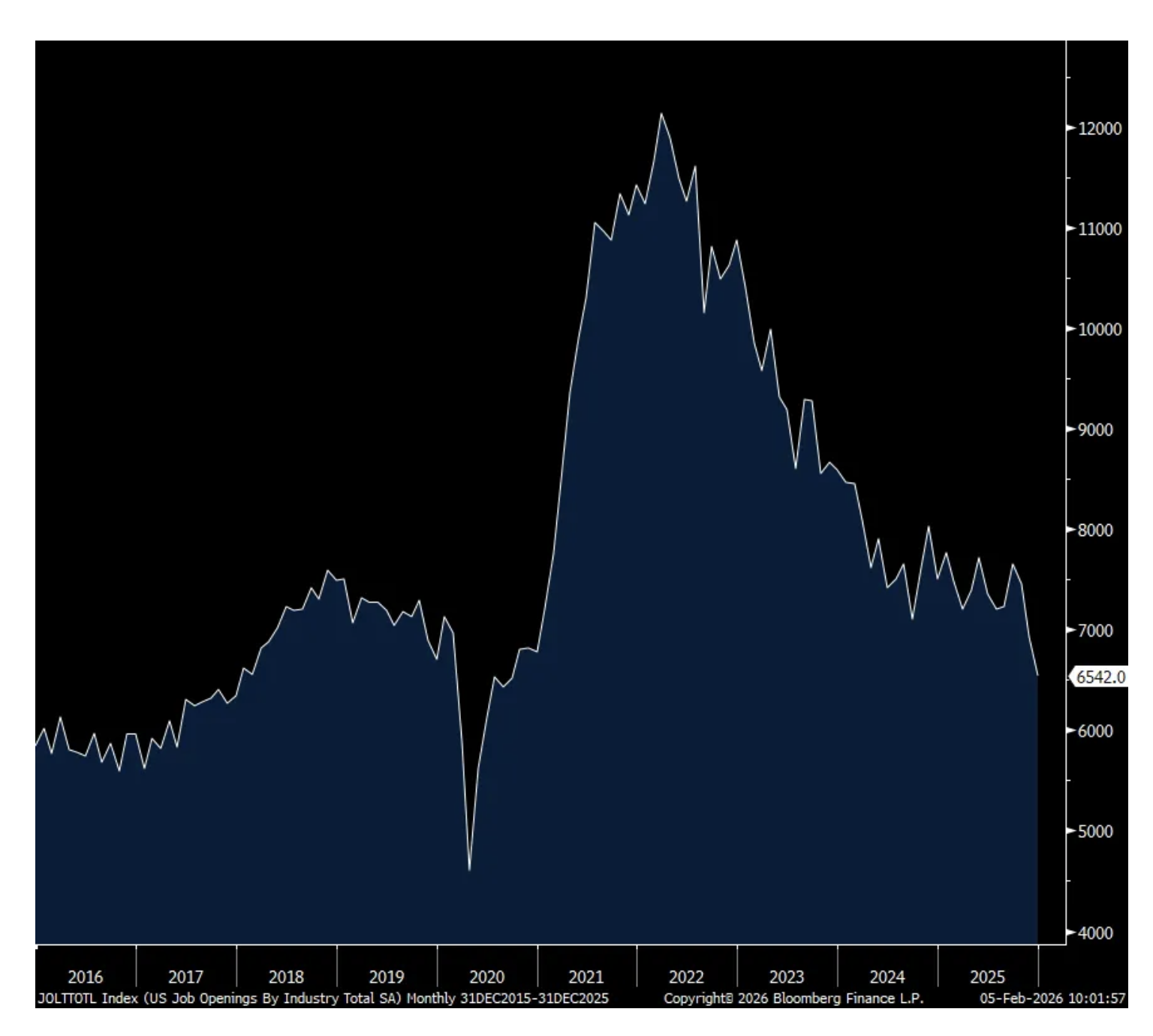
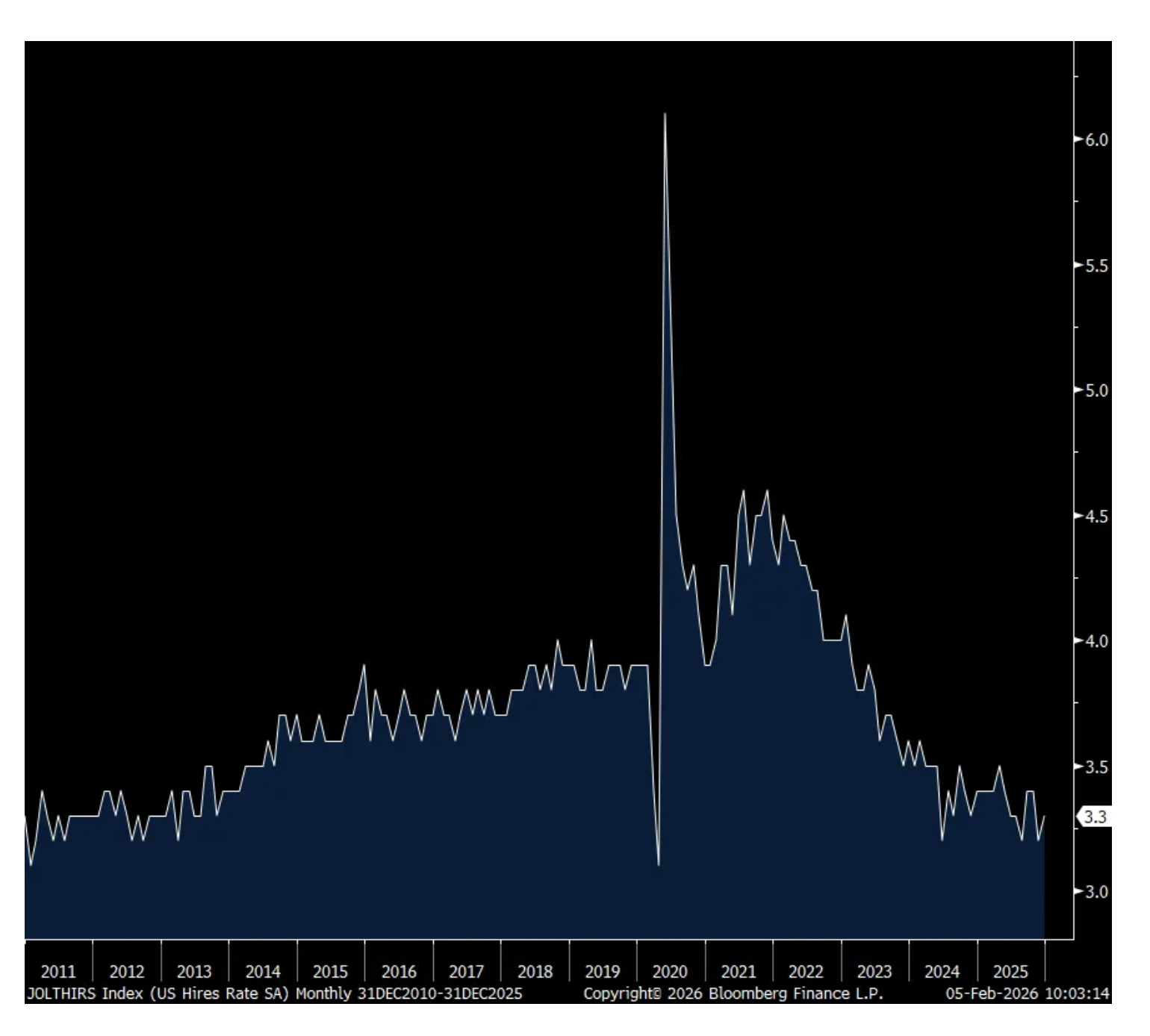
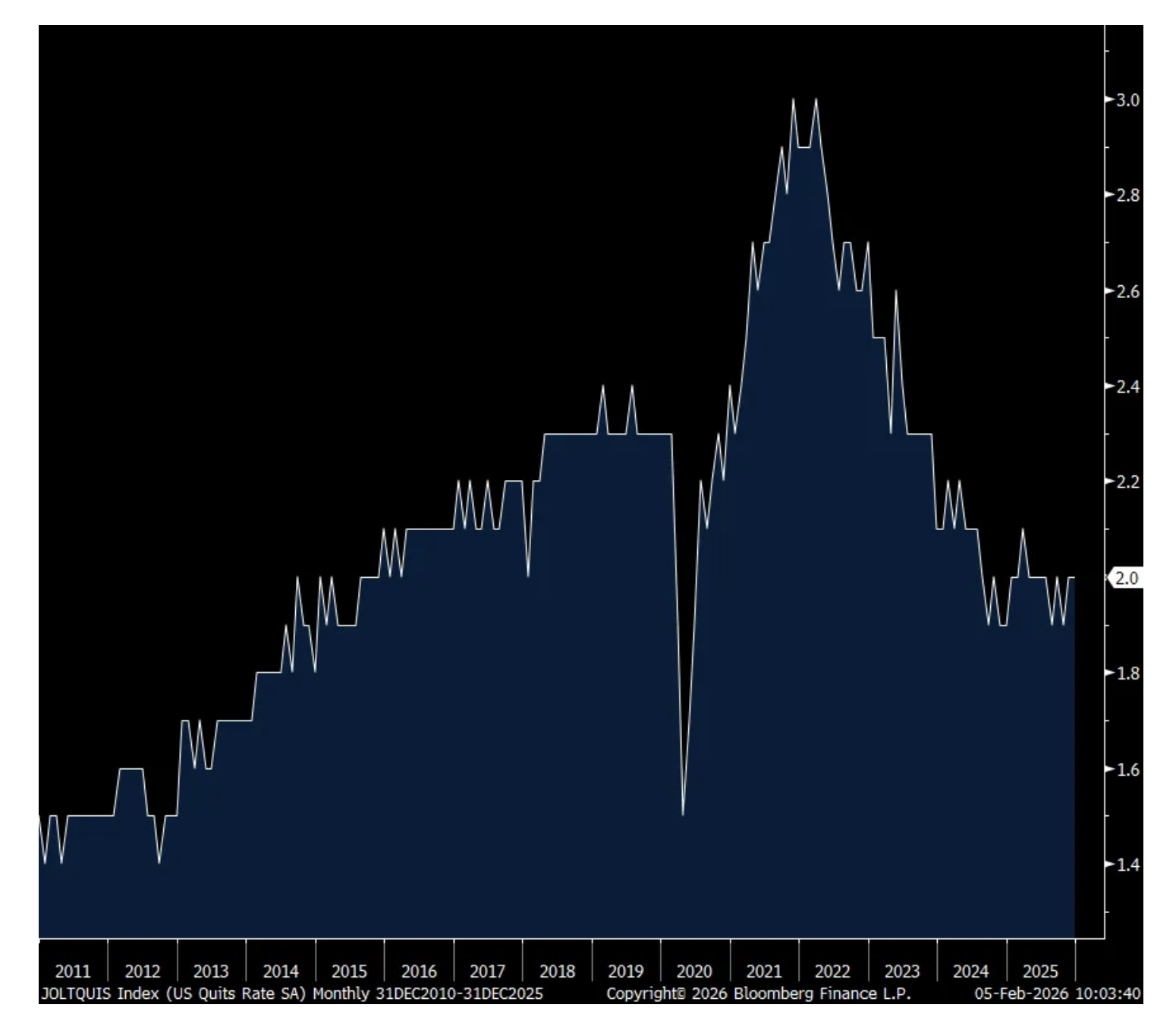
The number of job openings in December fell sharply m/o/m to 6.54mm from 7.15mm in November. That is the least since November 2020 and if we take out Covid, it’s the lowest amount since February 2018. The hiring rate did tick up by one tenth to 3.3% but off a level that matched the lowest since 2011 not including Covid. The quit rate held at 2%.
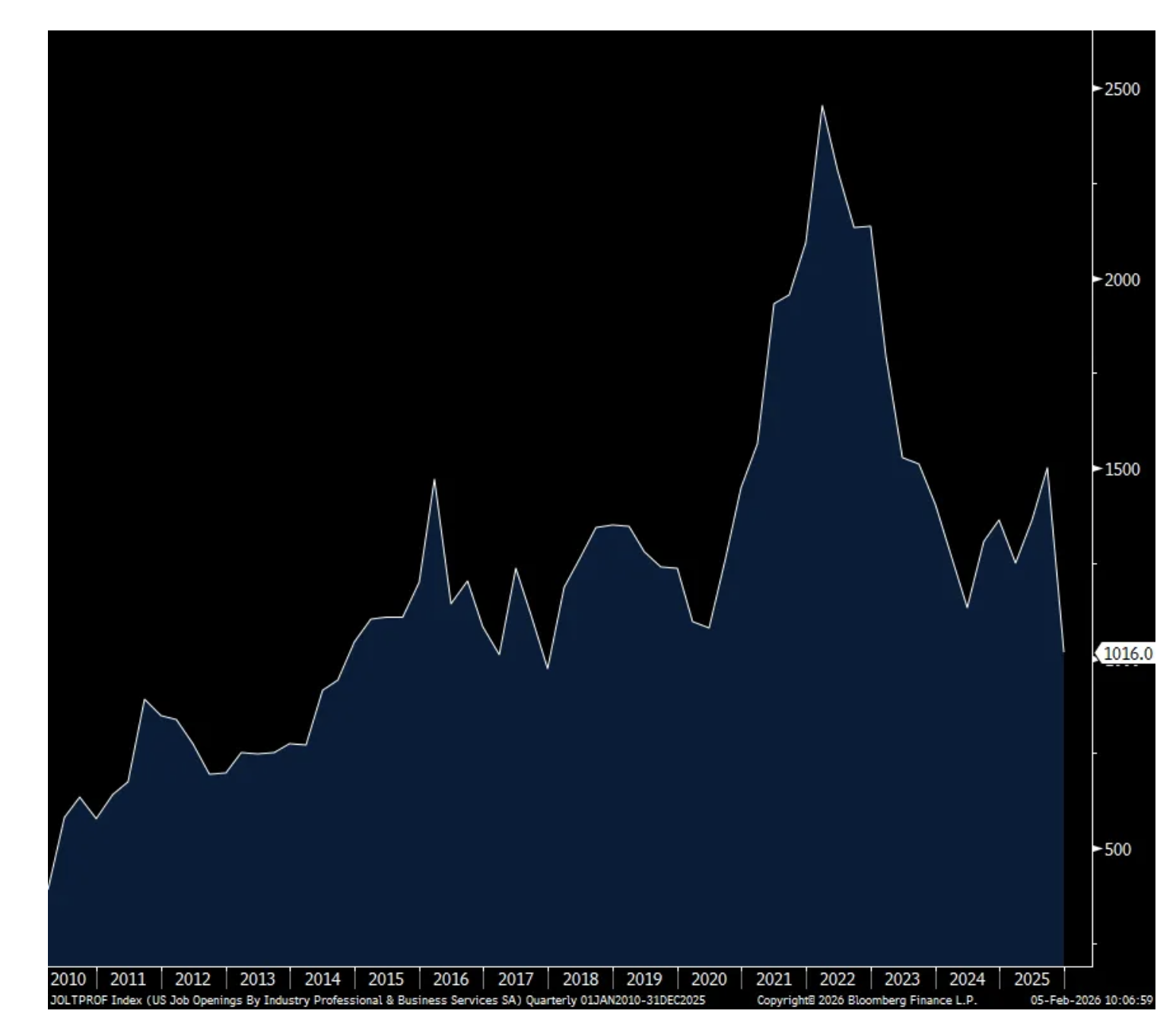
Sector wise, a chunk of the decline in openings came from the ‘professional/business’ service sector, down by 257k to the lowest amount since May 2020 and December 2017 not including Covid. Even the usually consistent healthcare/social assistance sector saw a reduction in job openings to the least since January 2021. Openings in the finance/insurance sector fell by 120k and were down in retail too.
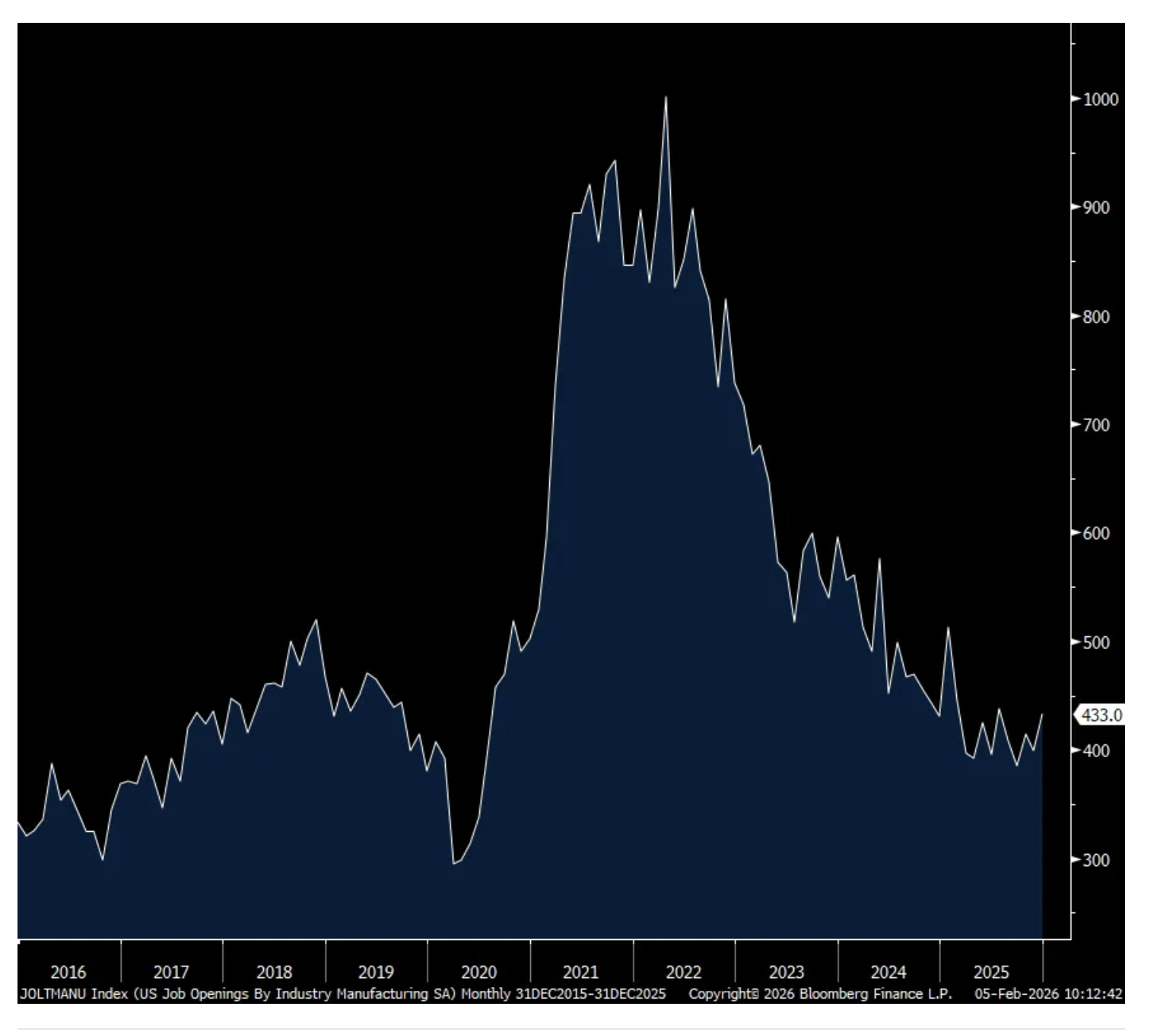
On the flip side, openings rose in construction and manufacturing (highest since July. They rose too in leisure/hospitality and information but after dropping in the month before.
Bottom line, this is just more evidence that the demand for labor continues to weaken.
Before I get to the claims data, the January Challenger report saw the biggest amount of January job cuts since 2009 and the “highest monthly total since October 2025.” They said “Generally, we see a high number of job cuts in the first quarter, but this is a high total for January. It means most of these plans were set at the end of 2025, signaling employers are less-than-optimistic about the outlook for 2026.”
They blame a few things like UPS shedding 30k workers as they are dramatically shrink their business with Amazon. Amazon also is cutting 16k people. While healthcare we know has been a big source of job creation over the years, Challenger said this, “Healthcare providers and hospital systems are grappling with inflation and high labor costs. Lower reimbursements from Medicaid and Medicare are also hitting hospital systems. These pressures are leading to job cuts, as well as other cutting measures, such as some pay and benefits.”
With AI, they said this, “It’s difficult to say how big an impact AI is having on layoffs specifically. We know leaders are talking about AI, many companies want to implement it in operations, and the market appears to be rewarding companies that mention it,” said Challenger.
On the hiring side, employers added 5,306 jobs, “the lowest total for the month since Challenger began tracking hiring plans in 2009.”
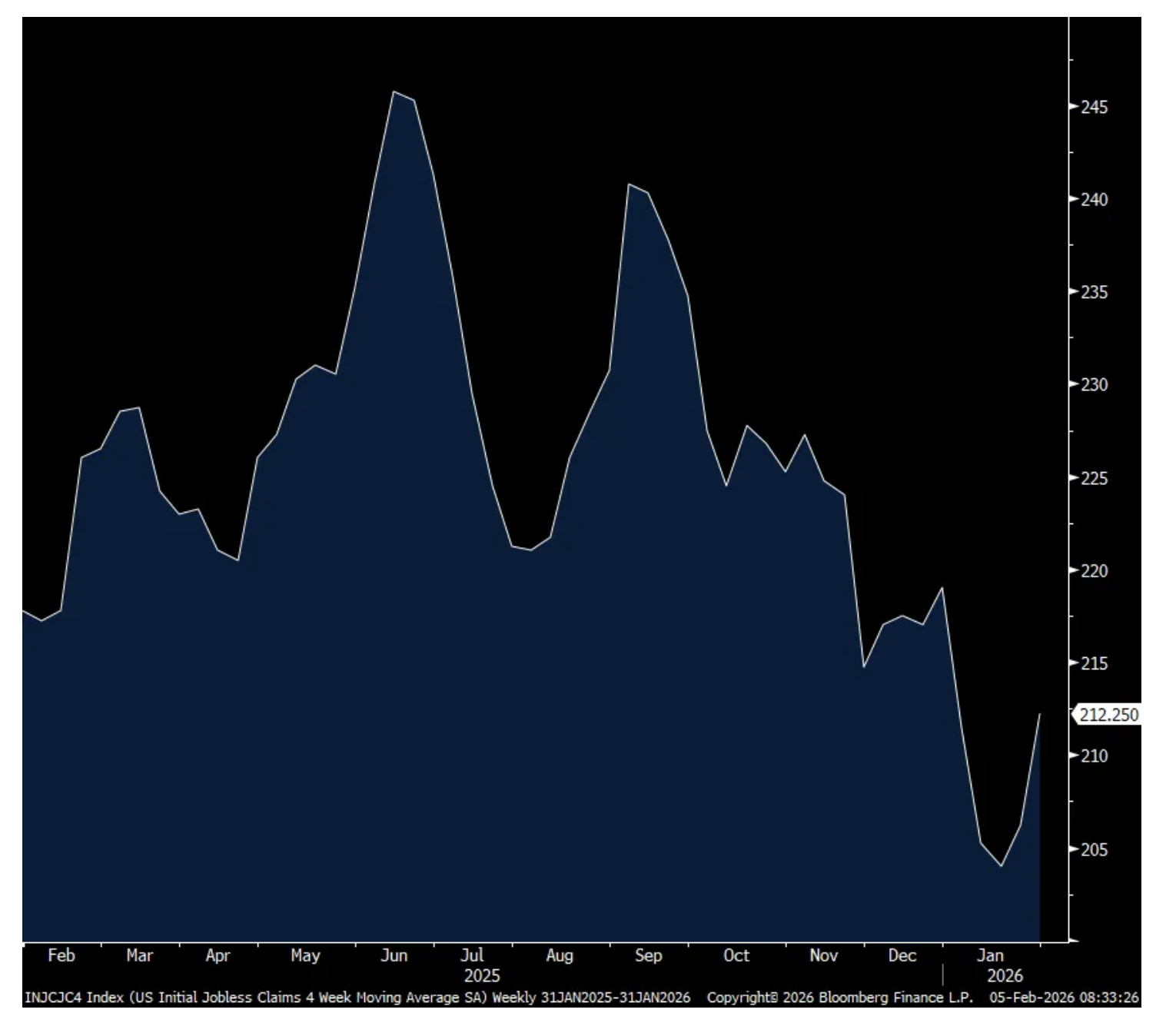
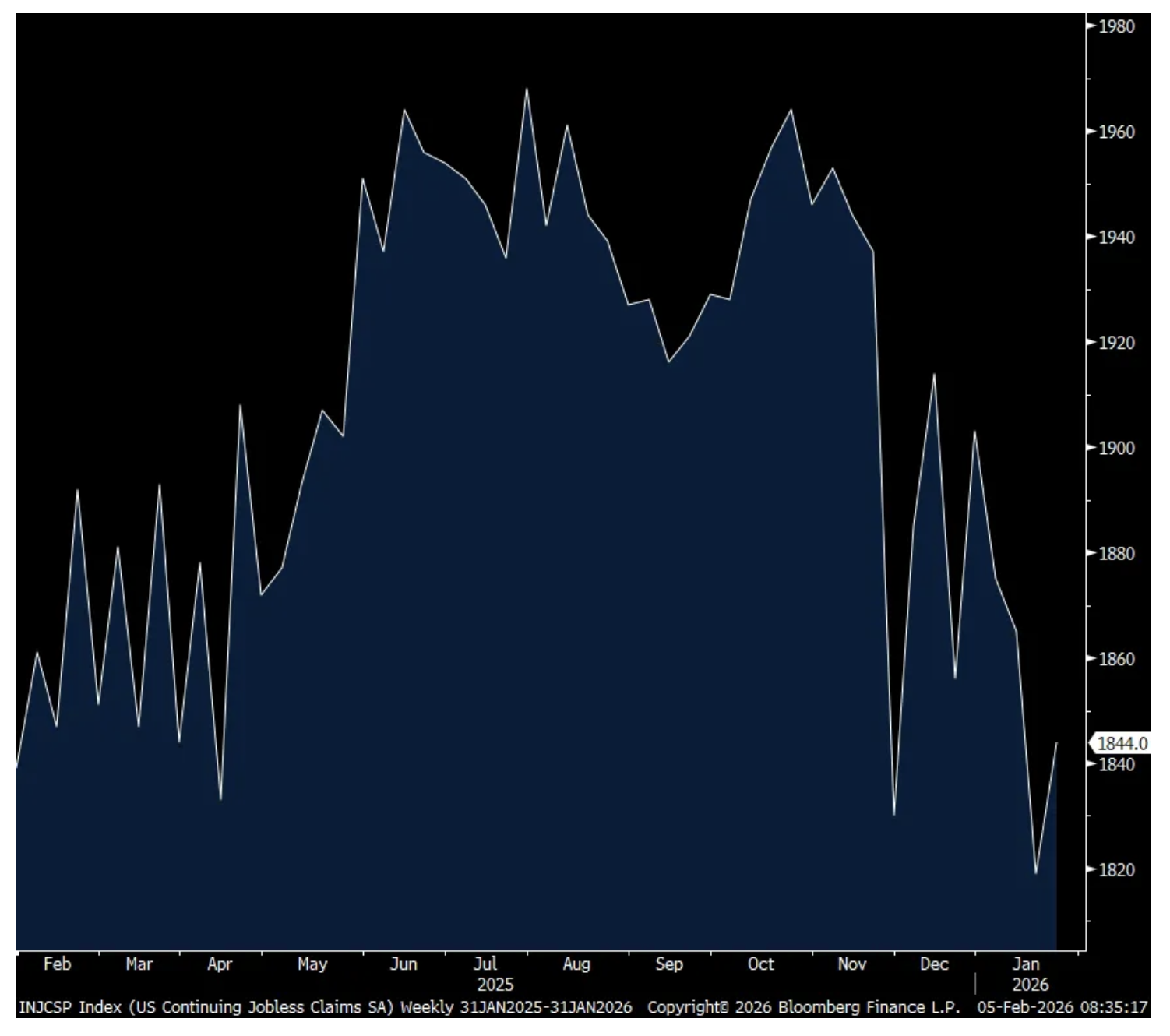
Initial claims totaled 231k, a jump from the 209k seen last week, well above the estimate of 212k and the most since early December. The 4 week average moved up to 212k from 206k, still very low however. Continuing claims, delayed by a week, rose to 1.844mm from 1.819mm, though remaining below the 2.0mm level and the question is whether claims are running out for people or they are finding new work as to why it remains under 2.0mm still.
Bottom line, the pace of firing’s has remained low but it’s hard to ignore the Challenger data. Hiring we know has slowed sharply but we need to debate to what extent is it due to the dramatic slowdown in the pace of population growth and/or a reduction in the demand for labor.
10:50 a.m.: Fed Bank of Atlanta President Bostic (Non-Voter) participates in moderated conversation and Q&A on monetary policy and navigating the economic environment after graduation at event hosted by the Clark Atlanta University School of Business, Atlanta, GA (Audience Q&A expected. No media Q&A. No embargoed text. Livestream here)
Treasury Auctions
11:00 a.m.: Treasury announces a 2-Week and 3 and 6 month bill auction;
11:30 a.m.: Treasury hosts a $105B 4 and a $95B 8 Week Bill Auction;
My MSOS Plan Amid a Potential Rescheduling Announcement
I emphasized in my (MSOS) post a few days ago that this was a trade (rental) and not an investment — as has been the case in my last eight positioning positions in cannabis (bought and sold profitably):
Rescheduling Update
My sources indicate that rescheduling will finally be driven home and finalized shortly by the Trump administration.
There is probably a very short-term trade in (MSOS) with limited risk.
I am now long MSOS common (cost $4) and I am buying in the money calls for February and March.
Importantly, this is a rental and not a long-term lease (given my secular industry concerns).
The news of an imminent announcement that rescheduling will be finalized by the Attorney General is clearly making the rounds as the shares have risen by 10% in the last two days (trading premarket above $4.40).
I have expected a 10% to 20% rally on the "news."
We have already gotten half of it, even without an announcement.
I have begun to sell the shares and on a bit more strength I will be out of the trade (hopefully, again profitably).
The secular fundamental outlook for cannabis remains muddled for all the reasons already discussed in my Diary over the last five years.
More Tales From Nvidia: Anthropic Goofs on OpenAI (Issue # 174!)
These are funny, but this is what the industry has come to.
It is all the same crap, so Anthropic is just left to making fun of Open AI as their advertising campaign, as opposed to mentioning any feature differentiation or what it can do for you.
Then of course the other issue are the open source guys and Chinese do the same thing 99% as well for about 2% of the cost.
For all the hype, it really has become a non-differentiated commodity industry. Anyone can build an LLM. It just takes money. No different than building a steel mill.
I like to feast on the opportunity presented before and after regular trading hours. Especially following EPS releases, where opinions are too often based on reading a release rather than waiting for forward guidance and thorough analysis.
Things, like quality of earnings (lower tax rates, non-recurring gains/losses, etc.) are often disregarded in hastily analyzed announcements, particularly on the part of commentators who should know better but are "forced" to venture a quick opinion (on the EPS announcement) and, more often than not, come to an uninformed conclusion.
To me, it's amateur hour — and multiple opportunities abound (for a variety of reasons).
Such was the case with Google (GOOGL) last night (where only Guy Adami and Carter Worth questioned the valuation):
I totally disagree with the market's and the 5PM show panelists' positive reaction to Google's EPS report and I shorted Google in the afterhours at $343.62.
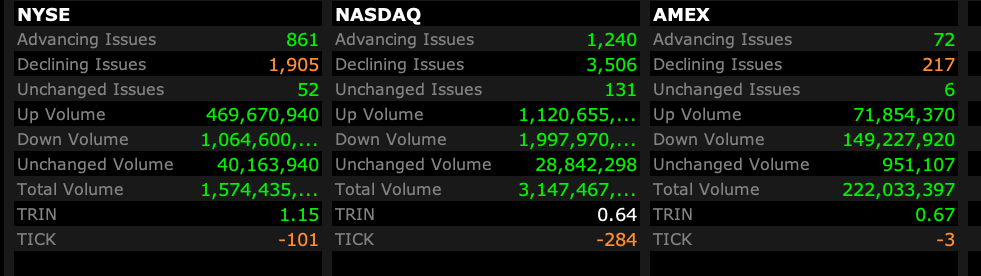
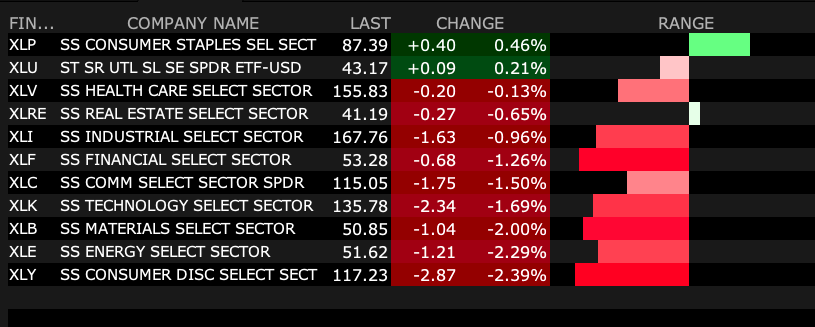
Today felt like shades of 2000 after the tech bubble started to break. My diversified high yield dividend portfolio (lots of "stodgy" old companies in there) finished up 2.21% on a red day for the S&P 500 and -1.51% day for the Nasdaq. Now, maybe this reverses tomorrow but it "feels" to me like its more of a trend. I began co-managing an equity income portfolio for a trust department in spring of 2000 and no one wanted anything to do with it until a year later when we were well in the money and the market was down as the bubble burst. Feels awfully similar.