Daily Diary

D
Doug Kass
DATE:

You're reading 0 of 1 free page.

Register to read more or Unlock Pro — 50% Off Ends Soon

Not logged in? Click here to log in

Subscriber Comments (And My Response)

Johnthegreek

Since 2017 the better part of this space has carried a rather sullen outlook of the economy and market. We’ve discussed

Recession

Deflation

Hyperinflation

Stagnation

Debt crisis

Trade deficits

Tariffs

Overbought

Positive points have sometimes been dismissed. People are sitting on cash waiting for the crash. How long?

I acknowledge that it’s great to take profits a little early, but what’s wrong with taking profits a little late?

Why leave a putt short when you can hit it a little harder to keep a good run going? This is the greatest economy in the history of the world. I believe in it and expect 5%-10% correction coming. When positions can more than sustain such a corrections, there is nothing to worry about. I retired in 2019 and have maintained an even higher level of living. My net worth is greater now than it was when I retired. This has been great!

The trend has been my friend.

Good night

tommyPA

Agree Johnny. Here's another challenged outlook I saw posted on Dougie's thread here this morning: (p.s. I respect all the data and input posted on this site)

Dow Theory Crash Indicator: Every single major crash over the last 100 years had the same setup: DJIA hit a new high, but the transports failed to do the same (1929, 1937, 1966-1975, 1987, 2000, 2007, 2020). And when transports fail to confirm the DJIA high, the wheels come off the bus and all equities veer offroad and Thelma & Louise it off the nearest cliff.

Why do I mention this? Well, low and behold, you'll see the chart shows that's it's precisely where we are today...DJIA hit another ATH but transports have failed to reach their own new high, after last setting one in February. Transports currently sit 4% below that mark. Bulls with net long equity positions are very likely picking up pennies in front of a freight train barreling down the tracks.

Do you feel lucky? (Spoiler: Your answer is no)

Dougie Kass

A lot of my Diary's research, output and investment decisions are contrarian.

I am making those decisions based on "margin of safety" and an assessment of reward v risk.

This has been the way I have managed money my entire life and it has worked out ok.

This approach has become passe, old fashioned in an investment backdrop dominated by momentum investors and gamblers (ODTE option players).

Listen to the money managers today on The Death Star - they are ALL confidentally long technology (especially AI related). (I would challenge the depth of their knowledge regarding the companies and industries they discuss - because I know a bunch of them!).

But more importantly, they dare not be contrarian for fear of losing their businesses.

Their memories are short - as in prior meaningful downdrafts they left their investor unprotected.

I provide a different and hopefully logical analysis of the potential downside in a lot of my commentary (especially, these days on AI).

My real time Diary is not intended to be a Recommended List - but rather tracks my moves.

I think a thoughtful contrarian view offers value to our subscribers who can evaluate its merit and weigh them against other views.

Finally, my concerns are shared by Buffett, Druckenmiller and Cooperman - investors we should all admire.

Ergo, my stupidity has good company.

PS Unlike many in the business media, I am often wrong and always in doubt. And in recent months I have been very wrong.

BY Doug Kass · Oct 2, 2025, 3:57 PM EDT
Summing Up the MacroStrategy Report

Recognizing that the the MacroStrategy report I attached to "More Tales From Nvidia: Is AI the Biggest, Most Dangerous Bubble the World Has Ever Seen?" was rather lengthy I asked Perplexity to give me a synopsis in ten bullet points (of under 500 words): 

  • The author argues today’s AI frenzy is the largest and most dangerous bubble ever: U.S. capital misallocation (housing, VC, crypto, Mag7, AI) is ~17× Dot-com and ~4× the 2008 housing bubble, setting up broad economic malaise and a challenge to the post-1980s globalist order.
  • Covid-era monetary and fiscal stimulus (~15% of GDP each in 2020–21), plus latent liquidity (reverse repo, TGA drawdowns, record corporate cash) seeded the mania; much of this excess ultimately chased LLM-AI and related assets.
  • Using a Wicksell spread framework, ultra-easy policy in late 2021 created unprecedented incentives to borrow and bid up assets; as the spread now rises above ~2%, cumulative misallocation dwarfs prior cycles, implying painful unwind dynamics.
  • Market power of the Mag7 extended the bubble: monopolies tolerate uneconomic spend to defend moats, mask losses via accounting (slow GPU depreciation; cloud-for-equity), and can cut quality and headcount without losing users—behavior impossible in competitive markets.
  • “LLMs were built to fail” commercially: they regurgitate rather than reason, break on originality/complexity, produce buggy/non-robust code, lack stack context, and don’t scale economically (heavy users/free users are loss-making for providers).
  • Scaling has likely hit a wall: GPT-5 required vastly more compute for marginal gains, enabling rivals to quickly catch up with synthetic data; inference costs stay high as vendors add compute-intensive “reasoning” and coding features; moats are weak and pricing power limited.
  • The application layer is thin and unprofitable (e.g., AI search and coding assistants); usage spikes around “homework”-type tasks with dubious monetization; advertising/copyright frictions and reliability gaps hinder viable consumer/enterprise apps.
  • Nvidia is portrayed as the central prop: unprecedented “round-tripping” (equity in, GPUs out, rent-backs, receivables swelling, backstops for AI data centers, enabling hyperscalers’ cloud-for-equity deals) keeps demand optics alive and buys insiders time to sell—while much of the ecosystem loses money.
  • Macro risk: the “Nvidia effect” (capex + wealth) is estimated to add ~3pp to U.S. nominal GDP; a stall or reversal akin to 2001’s tech unwind could subtract 3–6pp, tipping an already fragile economy into a deeper recession and complicating policy response (pressure to reflation, dollar devaluation efforts).
  • Aftermath/investment stance: expect a longer stretch in “reflationary boom → inflationary bust” regimes, favoring resources and EMs with rising middle classes (India, Vietnam) over Big Tech/platforms; the authors’ bias: long gold equities, long short-dated U.S. Treasuries, long vol, long JPY vs. AUD/GBP/EUR/NOK/NZD/CAD; structurally underweight AI-centric tech.

This Perplexity summary complements the following post:

More Tales From Nvidia: Is AI the Biggest, Most Dangerous Bubble the World Has Ever Seen?

BY Doug Kass · Oct 2, 2025, 3:46 PM EDT

Tweet of the Day

https://www.twitter.com/ShitMyChartSays/status/1973485649257963775

BY Doug Kass · Oct 2, 2025, 3:01 PM EDT

More Tales From Nvidia: The Skeptical View of (Elevation Partners) Roger McNamee

From my pal (and former NYC mayoral candidate Whitney Tilson):

The raging debate continues about the effect of artificial intelligence ("AI") on every aspect of our world and our lives...

Here's the most interesting take I've read lately – a column in the Guardian by legendary tech investor Roger McNamee of Elevation Partners. In it, he argues that AI investors are in for a rude awakening:

As McNamee continues:

And as he concludes:

I've warned many times about blindly piling into AI stocks amid this frenzy. Amid the huge winners, there will be plenty of losers. And you can bet that plenty of regular folks will get sucked into – and lose a ton of money on – those losers.

BY Doug Kass · Oct 2, 2025, 2:00 PM EDT

From Charlie!

https://www.twitter.com/charliebilello/status/1973791068278919496

BY Doug Kass · Oct 2, 2025, 1:38 PM EDT

More Tales From Nvidia: Is AI the Biggest, Most Dangerous Bubble the World Has Ever Seen?

Excerpt from MacroStrategy report:

This note seeks to set out the reasons why the AI bubble has grown so large and then to draw out the forces that will end the bubble, and what the aftermath will look like. Make no mistake, I think that this is the biggest and most dangerous bubble the world has ever seen. The misallocation of capital in the US (which also includes housing, VC and crypto) is already 17x the Dotcom bubble and 4x the 2008 real estate bubble, and as it unwinds it will not just threaten significant economic malaise, it will threaten to overturn the entire globalist agenda, that developed with the advent of Thatcher and Reagan in from 1979 and 1982, accelerated with the fall of the Berlin Wall fell in 1988, and sped up again with China’s accession into the WTO in 2002.

The extraordinary monetary and fiscal stimulus over covid set the foundation for the bubble. The concentration of monopoly power, in this case in the Mag 7, then created fertile ground for the right kind of person, who speaks the Silicon Valley language to big CEOs in the way that both salves their egos and ticks the boxes for ‘our kind of innovator’, to step in, sell them snake oil, and lead them down a path of no returns. That wouldn’t happen in a competitive economy, as CEOs would only employ capital or digital equipment if they knew it would make a return.

My golden rule of LLM AI’s is; ‘if you use an LLM AI to create an application, that application won’t have any commercial value’. LLMs either regurgitate well-worn facts, like homework. They regurgitate buggy code, which is a false economy. They become erratic when asked to do original or complex work. There are no economies of scale, and the heaviest users, who use the largest amounts of compute, as well as the free users, are lossmaking for the LLM and Ap developers. Apart from Nvidia, that is wildly profitable, and some LLM training facilitators, some of which are mildly profitable, the majority of the LLM AI ecosystem is heavily lossmaking, while funding, from most quarters, is drying up. It is only an explosion in round-tripping from Nvidia that is keeping the bubble inflated. Nvidia’s actions are unprecedented, and in the note, I ask the critical question; ‘Why is it doing this?’ One thing is clear; Nvidia’s actions are certainly buying time for insiders to sell out at a high price.

Full report, a must read (attached)!

BY Doug Kass · Oct 2, 2025, 12:45 PM EDT

The Buffett Indicator Reveals a Lopsided Market

  • Financials may be showing signs of rolling over
  • Technology continues to roll higher
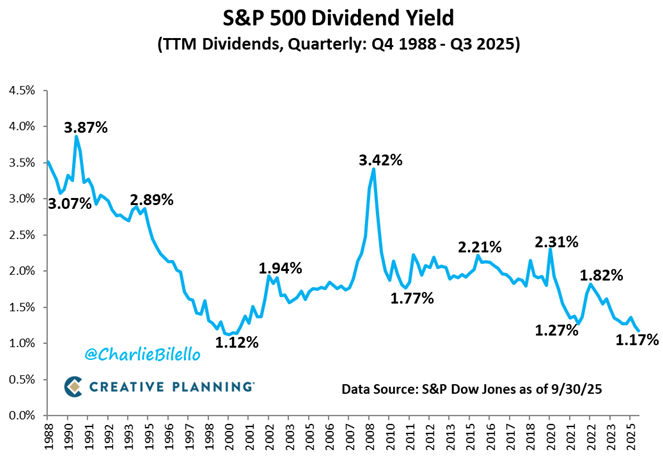
  • The low S&P dividend yield (1.17%) represents a challenge to intermediate-term stock market returns 

As we look at the market today, financials appear to be showing signs of rolling over as technology continues to rocket higher. And the low S&P dividend yield of 1.17% represents a challenge to intermediate-term stock market returns.

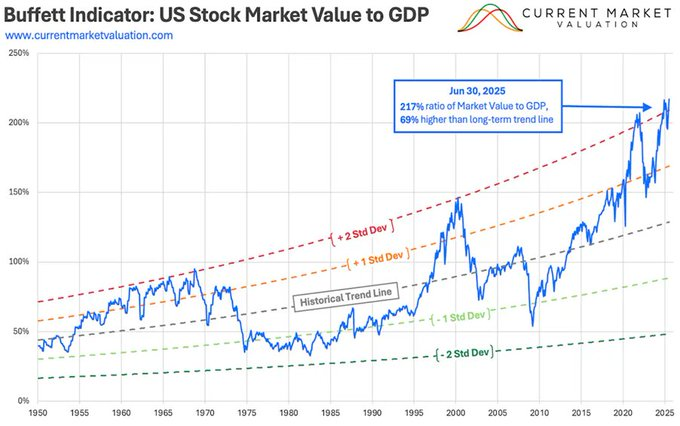
But there's something else worth watching: The ratio of the total U.S. stock market to the nation's gross domestic product. I'm talking about the Buffett Indicator (U.S. total stock market value/GDP), which now stands at two standard deviations above its long-term trendline. The indicator is now at a record high of 217%:

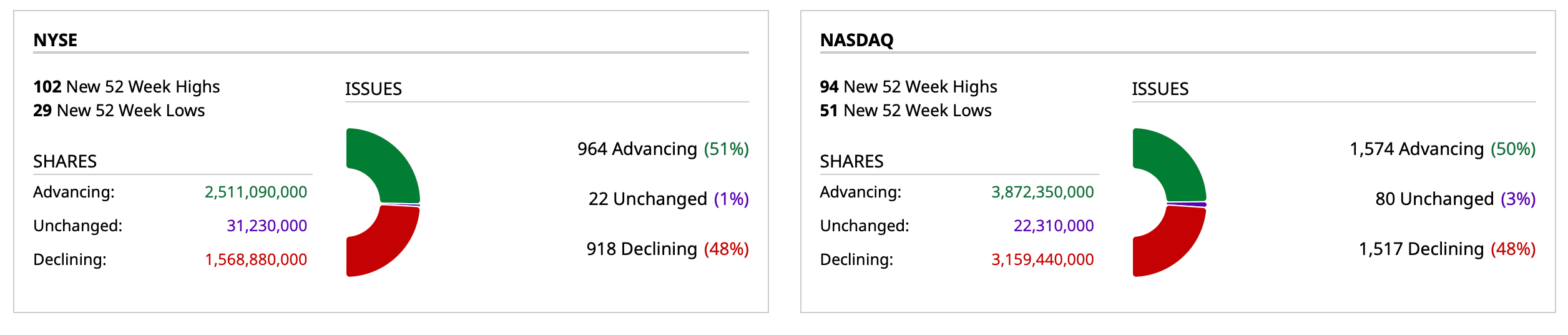
Meanwhile, financials have been notably weak in recent days and market breadth has eroded (yesterday advancers were again flat with decliners — though the averages rose nicely):

The narrow leadership of large-cap technology continues in a market dominated by passive products and strategies that worship at the altar of price momentum.

This is occurring amid continued signposts that domestic economic growth is moderating, inflation remains sticky (and cumulative or stacked inflation since 2020 piles up) and our politicians (on both sides of the aisle) are indifferent to rising deficits and expanding debtloads.

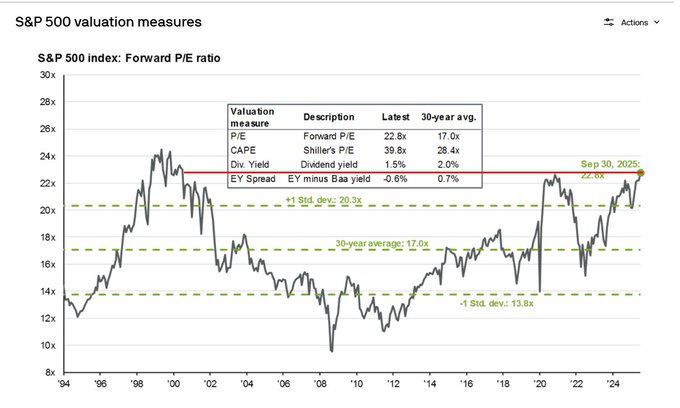
And this is happening at a point in time in which most traditional valuation metrics approach the 98th percentile. Today's price-earnings multiple on the S&P Index is 23-times — the highest in 26 years and compared to the 30-year long-term average of only 17-times: 

Finally, I would note (as few have noted!) that, over time, dividends have contributed about one third of the total return for stocks — with the rest coming from capital appreciation. Today the S&P Dividend Yield is only 1.17% — the lowest read in 2 1/2 decades. The difference between the S&P dividend yield (1.17%) and the risk free rate of return (on the 10-year Treasury note, which yields 4.10%) is also at a multiple-year wide level. By definition, an extremely low market dividend yield becomes a bonafide hurdle to intermediate-term stock market returns:

This commentary was orginally posted in Doug's Daily Diary on TheStreet Pro.

BY Doug Kass · Oct 2, 2025, 11:35 AM EDT

To Everything There Is a Season

To everything - turn, turn, turn

There is a season - turn, turn, turn

And a time to every purpose under heaven


A time to be born, a time to die

A time to plant, a time to reap

A time to kill, a time to heal

A time to laugh, a time to weep

- The Byrds, Turn! Turn! Turn!

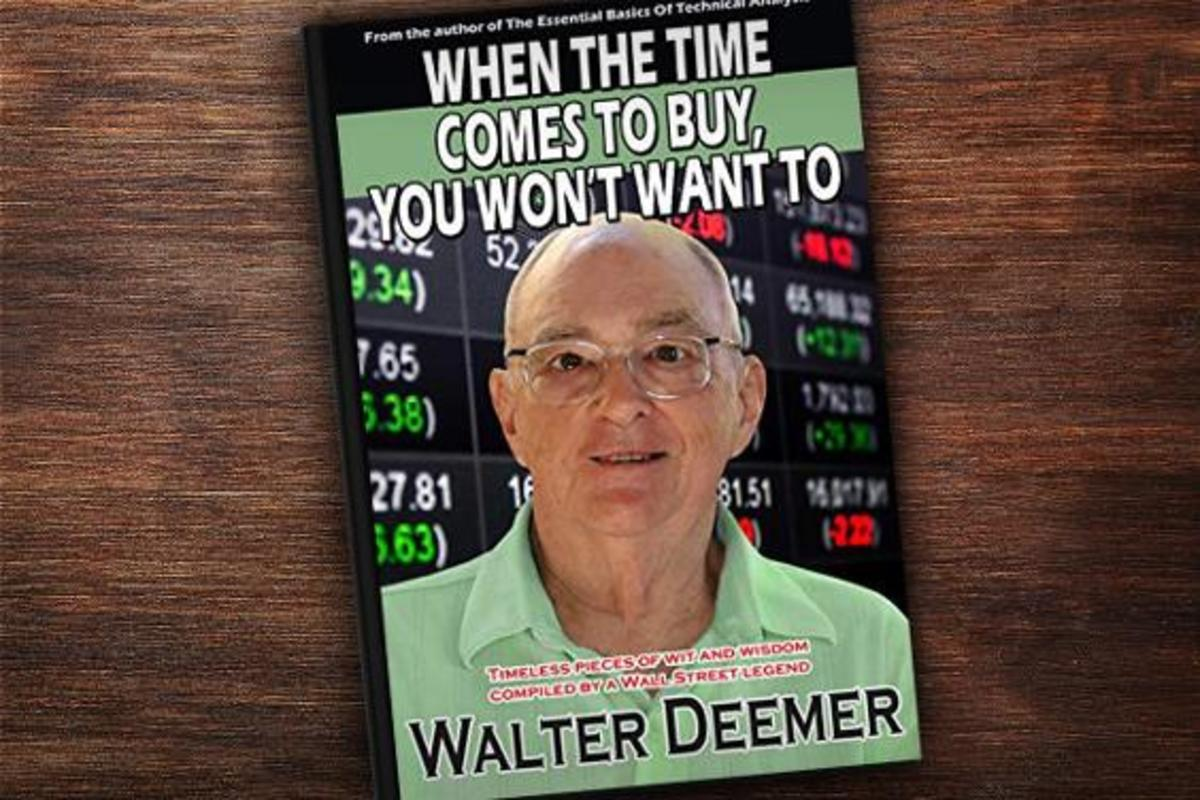
Wally Deemer famously said, "when the time comes to buy, you won't want to." (His book with the same title!)

I say, "when the time comes to sell, you won't want to."

Turn, turn, turn?

BY Doug Kass · Oct 2, 2025, 11:35 AM EDT

Adding Fuel to the Downside

Besides the continued rollover in financials, the "league leading" semiconductors have reversed from the opening strength. 

BY Doug Kass · Oct 2, 2025, 11:08 AM EDT

Weak Financials Might Presage a Fall in the Broader Market

Financials continue to be very weak (we are short a large swath in the sector) for the second day in a row -- though the overall markets have been unaffected.

It is my view, as chronicled over the last week, that this weakness (in money center banks, private equity and brokerage stocks) could presage broad market weakness.

BY Doug Kass · Oct 2, 2025, 10:20 AM EDT

Things I Did Today

Here are today's things:

* Added to Index shorts:  (SPY)  $670.23 and  (QQQ)  $606.40

* Added to  (GRNY)  short at $25.26

* Added to  (NVDA)  short at $189.51

BY Doug Kass · Oct 2, 2025, 9:44 AM EDT

From The Street of Dreams

From JPMorgan:

US: Futs are higher; NDX and RTY are both outperforming. Pre-market, MegaCap Tech are mostly higher led by NVDA (+1.3%) and TSLA (+1.5%). Bond yields are unchanged; USD is lower; Oil is lower, while metals are higher. Overnight, we have seen outperformance in both European and Asian markets despite relatively muted incremental news flows.

and...

JPM MARKET INTEL EQUITY & MACRO NARRATIVE

Yesterday, equities managed to stage a comeback rally after the initial selloff pressure early morning, led by Health Care and Tech, as investors digested the shutdown headline. However, the rally was relatively narrow: only 4 out of 11 sectors finished higher, with over 55% of the SPX stocks closing lower on the day.

We analyzed the historical shutdown events (see our full analysis below) and found that shutdowns lasting more than one business day, the SPX fell 2.5% in the 10 days leading up to the shutdown with Tech and Real Estate the biggest laggards. Once a resolution is reached, the SPX trades up 80bps at the 10-day mark, +3.6% at the 30-day mark, and +5.9% at the 90-day mark. That said, investor conversation today reflected some concerns over a prolonged shutdown period and risks around Trump’s threat on firing federal workers. Eyes on the development of the shutdown negotiation/resolutions in the next two weeks.

BY Doug Kass · Oct 2, 2025, 9:30 AM EDT

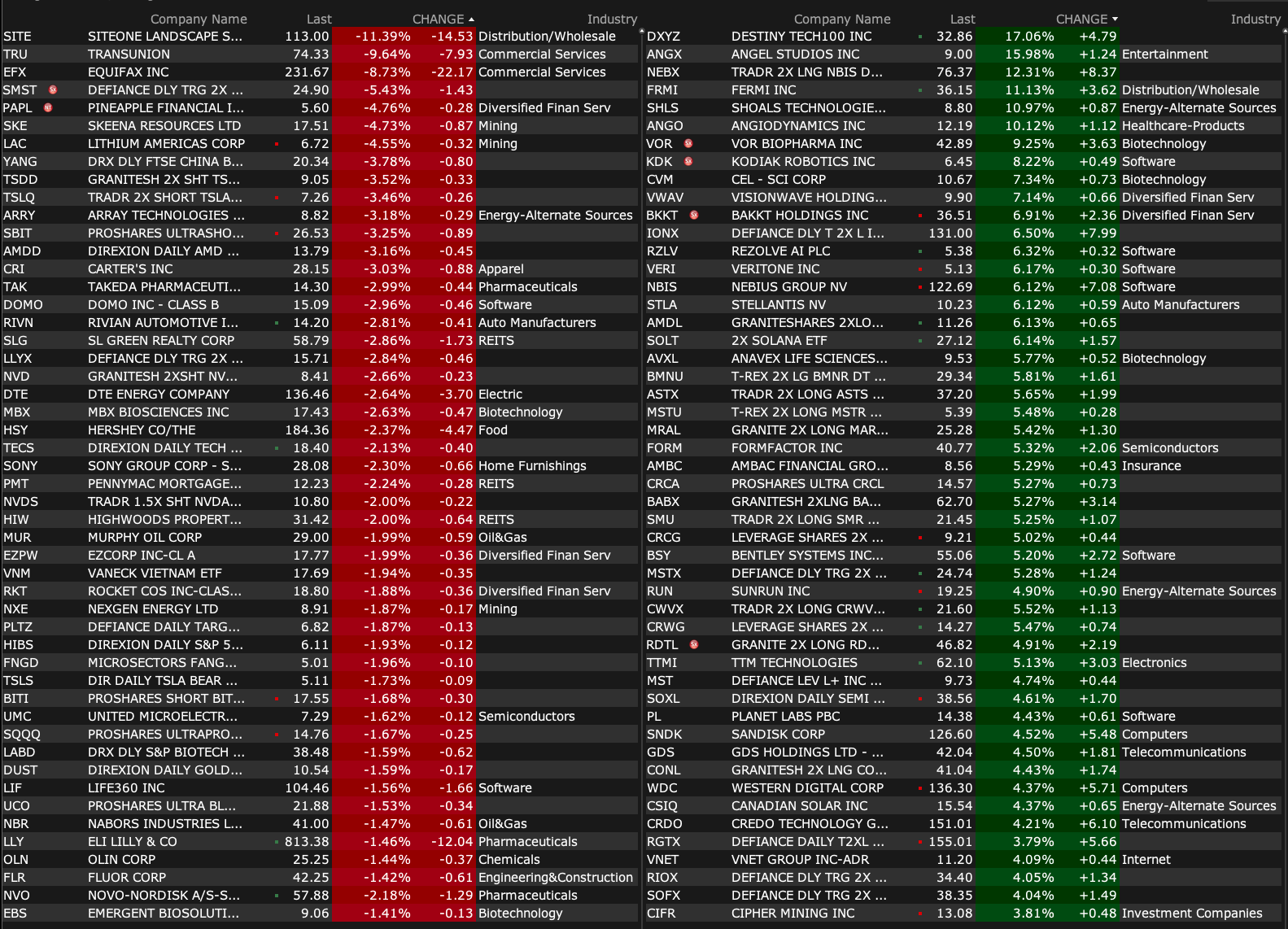
Upside, Downside Action in the A.M.

Upside:

-TSHA +34% (announces FDA Breakthrough Therapy Designation and Provides Positive Regulatory Update on TSHA-102 in Rett Syndrome)

-BINI +20% (signs agreement with Ariel Fleet Holdings to provide FedEx ISPs, advanced logistics systems and Springbok Holdings with 34 commercial EVs for last mile deliveries)

-NBTX +17% (first data from Phase 1 study evaluating JNJ-1900 (NBTXR3) for patients with Esophageal Cancer results in 85% disease control)

-FICO +16% (announces new direct-to-reseller license approach streamlines credit score access, saving lenders up to 50% on per score FICO fees)

-ANGO +12% (earnings, guidance)

-FRMI +11% (post-IPO momentum)

-KDK +11% (Soros Fund Management disclosed passive 5.7% stake)

-SHLS +11% (Barclays Raised SHLS to Overweight from Equal Weight, price target: $10)

-STLA +6.6% (reportedly explores sale of car-sharing unit Free2Move)

-BSY +6.0% (to replace WU in the S&P MidCap 400 Index, effective Oct 6th)

-RUN +5.5% (reportedly Sunrun and Tesla Residential Batteries could help power data centers)

-ONDS +5.2% (places Initial Order for Wasp Attritable Drones from Rift Dynamics for Distribution to U.S. Defense Markets)

-WDC +4.2% (momentum)

-CE +2.4% (CitiGroup Raised CE to Buy from Neutral, price target: $53)

Downside:

-TRU -9.7% (recent notable weakness in credit-reporting stocks attributed to Fair Isaac Corp. reported a new program giving mortgage lenders the option to calculate and distribute FICO scores directly to customers)

-EFX -8.8% (recent notable weakness in credit-reporting stocks attributed to Fair Isaac Corp. reported a new program giving mortgage lenders the option to calculate and distribute FICO scores directly to customers)

-RKT -5.8% (issues Class A common stock)

-LAC -4.1% (Canaccord Genuity Cuts LAC to Sell from Speculative Buy, price target: C$6.50)

-ARRY -3.2% (Barclays Cuts ARRY to Equal Weight from Overweight, price target: $9)

-RIVN -2.1% (reports Q3 production and deliveries; cuts FY25 delivery midpoint)

-SSII -2.1% (provides U.S. Regulatory Update for the SSi Mantra Surgical Robotic System)

BY Doug Kass · Oct 2, 2025, 9:15 AM EDT

The Morning Movers (in One Big Table)

BY Doug Kass · Oct 2, 2025, 9:10 AM EDT

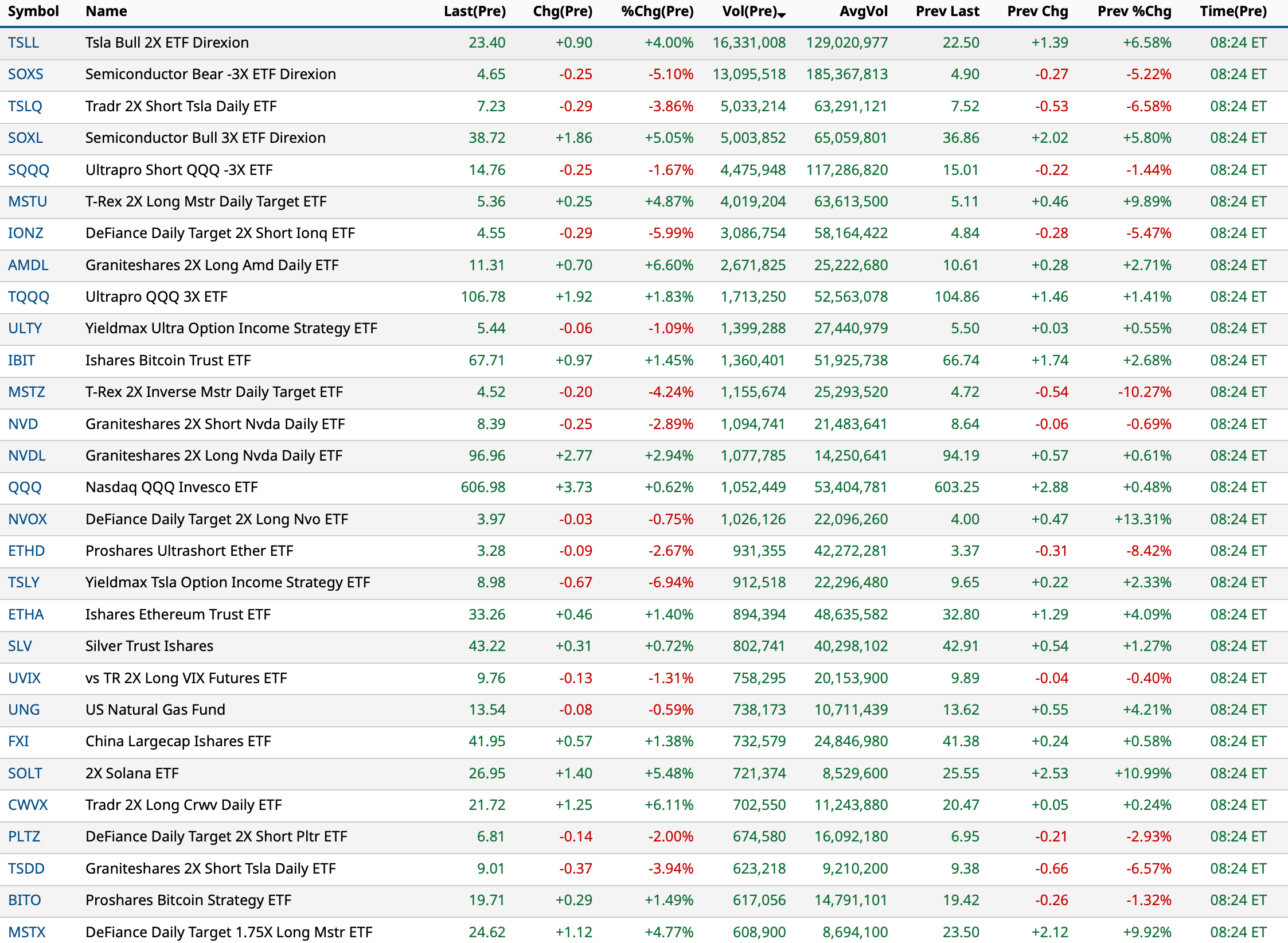
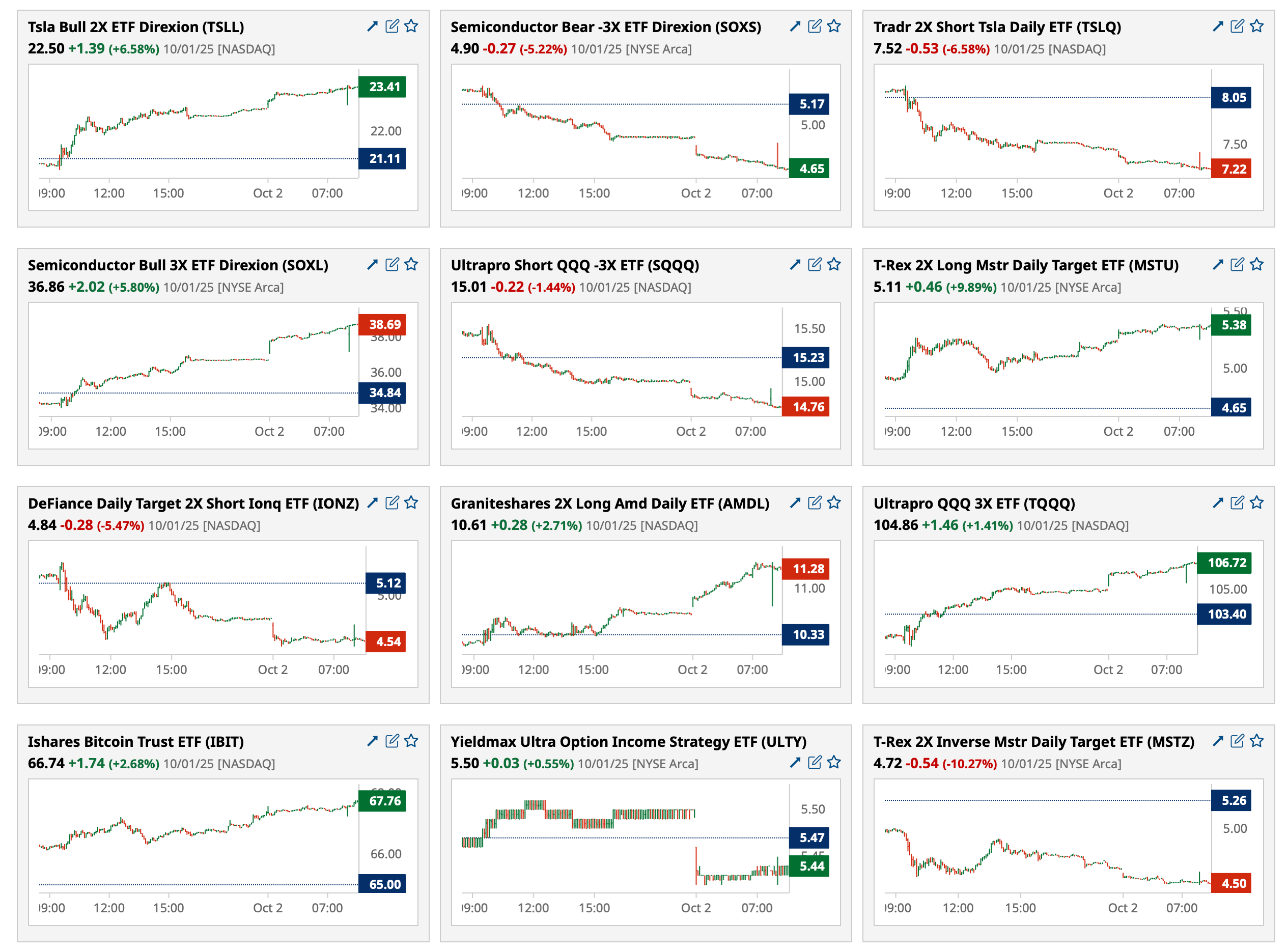
Charting the ETF Action in the A.M.

BY Doug Kass · Oct 2, 2025, 8:54 AM EDT

G'mar Hatimah Tovah!

"Three thousand years of beautiful tradition, from Moses to Sandy Koufax."

- Walter Sobchak (played by John Goodman), talking about his Jewish faith in The Big Lebowski 

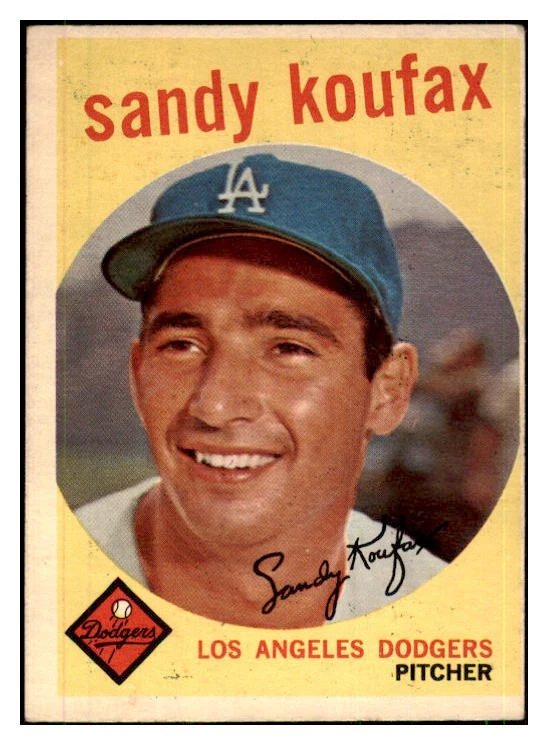
Ten years ago I wrote A Picture of Imperfection about my cousin, Hall of Fame Los Angeles Dodgers pitcher Sandy Koufax — comparing his pitching perfection 50 years earlier to the imperfect, quant-dominated stock-market mechanism that we face today.

As I wrote:

"In my recent column Season of the Glitch, I remarked that this is not your father's market -- it's materially influenced by quants and central planners. That makes it a model of imperfection (unlike my cousin Sandy Koufax, who pitched a perfect game 50 years ago today!)."

-- Doug's Daily Diary, A Picture of Imperfection (Sept. 9, 2015)

But something else important happened in 1965 with Sandy -- he decided to attend synagogue and observe Yom Kippur rather than pitch in the first World Series game against the Minnesota Twins.

Sandy's decision not to pitch on Yom Kippur, the holiest of Jewish holidays, still resonates today

Don Drysdale pitched instead, but was hit hard and the Dodgers lost. Sandy came back from the Jewish holiday the following day and pitched Game Two, but gave up two runs in six innings as the Twins won 5-1 and took a 2-0 lead in the series.

Drysdale and fellow pitcher Claude Osteen won in the next two games for the Dodgers and tied the series at 2-2, then Sandy pitched a complete-game shutout in Game 5 to give the Dodgers a 3-2 series lead. But then the Twins won Game 6 to force a seventh game.

Sandy started that last game on just two days rest. Pitching through fatigue and severe arthritis, which would eventually end his career, Sandy couldn't throw his curveball and pitched nearly the entire game relying on fastballs instead.

But Sandy still managed to strike out 10 Twins en route to a three-hit shutout, winning the series for the Dodgers and a second World Series MVP award for himself. He was also named the Sports Illustrated 1965 "Sportsman of the Year."

Sandy started his pro career in 1955, but didn't blossom into legendary status until 1961. His stats were as dominant as any pitcher in the majors, but it was his final four seasons (1963-66) that earned his reputation as the modern era's greatest left-handed pitcher.

He pitched no hitters in each of those four years, and his average seasonal record was 24-7 with a 1.86 ERA. He also averaged 298 innings pitched and 307 strikeouts per season -- striking out an amazing 382 batters in 1965.

Sandy's most remarkable stat of that period was that he averaged 22 complete games per season. And in his last season (1966), his record was 27-9, with a 1.73 ERA, five shutouts, 27 complete games, 323 innings pitched and 317 strikeouts. These statistics are even more amazing when you consider that every pitch Sandy threw that year was made while in terrible pain from a seriously arthritic arm and shoulder.

I suppose there are lessons to be learned from Sandy's career about perseverance, achieving success and "playing in pain." Much like investors have struggled this year. But to many, the lesson he delivered by deciding not pitch on Yom Kippur was the greatest one of them all.

I wanted to wish all of my Jewish friends an easy fast -- and a G'mar Hatimah Tovah! ("May You Be Sealed for a Good Year in the Book of Life") to everyone, Jewish or not!

BY Doug Kass · Oct 2, 2025, 8:30 AM EDT

The Buffett Indicator Hits a Record High

* Financials may be showing signs of rolling over

* Technology continues to roll higher

* The low S&P dividend yield (1.17%) represents a challenge to intermediate-term stock market returns 

The Buffett Indicator stands at two standard deviations above its long-term trendline and at a record high of 217%:

Meanwhile, financials have been notably weak in recent days and market breadth has eroded (yesterday advancers were again flat with decliners — though the averages rose nicely):

As the narrow leadership of large-cap technology continues in a market dominated by passive products and strategies that worship at the altar of price momentum.

This is occurring amid continued signposts that domestic economic growth is moderating, inflation remains sticky (and cumulative or stacked inflation since 2020 piles up) and our politicians (on both sides of the aisle) are indifferent to rising deficits and expanding debtloads.

And this is happening at a point in time in which most traditional valuation metrics approach the 98%-tile. Today's price-earnings multiple on the S&P Index is 23x — the highest in 26 years and compared to the 30-year long-term average of only 17x: 

Finally, I would note (as few have noted!) that, over time, dividends have contributed about one third of the total return for stocks — with the rest coming from capital appreciation. Today the S&P Dividend Yield is only 1.17% — the lowest read in 2 1/2 decades. The difference between the S&P dividend yield (1.17%) and the risk free rate of return (on the 10-year Treasury note which yields 4.10%) is also at a multiple-year wide level. By definition, an extremely low market dividend yield becomes a bonafide hurdle to intermediate-term stock market returns:

BY Doug Kass · Oct 2, 2025, 7:17 AM EDT

Charting the Technicals

https://www.twitter.com/WallStWingman/status/1973123257873408188
https://www.twitter.com/CyclesFan/status/1973479733322194947
https://www.twitter.com/MikeZaccardi/status/1973477010631696894
https://www.twitter.com/JSpitTrades/status/1973368269416616267
https://www.twitter.com/JC_ParetsX/status/1973484941167202751
https://www.twitter.com/KimbleCharting/status/1973408235316191600
https://www.twitter.com/NautilusCap/status/1973343940570128671
https://www.twitter.com/AlfCharts/status/1973360244953592110
https://www.twitter.com/conradseric/status/1973502634335318140
https://www.twitter.com/JasonP138/status/1973374899394584645

Bonus — Here are some great links:

A Quarter for the History Books

Is The Fed Behind the Curve?

Cheat Code Unlocked

It's All Relative

Small Stock, Big Trends

BY Doug Kass · Oct 2, 2025, 6:25 AM EDT

Howling About Tariff Income and More

Wolf Street on tariff income and the difficulty in passing on rising tariffs. 

BY Doug Kass · Oct 2, 2025, 6:10 AM EDT

The Oscillator Is Neutral

The S&P Short Range Oscillator is at -0.04% vs. -0.47%. That is neutrally positioned.

BY Doug Kass · Oct 2, 2025, 5:55 AM EDT

Premarket Trading (at 5:01 AM)

Added to short indices:

* SPY $669.84

(QQQ)  $605.67

BY Doug Kass · Oct 2, 2025, 5:44 AM EDT