From JP Morgan:
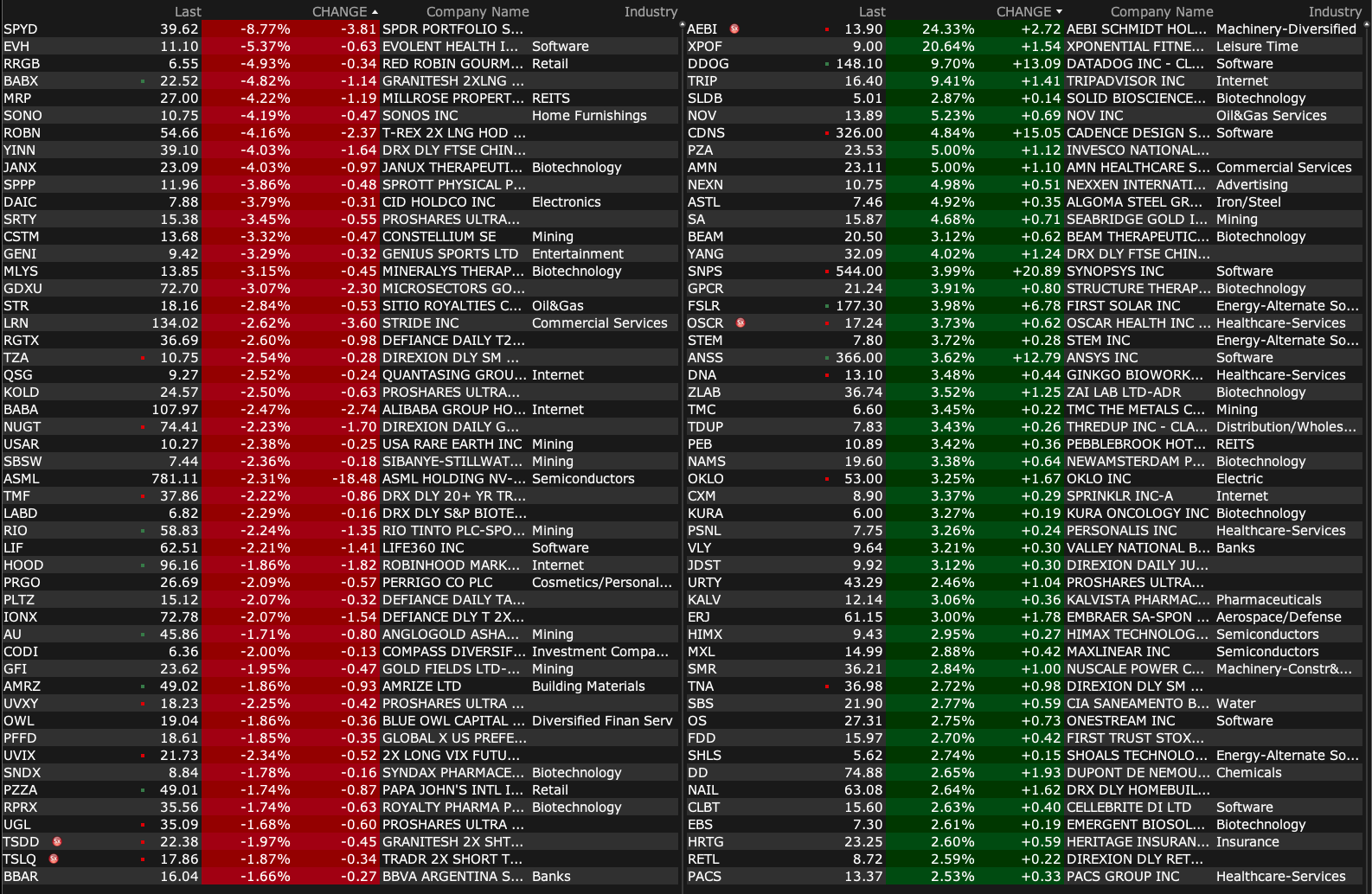
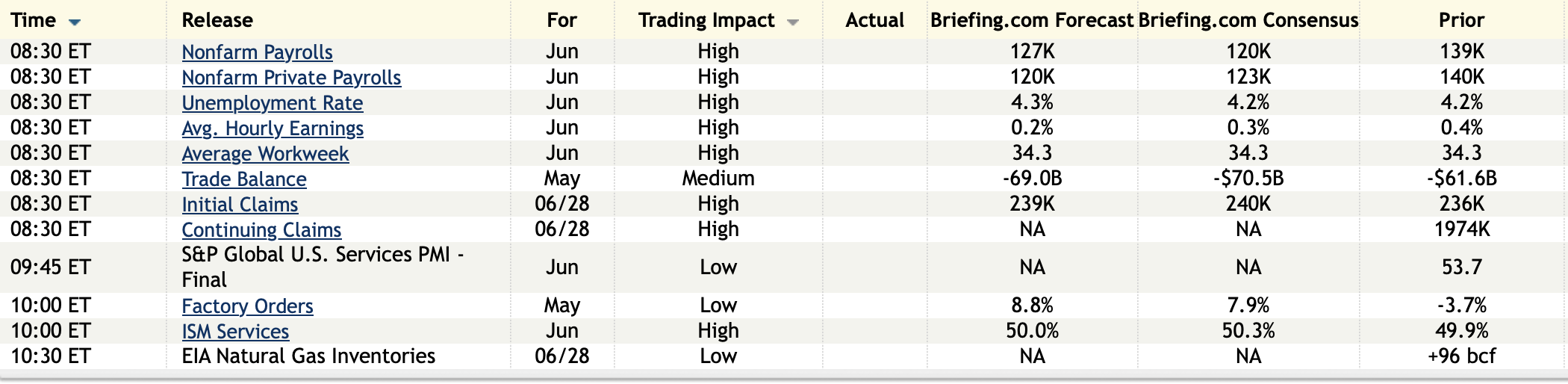
US: Futs are flat with RTY outperforming into NFP. Siemens says that the US has dropped its restrictions on software, used to design semis, exports to China, CDNS/SNPS are both up more than 6%. Pre-mkt, bond yields are lower reflecting heighten downside risk to NFP today; BBG consensus is 106k jobs with BBG whisper number of 96k. USD is flat with cmdtys higher led by ags, base/precious, and natgas. The tax/budget bill appears likely to pass later this morning so keep an eye on yields though any impact may be delayed until next week given the holiday.
and...
Prime Time / Monthly Wrap | Positive Momentum Continued in June Though Potential Rotations Remain in Focus
SUMMARY: June was another solid month for global equities with US TMT and Korea leading the way. Some of the trends last month broadly continued, such as positive HF performance (+2.4% MTD globally), high gross leverage (97th %-tile over past 5yrs), increased net leverage (+3% MoM and 77th %-tile over past 5yrs), continued rally (and higher risk) in Momentum globally, and further normalization in EU vs. US flows/positioning.
The first day of July brought with it a big sell-off in Momentum and there’s a sense that equity performance could broaden out in the US if macro data remains benign and the Fed were to pivot more dovishly. As we think about some of the key themes from June and what could be in focus going forward, here are a few things we’re focused on:
1. Will the Momentum unwind persist? On Tuesday, we saw modest de-grossing by HFs in aggregate, but the overall magnitude wasn’t that extreme (-0.4z gross flows globally, though almost -2z for Quants in N. Am.). Notably, the decline in Momentum has been global, but started in AxJ last week. In addition, there was also a drop in performance of HF crowded stocks, but the decline was greater on the long side than were gains on the short side.
Ultimately, whether the drop in Momentum persists could depend on a) macro data and whether Fed expectations shift, b) tariffs / trade deals, and c) earnings.
To us, the potential for further de-grossing remains high from a flows/positioning standpoint as: a) gross leverage and flows remain high, b) Momentum net risk is at multi-year highs for Quants and L/S funds, c) Equity L/S funds’ long leverage is at the highest since late 2021, d) Quants have seen choppy performance lately in the US, e) some sectors/themes continue to have relatively wide positioning divergences.
Additionally, EU Momentum positioning remains stretched among HFs with net exposure >90th %-tile, though flows started turning negative in late June.
2. How will US Tech vs. Russell perform going forward, given differential in positioning? On the Tech side, combined flows to Info Tech turned negative in June (despite index outperformance) and HFs started to sell AI TMT (JPAITMT) stocks into the late June rally (something they did earlier this year and last June), which could suggest less confidence in near-term upside.
However, there are still risks in terms of Tech positioning. HF positioning in US Semis remains very close to 10yr highs. ETF positioning shows Info Tech’s weight in absolute and relative terms (vs. SPX) at highs. CTA positioning in NDX vs. RTY was back at mid-Feb ’25 and early Jul ’24 levels.
On the small cap side, positioning and flows generally remain light. In futures, AM positioning is at neutral levels. ETF flows to small caps have been at lows for the past few months. Eq L/S net exposure to Size factor has gone up as SPX has outperformed RTY since late ’24.
3. Do HFs eventually cover shorts in a big way? So far, the drivers of US High SI stocks over the past couple months seem to be related to factors (our measure of Risky factors’ 3m returns are back at highs), rather than HF specific behavior as the Short Interest factor hasn’t seen nearly as big an increase as we’ve seen during other large short-cover periods. Thus, if the market keeps rallying and gains broaden out, it’s possible that we could see this dynamic shift a bit further. Retail flows have also been relatively limited, but could drive increases if they accelerate again.
4. Could Banks / Financials keep rallying? Among HFs, one of the most net bought groups in the US lately have been Banks. However, the group could keep outperforming, especially if we see ETF flows pick back up as Financials ETF positioning remains very low. On the European side, Banks remain one of the more favored trades and saw small buying among HFs last month (HF net exposure at the 85th %-tile since 2018, though not as high as Cap Goods).
5. Industrials (esp. Cap Goods) a sector to watch globally? In Europe, Cap Goods remains the most net long group (+3z and 98th %-tile since 2018), though overall net flows last month were neutral. Within the group, EU Defence was sold again in late June by HFs as they seemed to take profits. The profit taking has reduced risk levels a bit, but the overall positioning remains elevated. In the US, we’re seeing ETF inflows return to Industrials, while HFs further bought Cap Goods, putting net exposure at 12m highs, but only 70th %-tile since ’18. In AxJ, Cap Goods is the most net long group (98th %-tile since ’18) and in Japan, Cap Goods was bought for the past 2 months and positioning is relatively high as well (82nd %-tile).
6. Can Japan break higher? CTA positioning in Japan recovered further to 72nd %-tile (though still below HK at 98th %-tile). From a sector standpoint, key groups like Semis, Banks, and Autos have seen HF net buying from the lows, but positioning remains relatively neutral.
7. Will AxJ selling reverse? Despite the continued rebound in AxJ, HF net flows remained negative in June. Notably, some of the large selling over the past few weeks has come in Korea with longs sold into the sharp rally. Over the past few years, HF flows & positioning have generally been positively correlated to performance, so the recent divergence is quite large (though we saw something similar around the middle of last year).
VIEWS ON ADP YESTERDAY
· US MKT INTEL (we sent below immediately after the release to some IB chats): Post pandemic, this is the second time where ADP prints a negative number (the last time was March 2023). The decline in ADP employment was primary driven by Services (Financial activities, professional/business services and Education/Health services), while Leisure and hospitality remain robust (which is in line with the JOLTS report yesterday). While this is clearly a negative signal on labor market, two things may worth considering on the impacts: (i) ADP’s Chief Economists mentioned that layoffs continue to be rare and the decline was more driven by hesitancy to hire; (ii) Overall, ADP is not a reliable predictor of NFP. From ADP Chief Economist: “Job losses in professional and business services, and education and health services led the decline. Leisure and hospitality, and manufacturing showed gains…Though layoffs continue to be rare, a hesitancy to hire and a reluctance to replace departing workers led to job losses last month. Still, the slowdown in hiring has yet to disrupt pay growth.”