Taking in My Short Index Calls
With S&P cash +40 handles (halving from the highs of an hour ago!) I am taking in my short index calls for a small profit.
I now have no index positions on.
BY Doug Kass · May 8, 2025, 3:56 PM EDT
 Doug KassDoug Kass
With S&P cash +40 handles (halving from the highs of an hour ago!) I am taking in my short index calls for a small profit.
I now have no index positions on.
BY Doug Kass · May 8, 2025, 3:56 PM EDT
*The yield on the 2-year Treasury note is +11 basis points to 3.90%.
*The yield on the 5-year Treasury note +12 basis points to 4.00%.
*The yield on the 10-year Treasury note is +10 basis points to 4.37%.
*The yield on the 30-year Treasury bond is +6 basis points to 4.83%.
BY Doug Kass · May 8, 2025, 2:51 PM EDT
I have a 3 p.m. research meeting.
I am not sure how long it will be.
BY Doug Kass · May 8, 2025, 2:35 PM EDT
BY Doug Kass · May 8, 2025, 1:37 PM EDT
I am back to one of my largest net short exposures in the last six months.
If the rationale for the advance is the US/UK tariff "announcement" and its positive impact on our country's trade, I have a bridge to sell all of you!
BY Doug Kass · May 8, 2025, 1:23 PM EDT
About three weeks ago I initiated a long in Interactive Brokers Group IBKR at $159.30 (see below).
I just sold my position at $186.11.
From April 17:
Here are today's "things:"
* Financial buys: (IBKR) $159.30
* Added to (MSOS) at $2.31.
By Doug Kass Apr 17, 2025 12:05 PM EDT
BY Doug Kass · May 8, 2025, 1:06 PM EDT
As of 11:30 a.m. EST:
- NYSE volume 3% below its one-month average
- NASDAQ volume 7% below its one-month average
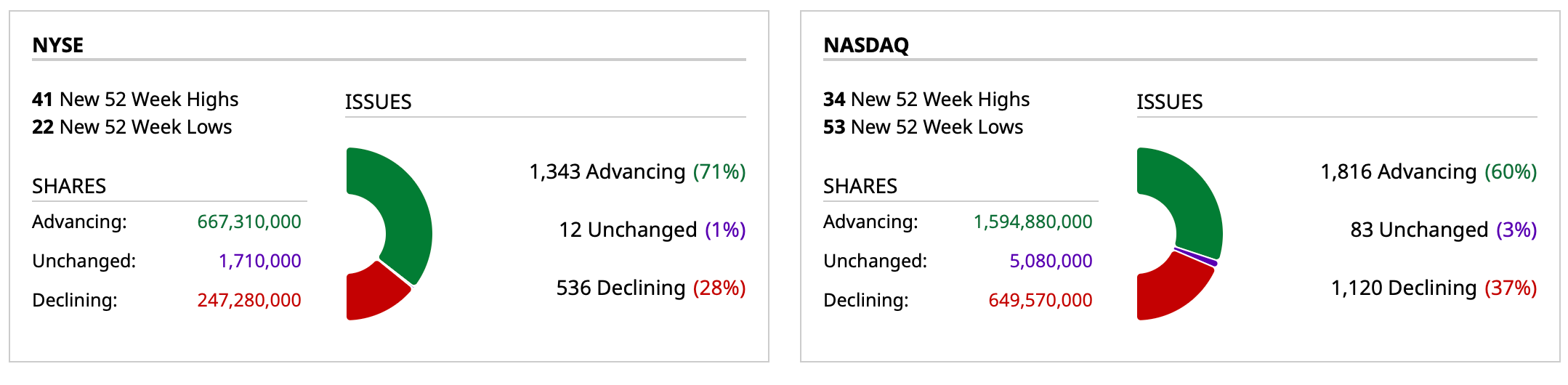
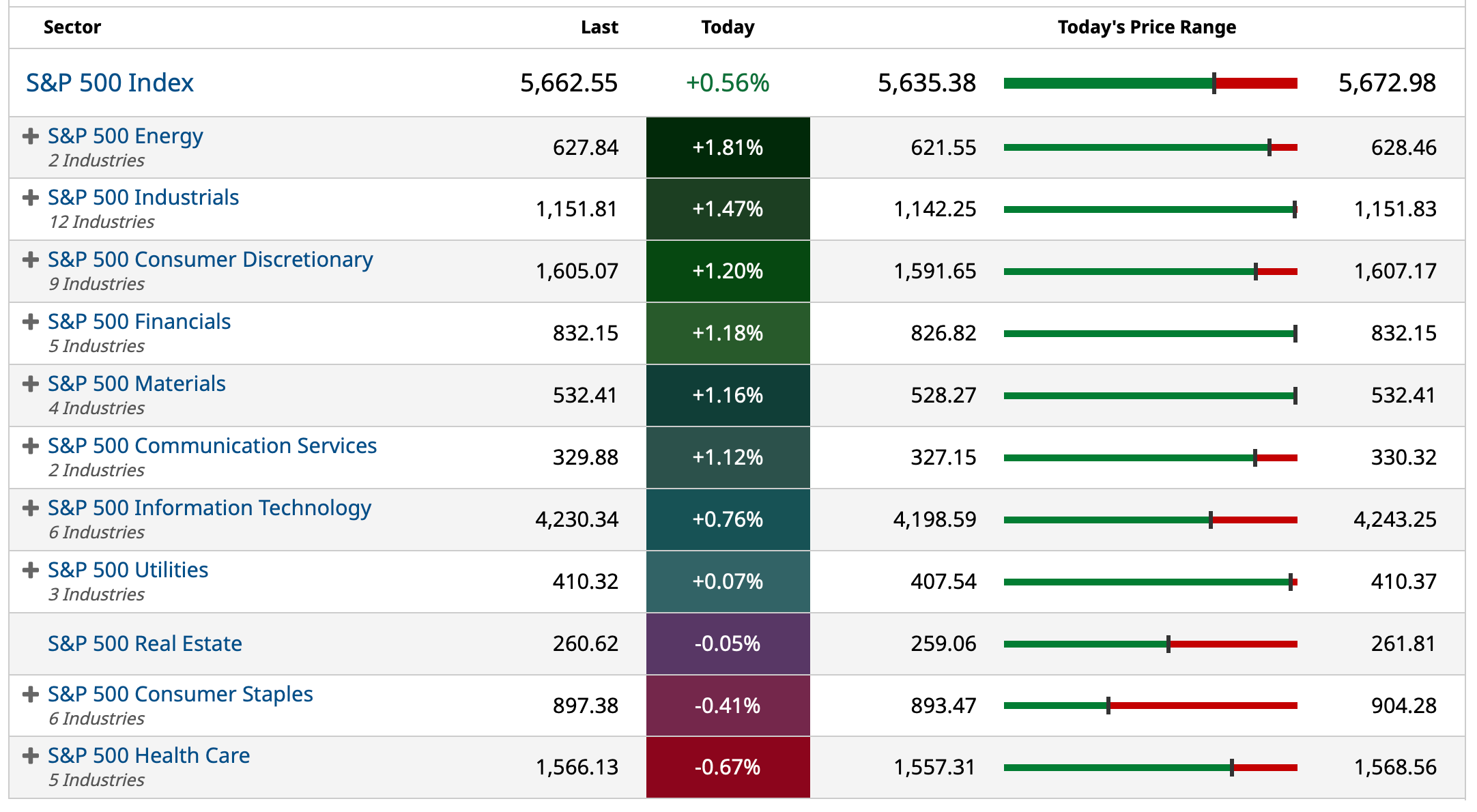
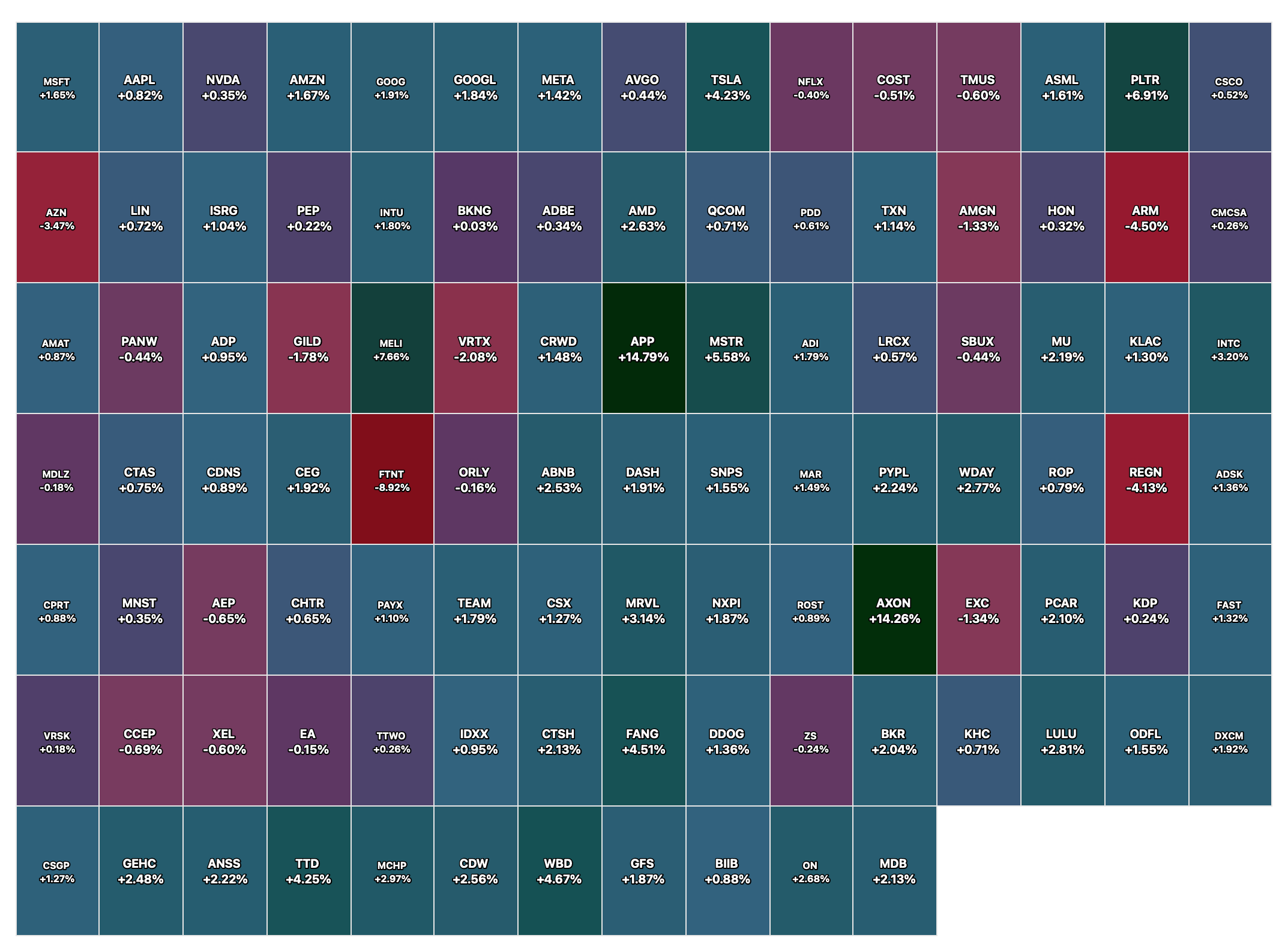
BY Doug Kass · May 8, 2025, 12:19 PM EDT
With S&P cash +80 handles I'm shorting more index calls.
BY Doug Kass · May 8, 2025, 12:11 PM EDT
From Peter Boockvar:
The breadth and scope of deal will be most interesting/BoE cuts as expected/Other good stuff
The announced US/UK trade deal today will be a good test case for all the other deals in terms of the scope and breadth of it. Are there going to be widespread declines in trade barriers and tariffs, the hoped for goal? Will this be a narrow deal instead with a few things here and there? Will the 10% baseline tariff on the UK, along with everyone else, still remain?
The Bank of England cut rates by 25 bps as expected to 4.25% in a 5-4 vote where two wanted a cut of 50 bps and two preferred no change. Their committee continues to be an interesting mix of opinions/dissents unlike the Fed which tends to coalesce around a consensus most of the time. They said "There has been substantial progress on disinflation over the past two years, as previous external shocks have receded, and as the restrictive stance of monetary policy has curbed second-round effects and stabilized longer-term inflation expectations...Progress on disinflation in domestic price and wage pressures is generally continuing."
What happens next? They set out two possible scenarios where in light of the global trade situation it could lead to either higher prices due to the weaker supply of things or on the other hand, demand falters more than supply does and prices fall. Thus, "Monetary policy is not on a pre-set path."
In response to the non-committal on what happens next, the pound went from red to green vs the US dollar, gilt yields went from slightly down to now up while the FTSE 100 is off its highs.
With respect to rate cut odds post the FOMC statement and Powell presser which went as a neutral stance as I suspected it would go, there is still almost a 100% chance of 3 rate cuts priced in this year.
The Swedish Riksbank and the Norges Bank each kept their policy rates unchanged as expected.
Something I expressed in early February after the DeepSeek news, I'll argue again on the heels of the Google story yesterday that the S&P 500 has lost the Big 7 stocks as the leadership group and it could be lost forever after an historic, incredible run. More challenging fundamentals and heady valuations/market caps that pulled forward a lot of future returns along with a world that overloaded on them are the main reasons. Whose hands the baton will eventually end up in remains to be seen but there is finally an opportunity to find other things to buy that could work as opposed to just anything related to AI. International markets have plenty of opportunities in addition to value stocks with good, boring businesses in the US.
Spurred on by the rush to buy new vehicles ahead of tariffs which in turn drove some to buy used vehicles instead led the Manheim wholesale used vehicle index to rise 2.7% m/o/m in April and 4.9% y/o/y on a seasonally adjusted basis. Manheim said "The 'spring bounce' normally ends the 2nd week of April, but this year, wholesale appreciation trends continued for the entire month and were much stronger than we typically observe. We expected to see strong price appreciation in response to the tariffs, and that's exactly what came. Weekly trends showed higher values as we moved through the month, but those increases tapered off each successive week. Used retail sales remain stronger than normal, and wholesale days' supply is a bit tighter, so we will likely see less depreciation than normal over Q2."
Of course in question is the sustainability of the price gains after the pull forward tires out. And we know vehicles, both new and used, are a key component of the core goods portion of CPI.
Staying on the inflation theme post Fed, I finally went through some multi family REIT conference calls to hear from them what is going on with rent trends, both for new and renewals.
From Camden Property Trust, whose portfolio is mostly in sunbelt states where the most supply has come online, a stock we own and run by one of my favorite management teams:
"New supply has peaked in our markets and apartment absorption continues to be strong. In fact, new starts are at a 13 yr low and are down 80% in Austin and between 65% and 80% in Houston, Denver, Charlotte, Raleigh, Atlanta, Nashville, and Washington, DC."
By the way, they said they've seen no DOGE impact on their DC occupancy and rents.
"Rent affordability continues to be a tailwind with wage growth outpacing rent growth by over 300 bps for the past 28 months. The premium to own versus rent continues to be at historically high levels, making apartment homes more affordable."
On the pricing side in Q1, effective new leases were down by 3.1% y/o/y while renewal rates were higher by 3.3% "for a blended rate of negative .1%." In the prior quarter it was down 1.1% and they believe that the current quarter will be slightly better than the one just reported. "Renewal offers from May, June and July were sent out with an average increase of 4.2%."
I will repeat my point that we should enjoy the current slowdown in rent growth because by next year and in 2027, rents are going straight up again because of the lack of new multi family supply going forward. Camden's belief on this, "we're underwriting with a view that rents are going to be flatish for this year. And then they're going to start to rise next year at probably better than normal rates. And then within, in '27, '28, we're going to have outsized revenue growth."
Equity Residential has more coastal city multi family exposure and they said this last week:
"blended growth of 1.8% in the quarter came in right at the midpoint of our expected range. We saw strength in New York and Washington, DC as well as continued improvement in our West Coast markets of Seattle and San Francisco."
"We have an expectation for blended rate growth of 2.8% and 3.4% in the 2nd quarter and feel really well positioned as we enter the primary leasing season, despite the overall economic ambiguity."
CDW is one of my go-to tech calls as they distribute about 100,000 different tech products to about 250,000 customers with businesses of all sizes, government, schools and healthcare facilities. Most of their sales are in the US and their stock rallied 7% yesterday.
"Broadly speaking, customers remained focused on mission critical projects and must to-do's and their priorities were consistent with 2024, laser focused on operating efficiency and expense elasticity with one addition, client device prioritization, which reflected three factors: need for refresh, the upcoming Windows 10 expiration and the desire to get ahead of tariff related price increases."
"Commercial market growth was consistent with the favorable trajectory we saw late in the fourth quarter. Tariff uncertainty slowed down major infrastructure investments, but also drove demand for client devices and greater focus on expense elasticity, consumption based solutions, and services."
"Federal government market growth was subdued throughout the quarter as agencies digested the impact of new policy priorities, while education growth accelerated towards the end of the quarter, driven by Chromebook demand ahead of potential price increases."
They forecast 2025 US IT market growth "to be in the low single digits on a customer spend basis with a CDW growth premium of 200 bps to 300 bps."
From Uber:
They saw "a bit more growth internationally than the US, especially in the travel sector that affected overall price/mix." And specifically with the US "that's a bit due to that lower inbound US travel, which comes with lower gross bookings per trip."
On the other hand, "We're not seeing trade downs in terms of the kinds of restaurants that our eaters are eating at...And remember, the categories that we operate in, these are restaurants, transportation, grocery, tend to be categories that are quite consistent even during periods of macro uncertainty."
Finally, reflecting the large amount of pull forward ordering, Taiwanese exports spiked by 30% y/o/y in April, well higher than the estimate of up 16%.
BY Doug Kass · May 8, 2025, 11:46 AM EDT
With S&P cash +51 handles, I'm back shorting the index calls:
I had covered my Index shorts earlier:
With S&P futures up by less than +10 handles I am taking in all of my Index common and call shorts for a profit.
That was quick!
Position: None.
By Doug Kass May 8, 2025 10:17 AM EDT
BY Doug Kass · May 8, 2025, 11:38 AM EDT
drrtl
So interesting that Trump team after 25 years gets a trade deal done with UK. Why 25 years !
TechNova
Because an implicit one was already in place. We have a massive trade surplus already with the U.K., and their import tariffs are negligible. (less than 1%).Do we need a manual on how to breath air as humans?
BY Doug Kass · May 8, 2025, 11:11 AM EDT
* Stated simply...
Little details and a lot of glittering generalities.
BY Doug Kass · May 8, 2025, 11:02 AM EDT
From Peter Boockvar
The announced US/UK trade deal today will be a good test case for all the other deals in terms of the scope and breadth of it. Are there going to be widespread declines in trade barriers and tariffs, the hoped for goal? Will this be a narrow deal instead with a few things here and there? Will the 10% baseline tariff on the UK, along with everyone else, still remain?
The Bank of England cut rates by 25 bps as expected to 4.25% in a 5-4 vote where two wanted a cut of 50 bps and two preferred no change. Their committee continues to be an interesting mix of opinions/dissents unlike the Fed which tends to coalesce around a consensus most of the time. They said "There has been substantial progress on disinflation over the past two years, as previous external shocks have receded, and as the restrictive stance of monetary policy has curbed second-round effects and stabilized longer-term inflation expectations...Progress on disinflation in domestic price and wage pressures is generally continuing."
What happens next? They set out two possible scenarios where in light of the global trade situation it could lead to either higher prices due to the weaker supply of things or on the other hand, demand falters more than supply does and prices fall. Thus, "Monetary policy is not on a pre-set path."
In response to the non-committal on what happens next, the pound went from red to green vs the US dollar, gilt yields went from slightly down to now up while the FTSE 100 is off its highs.
With respect to rate cut odds post the FOMC statement and Powell presser which went as a neutral stance as I suspected it would go, there is still almost a 100% chance of 3 rate cuts priced in this year.
The Swedish Riksbank and the Norges Bank each kept their policy rates unchanged as expected.
Something I expressed in early February after the DeepSeek news, I'll argue again on the heels of the Google story yesterday that the S&P 500 has lost the Big 7 stocks as the leadership group and it could be lost forever after an historic, incredible run. More challenging fundamentals and heady valuations/market caps that pulled forward a lot of future returns along with a world that overloaded on them are the main reasons. Whose hands the baton will eventually end up in remains to be seen but there is finally an opportunity to find other things to buy that could work as opposed to just anything related to AI. International markets have plenty of opportunities in addition to value stocks with good, boring businesses in the US.
Spurred on by the rush to buy new vehicles ahead of tariffs which in turn drove some to buy used vehicles instead led the Manheim wholesale used vehicle index to rise 2.7% m/o/m in April and 4.9% y/o/y on a seasonally adjusted basis. Manheim said "The 'spring bounce' normally ends the 2nd week of April, but this year, wholesale appreciation trends continued for the entire month and were much stronger than we typically observe. We expected to see strong price appreciation in response to the tariffs, and that's exactly what came. Weekly trends showed higher values as we moved through the month, but those increases tapered off each successive week. Used retail sales remain stronger than normal, and wholesale days' supply is a bit tighter, so we will likely see less depreciation than normal over Q2."
Of course in question is the sustainability of the price gains after the pull forward tires out. And we know vehicles, both new and used, are a key component of the core goods portion of CPI.
Staying on the inflation theme post Fed, I finally went through some multi family REIT conference calls to hear from them what is going on with rent trends, both for new and renewals.
From Camden Property Trust, whose portfolio is mostly in sunbelt states where the most supply has come online, a stock we own and run by one of my favorite management teams:
"New supply has peaked in our markets and apartment absorption continues to be strong. In fact, new starts are at a 13 yr low and are down 80% in Austin and between 65% and 80% in Houston, Denver, Charlotte, Raleigh, Atlanta, Nashville, and Washington, DC."
By the way, they said they've seen no DOGE impact on their DC occupancy and rents.
"Rent affordability continues to be a tailwind with wage growth outpacing rent growth by over 300 bps for the past 28 months. The premium to own versus rent continues to be at historically high levels, making apartment homes more affordable."
On the pricing side in Q1, effective new leases were down by 3.1% y/o/y while renewal rates were higher by 3.3% "for a blended rate of negative .1%." In the prior quarter it was down 1.1% and they believe that the current quarter will be slightly better than the one just reported. "Renewal offers from May, June and July were sent out with an average increase of 4.2%."
I will repeat my point that we should enjoy the current slowdown in rent growth because by next year and in 2027, rents are going straight up again because of the lack of new multi family supply going forward. Camden's belief on this, "we're underwriting with a view that rents are going to be flatish for this year. And then they're going to start to rise next year at probably better than normal rates. And then within, in '27, '28, we're going to have outsized revenue growth."
Equity Residential has more coastal city multi family exposure and they said this last week:
"blended growth of 1.8% in the quarter came in right at the midpoint of our expected range. We saw strength in New York and Washington, DC as well as continued improvement in our West Coast markets of Seattle and San Francisco."
"We have an expectation for blended rate growth of 2.8% and 3.4% in the 2nd quarter and feel really well positioned as we enter the primary leasing season, despite the overall economic ambiguity."
CDW is one of my go-to tech calls as they distribute about 100,000 different tech products to about 250,000 customers with businesses of all sizes, government, schools and healthcare facilities. Most of their sales are in the US and their stock rallied 7% yesterday.
"Broadly speaking, customers remained focused on mission critical projects and must to-do's and their priorities were consistent with 2024, laser focused on operating efficiency and expense elasticity with one addition, client device prioritization, which reflected three factors: need for refresh, the upcoming Windows 10 expiration and the desire to get ahead of tariff related price increases."
"Commercial market growth was consistent with the favorable trajectory we saw late in the fourth quarter. Tariff uncertainty slowed down major infrastructure investments, but also drove demand for client devices and greater focus on expense elasticity, consumption based solutions, and services."
"Federal government market growth was subdued throughout the quarter as agencies digested the impact of new policy priorities, while education growth accelerated towards the end of the quarter, driven by Chromebook demand ahead of potential price increases."
They forecast 2025 US IT market growth "to be in the low single digits on a customer spend basis with a CDW growth premium of 200 bps to 300 bps."
From Uber:
They saw "a bit more growth internationally than the US, especially in the travel sector that affected overall price/mix." And specifically with the US "that's a bit due to that lower inbound US travel, which comes with lower gross bookings per trip."
On the other hand, "We're not seeing trade downs in terms of the kinds of restaurants that our eaters are eating at...And remember, the categories that we operate in, these are restaurants, transportation, grocery, tend to be categories that are quite consistent even during periods of macro uncertainty."
Finally, reflecting the large amount of pull forward ordering, Taiwanese exports spiked by 30% y/o/y in April, well higher than the estimate of up 16%.
BY Doug Kass · May 8, 2025, 10:30 AM EDT
With S&P futures up by less than +10 handles I am taking in all of my Index common and call shorts for a profit.
That was quick!
BY Doug Kass · May 8, 2025, 10:17 AM EDT
I accelerated my short sales on strength and throughout the opening minutes of trading and leading up to the President's tariff "announcement."
BY Doug Kass · May 8, 2025, 9:53 AM EDT
BY Doug Kass · May 8, 2025, 9:19 AM EDT
From JPMorgan:
US: Futs are higher on positive trade news (Imminent deal with UK; removal of chips restrictions) and a neutral Fed (economy has strength to wait to see trade war impact hit hard data). Pre-mkt, Mag7 names and Semis are pushing markets higher along with Cyclicals and AI theme. Bond yields are 4-5bp higher across the curve and USD is poised to have its best day 6 sessions with DXY +50bp. Today’s macro data focus is on jobless claims, NY Fed 1-year inflation expectations, and labor costs/
and...
EQUITY & MACRO NARRATIVE“We don’t see big economic effects in the data yet.” – Jay Powell. This helped buttress markets as part of a press conference that was viewed as a bit more dovish than the statement. Ultimately, the remarks/quote are supportive of the hypothesis that NFP is the key macro data point and the May NFP bought the market more time to close some trade deals. Powell mentioned that US debt is on an unsustainable trajectory. Earlier in the day, 32 House Republicans expressed a view that the new tax bill must not add to the deficit; the current price tag on the tax bill is $4.5T but is expected to generate $2.5T in revenue via economic growth which means that to pass the $4.5T tax bill there needs to be $2T in spending cuts. So if only $1T in spending cuts are offering, this would cap the tax bill at $3.5T (Politico).
The trade war headlines were mixed with US/Vietnam kicking off and Vietnam’s Trade Minister urging companies to buy high-value US products, in large volumes. Vietnam has the third largest trade imbalance with the US, behind China and Mexico, as firms shifted their supply chains out of China during Trade War 1.0, Vietnam became one of the biggest beneficiaries. Vietnam has a 46% tariff from Liberation Day. Alternatively, Trump said that he will not, pre-emptively, pull back tariffs on China into this weekend’s summit; and Trump said that he is uncertain on further item-specific exemptions. Add this up and we continue to maintain our tactical bullish call based on (i) resilient macro data; (ii) positive EPS growth, that prints better than expected; and (iii) positive, increment trade war news. I. Last Friday’s NFP print effectively buys the market another month to understand the trade war dynamics. The May 13 CPI and May 15 Retail Sales prints can give an additional boost as well as helping to calibrate Fed timing, which currently sees 3x 25bp rate cuts this year. II. Earnings are proving to be resilient with 4.4% YoY revenue growth and 13.8% YoY EPS growth, with 69% of the SPX having reporting. Further, we are on track for the 4th consecutive quarter of above 12% profit margins. III. We think there remains upside as the market trades higher on positive headlines pertaining to US/China. While it appears that Japan and UK are in the queue to complete a deal soon, the most important deal ex-China is with Canada/Mexico followed up the EU. The timeline for those 3 countries/regions is unknown. Despite the increasing optimism around these trade deals, the risk is the potential for a lack of detail to disappoint markets. Some questions remain: (i) are these expected to be full trade deal, which typically take 2-3 years to negotiate; (ii) if these are more MoU than full trade deal, then how are tariffs treated while a full deal is negotiated; (iii) if the US still pursuing a strategy of trying to isolate China. Of these questions, the status of tariffs is the most important with the most bullish outcome being a suspension of tariffs, or rollback to 2024 levels, and the most bearish being a reversion to Liberation Day levels.
BY Doug Kass · May 8, 2025, 8:26 AM EDT
* IWM $200.20
* GRNY $19.80
BY Doug Kass · May 8, 2025, 7:50 AM EDT
As noted earlier I re-established my index common shorts on the sharp rally in stock futures (premarket).
Here is my cost basis on this morning's trades:
* SPY $567.06
* QQQ $490.21
BY Doug Kass · May 8, 2025, 7:40 AM EDT
BY Doug Kass · May 8, 2025, 7:30 AM EDT
BY Doug Kass · May 8, 2025, 7:20 AM EDT
BY Doug Kass · May 8, 2025, 7:10 AM EDT
BY Doug Kass · May 8, 2025, 6:55 AM EDT
BY Doug Kass · May 8, 2025, 6:45 AM EDT
Wolf Street howls about used car pricing.
BY Doug Kass · May 8, 2025, 6:35 AM EDT
The reasons why I am shorting more aggressively in premarket (with Spoos +63 handles) are these:
* And... that the Footsie is barely higher.
BY Doug Kass · May 8, 2025, 6:25 AM EDT
BY Doug Kass · May 8, 2025, 6:15 AM EDT
* At 4:50 a.m.
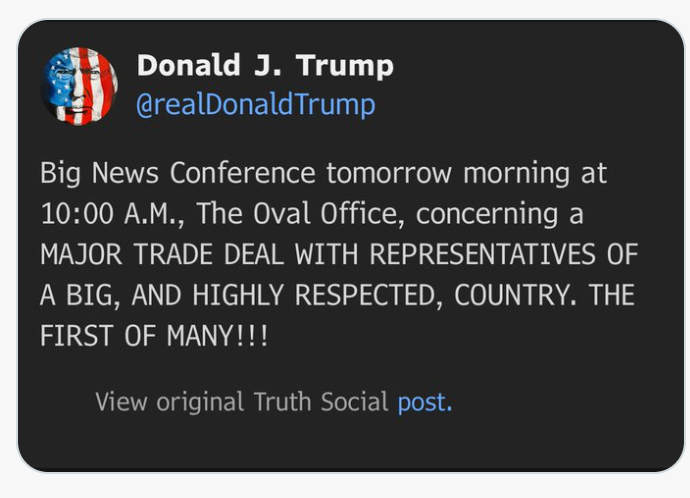
With S&P futures +53 handles on ANOTHER Trump announcement of a tariff deal (ostensibly with the U.K.), I am shorting more indices:
* SPY $566.92
* QQQ $490.00
BY Doug Kass · May 8, 2025, 6:05 AM EDT
The S&P Short Range Oscillator slipped from 5.71% to 5.18%. It is still in overbought territory.
BY Doug Kass · May 8, 2025, 5:55 AM EDT
BY Doug Kass · May 8, 2025, 5:45 AM EDT